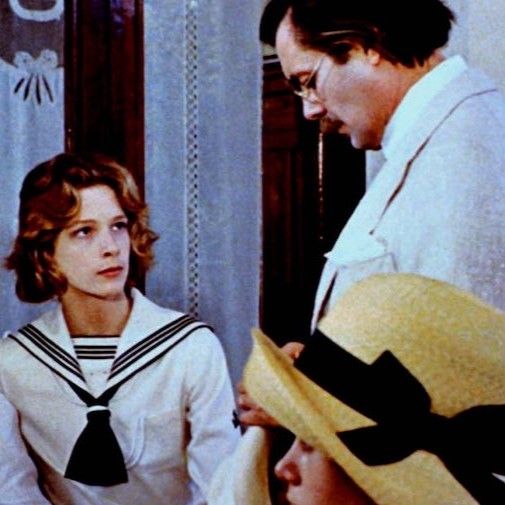
Žarko Paić: Luchino Visconti – Death in Venice
Žarko Paić
At the beginning of this discussion on the relationship between Mahler's music and the film adaptation of Thomas Mann's novella Death in Venice, directed by the Italian cinema master Luchino Visconti, I want to say the following: this is one of the best films ever made, in which cinematic imagery, literature, and music converge in a unique way. Mahler's Adagietto from his fantastical and metaphysically perfect Symphony No. 5 gained, through this film, what I will call a synesthesia of beauty, sublimity, and aesthetic messianism in which the meaning of art overcomes the suffering and pain of human existence. In 1971, Luchino Visconti brought the pure essence of Mann's famous novella to the screen. Interestingly, this happened sixty years after Mann's trip to Venice and twenty years after he discussed the meaning and mysteries of this novella with the author of Doctor Faustus, only a few years before his death. Allegedly, Mann said on that occasion that he actually wanted to portray Gustav Mahler in the character of Gustav von Aschenbach.
Death in Venice (original title: Morte a Venezia) is, from a narrative perspective, a correlative work to Mann's novella, but it is not a mimetic transcription of the text into cinematic images. Visconti shows how Gustav von Aschenbach, played by English actor Dirk Bogarde, falls in love with a beautiful boy, Tadzio, during his vacation in Venice, secretly watches and follows him, and refuses to leave this fatal and decadent city despite the cholera epidemic spreading and bringing the deadly agony of the world. Unlike the novella, the traveler in Visconti's film is not a famous writer but a failed and sickly composer. Visconti incorporated Mann's novella in his own creative way into flashbacks, posing questions about the artist's struggles and the aesthetics of metaphysical music. Through detailed depictions of Venice, the atmosphere of decadence and decay, and Mahler's late Romantic music, this multi-award-winning yet highly controversial film, in terms of its representation of literary prose in the medium of film, marks a certain turning point in the history of Thomas Mann's adaptations. The film is a mesmerizing composition of color symbolism, immersion in the landscape and atmosphere of a city embodying aesthetic decadence—a city Goethe once described as "frozen in eternity." Morte a Venezia had an almost "pedagogical" impact on popular culture in the second half of the 20th century. It brought about notable popularization of Mahler's music and had an invaluable impact on further efforts to synthesize great literature and cinematic art. Dirk Bogarde himself stated that the role of the torn and neurasthenic artist was the pinnacle of his career. Björn Andrésen, the actor who portrayed Tadzio, became world-famous but later spoke about the tragic consequences of his early fame.
The film begins with Aschenbach’s boat crossing the sea, accompanied by the Adagietto from Mahler's Symphony No. 5. Mahler’s Adagietto, which is based on Friedrich Rückert’s poem I Am Lost to the World, is repeated throughout the film. Visconti's masterpiece made this music one of Mahler’s most recognizable works. Mahler’s biographer Jens Malte Fischer writes that the version recorded specifically for the film, despite its "modest" interpretation, sparked Mahler's "triumphant march." In Reinhold Pabst’s book Thomas Mann in Venice, it is noted that Visconti made the Adagietto "the identifying melody of the lagoon city," and since then, it has appeared as a musical "city guide" through Venice. (Reinhold Pabst,_ Thomas Mann in Venice_, Insel, Frankfurt a. M., 2004, p. 49.)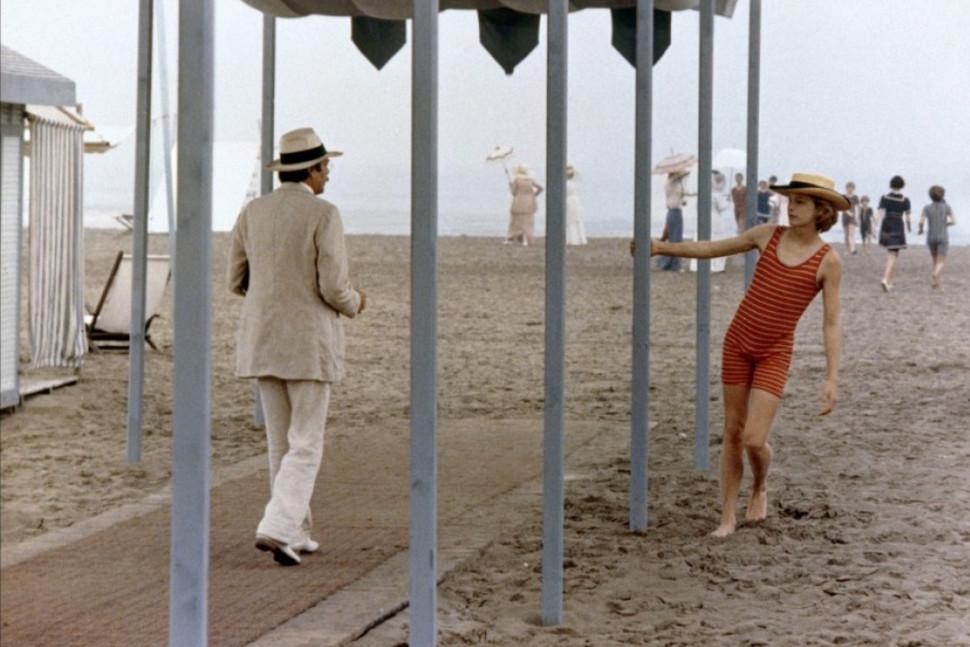
"When we listen to Mahler's Adagietto, everyone sees Tadzio and the Lido beach in front of them," says Michael Gielen. This effect of the film, although precisely describable, is nevertheless based on deception. In Visconti’s film, Tadzio on the Venetian beach is not accompanied by the Adagietto, but rather the Misterioso from Mahler's Symphony No. 3 in D minor, which, like a siren, conveys Aschenbach's emotions while Tadzio dances before him on the beach. Thus, the_ Adagietto_ is both the melody of Aschenbach's fatal longing and, above all, the melody of his arrival as "lost to the world," which also makes it the melody of his death in Venice, always repeating: most strikingly in the film’s final scenes, where two attendants carry the deceased Aschenbach on a stretcher to the divine music of Mahler's _Adagietto. Thus, music instead of irony at the end; specifically, a "funeral march" instead of an ironic choir of mourners. In Death in Venice, Visconti finally and irrevocably addresses the oft-rumored issue of Thomas Mann's latent homosexuality. Everything is at once transparent and metaphysically hidden. In the film, Aschenbach is an elderly composer deeply fixated on a boy. However, this fixation, brilliantly expressed by Dirk Bogarde’s gestures and visualizations, is not "of this world."
The artist-composer, whose suffering is expressed through the melody of melancholic music, experiences love as the highest possible ideal of formal perfection and immortalized corporeality. Hence, the beauty and sublimity emanating from this film are the result of Mahler’s music, not merely the images that Visconti arranges in his magical kaleidoscope. I am almost tempted to say that with this film, we enter a musical turn that transcends the boundaries of linguistic and iconic turns. Without music reaching the height of emotional sensitivity as a messianic event that encapsulates pleasure and contemplative suffering, the images of Venice—imbued with melancholy, beauty, and decay—would remain mere landscapes, rather than living wounds of existential collapse and transcendence after Aschenbach's death. Does the composer’s death at the film’s end, portrayed by Bogarde with his collapse, not evoke irony instead of tragedy? And is this moment of disappearance from the world, by someone who brings the spirit of beauty into the world with his art, not also the separation of the work from its mortal creator? In Visconti’s film, Gustav von Aschenbach does not actually portray Mahler, and this is not, in any way, a so-called biographical film. Instead, Visconti’s Aschenbach can be seen as a representation of Mann’s project of transcending oneself through Mahler. (See: Michael Chanan, Mahler in Venice?, Music & Musicians, June 1971, updated 2000.) Here, the Adagietto is a creative medium of artistic expression that allows the City of Beauty and Death (Eros and Thanatos) to become a visualization of the Gesamtkunstwerk. By allowing it to repeat endlessly and ultimately become a funeral march—profoundly blasphemous in terms of the musical structure of the Symphony No. 5—Visconti transformed Mahler’s "haunting" Adagietto in C-sharp minor into a melody of absolute poignancy, haunting the artist and giving the film its unique Stimmung. What does this mean?
Adagietto, the fourth movement from Mahler's Symphony No. 5, which, together with the Scherzo, reaches a "polyphonic complexity" (Stephen E. Hefling, "Song and Symphony: (II) From Wunderhorn to Rückert and the Middle-Period Symphonies: Vocal and Instrumental Works for a New Century," in: Jeremy Barham, ed., The Cambridge Companion to Mahler, Cambridge University Press, Cambridge-New York, 2007, p. 114), appears to echo a Nietzschean motif, eternally repeating as a structure of being and becoming, bearing cosmological-anthropological significance in its connection between heaven and earth. In the film_ Death in Venice_, it serves as the accompanying music for the artist's death—a character to whom Thomas Mann and Luchino Visconti added some of Mahler’s own psycho-aesthetic traits. Consequently, both the literary text and the film are creative palimpsests of what can only conditionally be called the contingent case of the composer's life as an original. Mahler worked on his Symphony No. 5 over several years in the early 20th century. Its premiere took place under his direction in 1904. The fourth movement, titled "Very Slow," represents a unique quintessence within this profoundly profound work. For some musicologists, this pianissimo by strings and harp is seen as Mahler's heartfelt declaration of love for his wife, Alma. However, sixty-seven years later, Luchino Visconti used this sublime music to portray the final scene of a platonic love and death meeting in the perfect decadence of the Venetian Lido, under sunlight that slowly fades. According to prominent theorists of music and Mahler's symphonic achievements, the straightforward explanation for the meaning of Adagietto within the context of Symphony No. 5 is that it is a "love song," while all
"culminates in the transformation of the meditative passage that… connects the slow movement of the Symphony No. 4 and Ich bin der Welt, with the text 'I live alone in my heaven, in my love, in my song.' (…) This may be the most erotic and idealistic moment in Mahler’s entire oeuvre. Thus, as in Schopenhauer and Wagner, eros and thanatos form binary opposites for Mahler" (Stephen E. Hefling, "Song and Symphony: (II) From Wunderhorn to Rückert and the Middle-Period Symphonies: Vocal and Instrumental Works for a New Century," p. 118).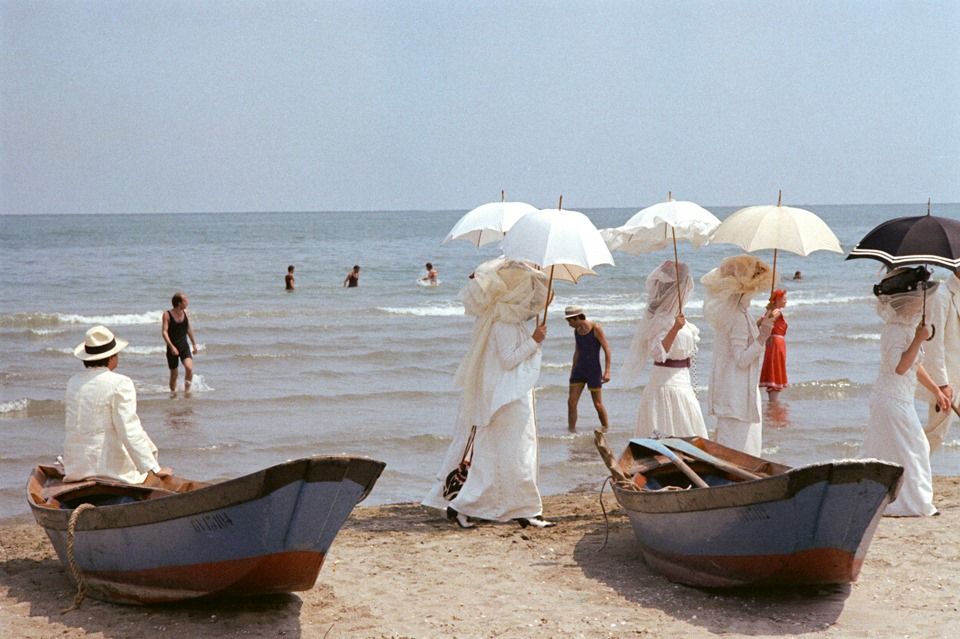
Visconti’s film Death in Venice belongs to the rare instances of synesthesia, where high literature, music, and a new visual medium—the paradigmatic medium of the 20th century—merge to render the sound of life as an existential drama far more compelling than is granted to the art of theater. Furthermore, the film’s narrative shows us that the groundbreaking forms of early modernist literary storytelling, such as Mann’s and Kafka’s novellas and parables, genuinely provide the framework for cinematic aestheticization. Yet, only this Visconti film, though not genre-defined as a musical drama, reached the threshold of the metaphysical duality between this-worldliness and other-worldliness, solely due to the director’s inventive approach, which, naturally, many contemporary composers and musicologists might, from a so-called expert standpoint, regard as either a colossal misstep or, worse still, as an example of the “popularization of classical music” in the postmodern context of stylistic syncretism and eclecticism. Both views are completely misguided judgments on Visconti’s quality and inventiveness. He intuitively, yet thoroughly, understood how the essence of (bourgeois) decadence in the magnificent modern culture of the European spiritual circle is concentrated in a single fatal city—a symbol of elegant ruin through the ages—and in the music of the last great composer of the idea of absolute music, who formally belongs to post-impressionism and post-romanticism. Therefore, if Adagietto is “a love song dedicated to his beloved Alma Mahler,” it is only one side of a musical dreamscape filled with messianic aesthetics rather than ethical content in the final consequence. The other side, metaphysically lofty and elevated, lies in the essence of great art, which unites the Nietzschean will to power as eternal recurrence of the same with what the thinker of overcoming nihilism calls a “stimulant for life”—a poetic definition of art in the ecstatic moment of eternal love as both eros and thanatos. Visconti captured the virtual radiance of Venice through Adagietto, a moment of ecstasy and rapture, by which art transcends life, celebrating its Apollonian and Dionysian elements as a fragmented whole, futilely striving to reassemble into a Gesamtkunstwerk, or complete work of art.
Nothing in this singular contingency of Gustav von Aschenbach's aesthetically driven life repeats itself, except fragments of the past in confrontation with the city, sinking into its foundationless state through deadly cholera. The only authentic and creative repetition from start to finish is Mahler’s Adagietto as a true film of life’s complete decadence. That’s it. Thanks to Visconti’s film, Mahler’s music from Symphony No. 5 has become what it has always latently been, as a secret metaphysics on its downward arc—nothing other than the very essence of art as an event. Thus, everything gains its own irreducibility and autonomy only by beginning with fragments of a whole, striving for the union of artistic religion and the Gesamtkunstwerk. The image portrays the world of Western decadence at its historical end. Literature, in visualizing life, requires a space of silent imagination because, without it, nothing would be possible—not even this film, based on the superb novella by Thomas Mann, Der Tod in Venedig. Music, finally, is not an undermining of Mahler’s greatness by “profaning” it and removing it from its symphonic context; instead, it is an elevation to a new peak, where everything merges into an integral synesthetic event. Both the genius actor Dirk Bogarde as Gustav von Aschenbach, the Apollonian beauty of the boy Tadzi, the Venetian Lido beach, the ghostly dance of masked dead, and the dusky light of a city that stonily links Goethe, Mann, Mahler, and Visconti—all make us, as viewers, wish that divine Adagietto would never end, absolutely never…
At the end of his essay On Love, José Ortega y Gasset writes:
"We live in a time of universal twilight. A whole part
of the world is sinking, illuminated by a solemn agony.
The blazing, fiery sphere is already touching the cold,
green edge of its restless grave. And yet a sliver of light remains...
The sun is setting, evening comes;
Do not stop here, but watch as it
continues until the western horizon fades."
(José Ortega y Gasset, On Love: Meditations, Svjetlost, Sarajevo, 1989, p. 35. Translated from German by S. Marojević.)
An excerpt from the book Why Music?, to be published by Litteris, Zagreb, in 2025.
Pier Paolo Pasolini and the Renunciation of (the Trilogy of) Life
There is a certain discomfort we encounter when attempting a discursive or essayistic—bounded by predefined norms—illumination of the life and work of a great figure.
Identity and Religious “Coming Outs”
Two Basque films — "Maspalomas" and "Sundays" — have already won over both audiences and critics, while the French film "Couture" has brought together Jolie and Garrel.
'In Every Theatre, People Would Leave"
How 'gay cowboy movie' "Brokeback Mountain" challenged Hollywood – and the US.