Sex Is Not Just a Physical Experience
Dragan Jovićević
Two films from Dag Johan Haugerud's trilogy were presented in the anniversary program of the Free Zone festival. Both Sex and Love explore fundamental human needs, but the examination of these themes from different angles is especially intriguing. The author reveals how this approach came about in an interview for Radar.
In its 20th anniversary edition, the Free Zone film festival celebrates two decades of showcasing works that pose uncomfortable questions or provide answers that can be hard to hear. Comprising film programs, debates, and events on diverse human rights topics, Free Zone ambitiously kicks off its jubilee with screenings of two Cannes winners: Sean Baker’s Anora, winner of the Palme d'Or for Best Film, and Nebojša Slijepčević’s The Man Who Could Not Remain Silent, which won the Palme d'Or for Best Short Film. This year, the festival will screen dozens of impactful films from around the world, honored at prestigious international festivals, divided into various program segments.
Attention is drawn to two films by a single director, selected for the “Borderless Zone” program. Dag Johan Haugerud, a screenwriter and director known for his acclaimed novels, feature films, and short films, achieved significant success with Beware of Children, which was highly praised by critics and audiences alike. The two feature films from Free Zone, titled Sex and Love, both released this year, are fascinating and elusive achievements for many filmmakers. However, Dag Johan has actually completed a third film (not in the festival program), thus completing his trilogy. If we add that the third film is called Dreams, the titles themselves suggest that the author dealt with phenomena without which a day in a person’s life is unimaginable.
In Love, a pragmatic doctor and a compassionate medical technician explore the limits of intimacy during an encounter on a ferry. In Sex, two heterosexual men experience unexpected encounters with other men that challenge their understanding of sexuality, gender, and identity.
"I first wrote Sex and applied for funding to make it as a short feature film of 70 minutes," begins Dag Johan Haugerud in discussing his unusual career journey. "But a consultant at the Norwegian Film Institute requested that I make a longer film. She had seen my previous film, Beware of Children, which lasted almost three hours, and was thrilled by it. Interestingly, while filming that movie, we faced major financing issues because the consultant at the time thought it was too long! Anyway, I grew tired of debates over film length and realized I could never find the perfect duration. So, I thought—if they want a bigger project, they’ll get a much bigger project. And not just one film, but three!"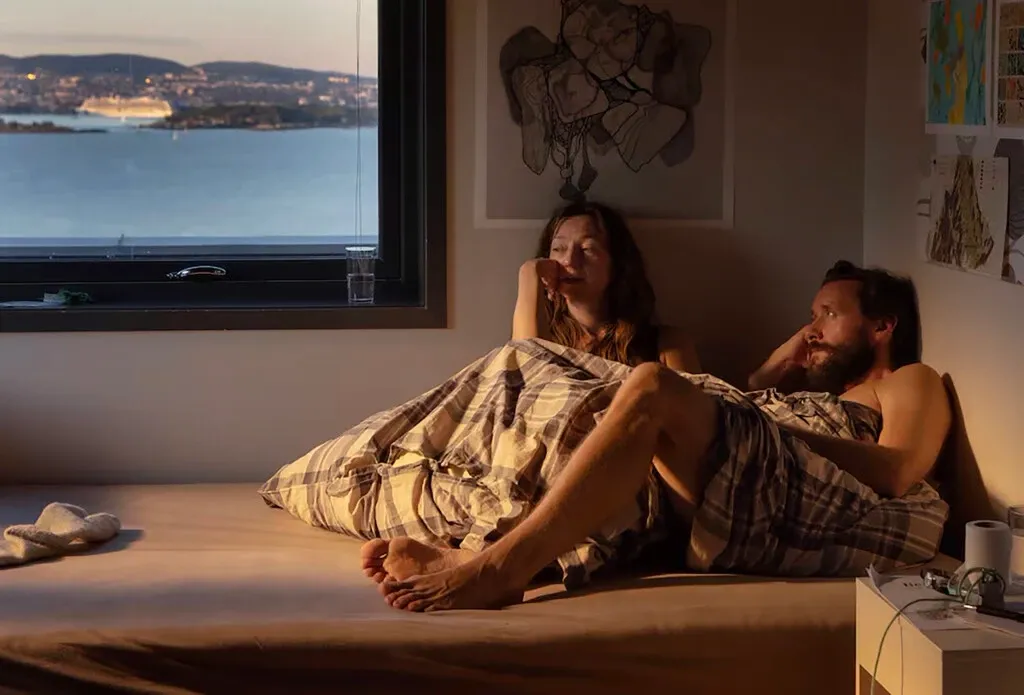 Film Love. Photo Agnete Brun/Arthaus
As you can see, the motivation for the trilogy began as pure defiance. But then I started considering the kind of challenges that making three films in a row could create. It was also a chance for me to delve deeper into given themes and show these stories from a different angle and various perspectives. I've long thought about sexuality on film and how it’s portrayed. Particularly, I reflect on how it's spoken about and depicted. You rarely see a real representation of sexuality, one that reflects reality. In films, sex scenes mostly feature young, beautiful actors with sculpted bodies. And as we all know, sex rarely looks so aesthetically perfect.
Also, it’s always a big question of how to portray sex acts on camera. Personally, I find it unacceptable to ask actors to act as they naturally would during sex—it’s too private an act, individual and vulnerable. I think it’s nearly impossible to convincingly perform sex with so many people standing around watching. As a result, we often get scenes that are more cinematic sex than real sex.
I’m not saying it’s impossible to create a genuine sex scene on film. There are many examples of directors who’ve succeeded at that. But I thought it would be far more interesting to write dialogue as intimate and vulnerable as sex itself. I need to emphasize that sex is not just a physical sensation or a bodily experience; many aspects of sexuality involve what happens in our minds—what attracts us, what we imagine, what we fantasize about, and how we envision sex could be—which rarely matches what we get in our sexual experiences.
Our perception and experience of sexuality are connected with ideas of morality, conscience, and shame, which are also deeply personal and rarely spoken about. I thought this could be interesting for film."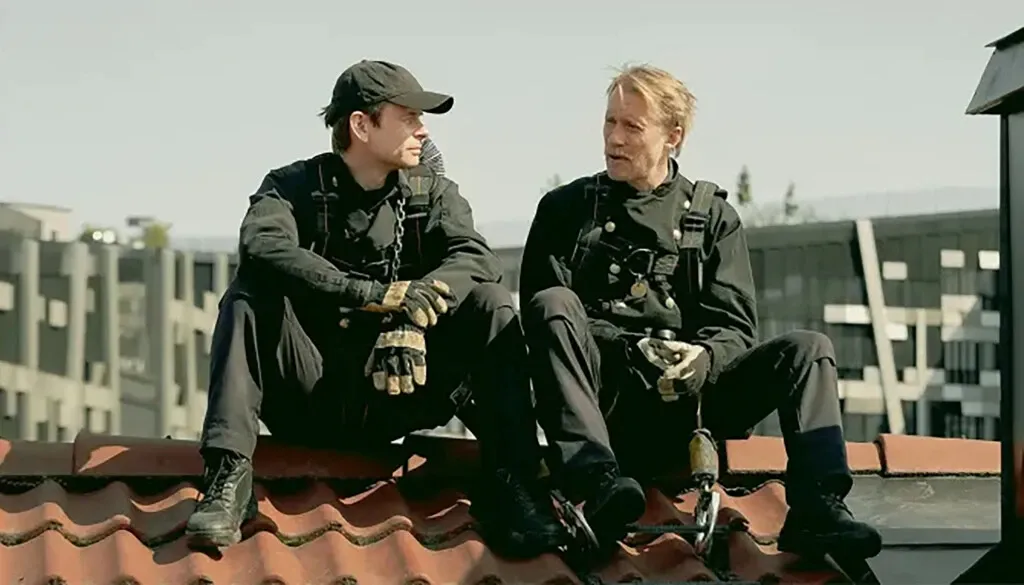 Film Sex. Photo: Berlin Film Festival
In the trilogy, Love, Sex, and Dreams, the three big themes overlap and interconnect. We were curious about how he decided which film would carry which title, given that they explore the same phenomena from different perspectives:
“Sex, dreams, and love are big words, and they gain complexity when combined. Sex as a term becomes more nuanced when it’s intertwined with dreams and love. The same applies to the other two terms. But for me, all three films are about all these themes; I just approach each differently and highlight them from unique perspectives. For example, Love is much more about sex than Sex is, and vice versa. Initially, I wanted the films to be titled Sex, Dreams, and Love 1, 2, and 3. And that’s actually how they’re titled in Denmark. It was a smart choice by the Danish distributor.”
Sex delves into the deep spheres of male sexuality, a topic not often seen in film. Dag Johan says he did thorough preparation before beginning the story: “I spoke with Norway's health service for gay men in Oslo. They offer free and anonymous testing for all sexually transmitted diseases, as well as a test, also completed anonymously, to gather information on today’s sexual habits. A part of the survey involves identification—whether they’re ‘homosexual,’ ‘bisexual,’ or ‘men who only have sex with other men.’ And, to our surprise, ‘men who have sex with other men’ make up the largest group! There are many reasons for this—most people live discreetly or are part of cultures that don’t support the gay community. Nevertheless, it’s striking that there are so many who regularly have sex with other men yet don’t identify as gay or bi. Or maybe it’s not surprising: I know people who are in functional heterosexual relationships who, at the same time, enjoy sex with men. They would never admit their sexuality or accept a particular sexual identity because they don’t feel gay or bi and wouldn’t let it define their identity. So, while I encourage people to ‘come out of the closet,’ I also respect that for many, coming out about their sexuality would be limiting.”
And the actors in Sex are quite convincing. They play characters with irony and emotional detachment. One has sex with another man but doesn’t consider it a homosexual act or infidelity toward his wife; the other dreams of a strange figure resembling David Bowie, realizing he actually sees himself as a woman: “I’ve worked with them both many times. They went to acting school together and developed a rare collaborative rapport based on trust and openness. The script was written for them. Since they often played macho men, I thought it would be intriguing to offer them something entirely different…”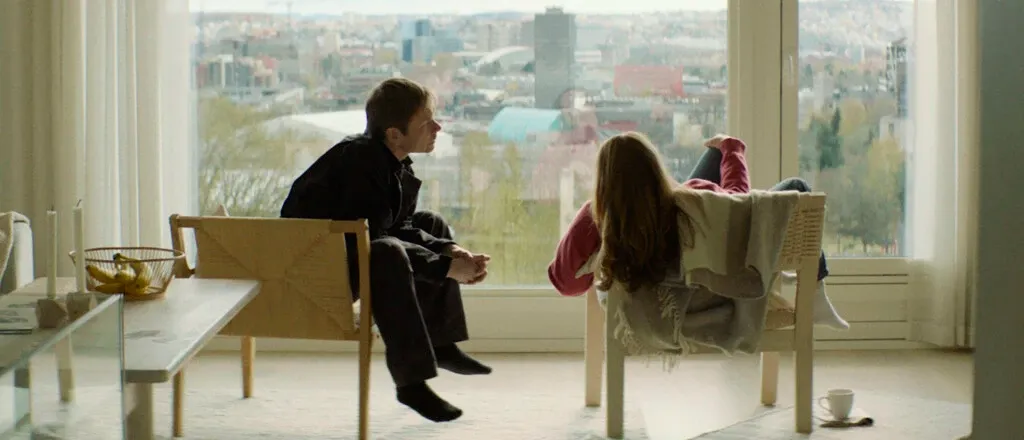 Film Sex. Photo: Arthaus
And, of course, David Bowie was not a random choice: “Not at all,” Dag Johan responds. “David Bowie is perhaps the most well-known pop-cultural symbol of public gender-transgressive behavior. So, it made sense to use him as an object in dreams. But, as I don’t think Bowie or his music is particularly queer—in his later phase, both his persona and music became traditional male-oriented rock—it was important to mention ABBA and Anni-Frid Lyngstad. She released a solo album in the ’80s with a cover image where she looks remarkably like Bowie. She also recorded her version of Life on Mars in Swedish. Their crossing and overlap made the queer element of the dreams far more impactful.”
When asked if he considers Sex a queer film, Dag Johan immediately responds: “Absolutely. Just as I am queer, and I see things from a queer perspective, and everything I create is queer. But I understand why you ask because to some, the film may not appear explicitly queer, and the treatment of the theme may not be what you’d expect from a queer film.”
In Love, however, things are different, though not drastically. Dag Johan doesn’t see the film as we do—as a story where, despite its title, there’s little room for real love and the characters seem desperate and inconsolable: “They’re just trying to find a balance between their liberated sexualities, freely evolving with love and responsibility. And that’s sometimes a very difficult task. In fact, nothing is ever easy. You can be in a casual sexual relationship with someone, but the moment deeper emotions develop, that arrangement becomes challenging and far less free than expected.”
As a capital city, Oslo is under constant reconstruction. The city is developing and changing, but its core development is driven by money. Economic considerations outweigh concerns for people’s health and well-being.
It seemed that the legendary Krzysztof Kieślowski, with his Three Colors trilogy (Blue, White, and_ Red_), may have influenced Haugerud while making his trilogy, at least through the overlap of well-known motifs: “I can’t say he influenced me. I watched that trilogy many years ago and remember that I liked White a lot, Red quite a bit, and I didn’t like Blue at all. But perhaps I’ve changed. If I watched them today, I might like them in a completely different order.”
When asked if he read books on psychology or film theory while preparing Love, Haugerud says: “I studied film science and film history at university. But that was a long time ago."I still read a lot, but I rarely read film theory. Now, I learn and find inspiration far more by watching films. I watch and read all sorts of things, but I don't have favorites. Before writing the script for Love, I read—and was greatly influenced by—the letters and diaries of Etty Hillesum, the diaries of Derek Jarman, and Olivia Laing's The Lonely City.”
This brings us to a crucial point—in both films, the city plays a major role: "All three films cover different parts of Oslo," Dag Johan adds. "As the capital, Oslo is constantly being reconstructed. The city is evolving and changing, but at the core of this development is money. Money is considered far more than the health and well-being of the people. Like in all other areas of society, the planning and development of the city are based on economics and finance. A city under reconstruction isn’t designed for people; rather, it works against them. That’s why my films are about people trying to shape the city into something it currently is not. In a film with so much dialogue, the chance to pause the story and just listen to music is much needed.”
And what was it like to shoot three films back-to-back and finish them all within the same calendar year? "Since I'd never done it before, I didn’t know what to expect. But it was easier than I could have imagined. We had the same crew for all three films, which was very helpful, as the better you know each other, the easier it is to work and the better the working conditions. I’d say that pre-production (though accelerated) and the filming itself were easier than the post-production, which was personally very challenging. I wouldn’t recommend editing three films at the same time to anyone.”
Finally, Dag Johan Haugerud remains optimistic. He believes film will endure, just as he believes that books and newspapers will survive in the age of new technology. He has a strong belief in the future of film. "I believe that film has a very important role today in this crazy world we live in, perhaps more than ever. But while the world keeps getting crazier, there are still people all over the planet who live in ways completely opposite to how the world is developing. These are people who gather together and watch films. I know I need cinema, I need literature and art, and I don't think I’m the only one. So hope is all I have left.”
Published on the Radar.rs portal, November 7, 2024.
Pier Paolo Pasolini and the Renunciation of (the Trilogy of) Life
There is a certain discomfort we encounter when attempting a discursive or essayistic—bounded by predefined norms—illumination of the life and work of a great figure.
Identity and Religious “Coming Outs”
Two Basque films — "Maspalomas" and "Sundays" — have already won over both audiences and critics, while the French film "Couture" has brought together Jolie and Garrel.
'In Every Theatre, People Would Leave"
How 'gay cowboy movie' "Brokeback Mountain" challenged Hollywood – and the US.