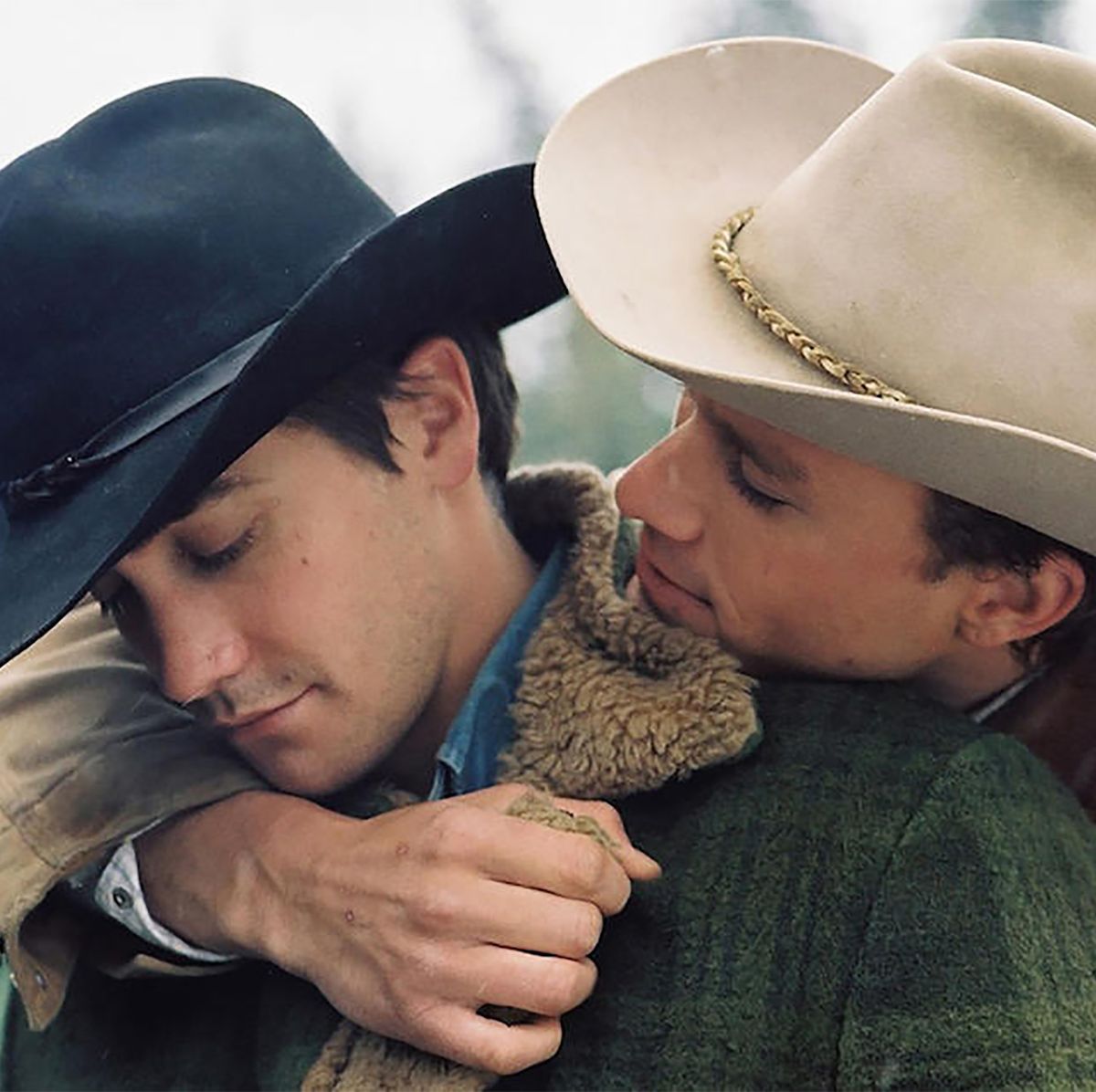
Brokeback Mountain - Only Gay Cowboys Will Win
Slavoj Žižek
It could be foreseen in advance: the fact that Brokeback Mountain on March 5, 2006, didn't win the Oscar for Best Picture was immediately branded in certain circles as an expression of Hollywood homophobia. And the overwhelming victory of L.A. Crash, according to this beautiful theory, is to be attributed to the guilt of the Film Academy, which chose, instead of a gay film and solely for that reason an unsuitable Western epic, the politically correct film, and moreover, an anti-racist one, beyond any doubt. According to the motto of being critical but still not causing too much offense.
In the case of this theory, everything is wrong. First of all, we need to understand that Brokeback Mountain has little to do with our present. It depicts a tragic romance in America from decades ago. For some liberal cinema-goer, especially from an urban environment, the love story between two men may barely resonate, at best they might feel some satisfaction from the victory achieved: the film they are watching doesn't address any current issue. Quite the opposite of L.A. Crash, which clearly grapples with the pressing issues of our time.
So, while Brokeback Mountain at best provides us with narcissistic pleasure by presenting problems from the past that have long been solved, allowing us, the triumphant insiders, to win battles that have long been won, L.A. Crash poses a real challenge. If Brokeback Mountain had won the Oscar for Best Picture, it would have been the same as escaping from the present and reality. Escapism in Hollywood? Unthinkable! It's more likely that the best film won.
However, these thoughts cannot be abandoned so quickly: have we really already won the battle? Didn't the Christian right accuse the film Brokeback Mountain of tarnishing the reputation of an honorable American institution - cowboys? Gay cowboys - doesn't that threaten the American way of life? Even though there were no calls for a boycott of the film, the reaction of the Christian-conservative press was quite intense. Robert Knight, director of the Culture and Family Institute, argued that the film perverts the exceptional message of every Western, "if it speaks of real brotherhood and is devoid of any sexuality." David Kupelian of World Net Daily accused Brokeback Mountain of "raping the Marlboro man" and of nothing less than nullifying "Judeo-Christian values, which are fundamental to Western culture."
Military communities and their "dirty" secret
Such criticisms can be immediately countered with: "Western ethics" are fundamentally anti-Christian because they promote ethics of revenge and violence. Here, turning the other cheek doesn't apply; instead, it's a literal "eye for an eye, tooth for a tooth" – not with divine assistance, but with law in one's own hands. In the book The Quick and the Dead (which inspired the film starring Sharon Stone, Gene Hackman, Russell Crowe, and Leonardo DiCaprio), Louis L'Amour explains the ethics of the West to his hero, Valiant Kane, with the words: "The soft and tame have no place further west than Chicago." So, it's no wonder that those belligerent individuals in the Bush administration, post-9/11, behaved like Western heroes: "Drive them out!", "Capture them, dead or alive!"
However, a completely different theme is the homoerotic undertone in almost every Western. Here, it's primarily about male relationships and the belittling (often humiliation) of women. It's crucial not to see this factual situation as a subversive point, perhaps even a particularly refined form of resistance to the ruling "patriarchy" or the official, not least, Christian "paradigm of heterosexuality". Homosexuality appears here as a decisive, integral, and above all, integrating part of the Western world – as in all military or militarized communities.
Let's recall the rule of the Clinton administration. It attempted to solve the problem of how to treat homosexual soldiers who didn't want trouble because of their sexual preference but also didn't want to be discriminated against. The solution then was: soldiers wouldn't be asked, so they wouldn't have to lie and deny; their sexuality remains a private matter and would be tolerated in that regard. Some found this rule hypocritical because it maintained a homophobic stance – similar to how prostitution is condemned but tacitly tolerated in deeply Catholic countries. In short, problems aren't solved by not talking about them.
But this criticism is empty because it doesn't understand the social sense of intolerance. Let's ask ourselves just one question, which may seem somewhat naive: why does the military fiercely resist publicly acknowledging its homosexual soldiers? Only one answer is likely here: it resists not because it fears that homosexuals would undermine and abolish the "phallic and patriarchal order," but because acknowledging homosexual inclinations in the libidinal order of the military entails overtly denying even the slightest suspicion of homosexual tendencies, cutting it off at the root, so as not to disturb internal male bonding. Men need to be alone among themselves, undisturbed.
How should a film deal with homosexuality today?
From my time in the Yugoslav People's Army in 1975, I gained appropriate experience. It was an extremely homophobic male alliance; as soon as someone was discovered to be gay, they could expect harassment, they were simply considered unfit, and were discharged from the army as quickly as possible. On the other hand, mocking among soldiers was commonplace. When we stood in the canteen, for example, it was forgiven to put a finger in the buttocks of the one behind you and immediately pull it out, pretending that it had nothing to do with you. The one in front, surprised, would turn around but wouldn't know which of his comrades did "it". They would laugh and grin. Or another example: the main form of greeting a military comrade wasn't a simple "Hello" but rather: "Suck a dick"! This expression became so common that it lost any obscene meaning. For us, it was considered a completely self-evident act of courtesy.
The fragile relationship between violent homophobia and underground homosexuality is constitutive for the libidinal order of the military community and can only be maintained through its denial. Externally, it presents itself as a rigid, organized, self-disciplined and uniform order, while internally, another economy ensures strict solidarity – where their little "dirty secret" is soldered. This is how the election campaign of the conservative Republican populist Jesse Helms functioned, who refrained from making racist and sexist statements in his speeches but let his intolerance flow "between the lines," noticeable to all.
Let's return to the film. Andrew Longman, the infamous columnist of the conservative publication Renew America, spoke out against the film: "You can't fight Islamists with gay cowboys." Here, there are two mistakes. Firstly, because soldiers fighting Islamists in Iraq or elsewhere are a kind of "gay cowboys" if they owe their group identity to homosexual bonding (not to mention the exceptional significance of homoerotic relationships in Muslim societies). Secondly, because one must fight militant Islamists with "gay cowboys": the way to win the battle against militant Islamism is to expose the hidden and suppressed "erotism" of male military bonding.
So, how should a film deal with the topic of homosexuality today? In this sense, the film Capote can serve as a positive example, as opposed to Brokeback Mountain. If these two films are categorized as "gay," the real point is missed: while Brokeback Mountain tells a tragic story of a homosexual relationship in a hostile, homophobic environment, Capote is about a writer who, among many other qualities, is gay. Shouldn't we see this as a victory for the gay movement? Because in his case, the hero of the film whose sexual preferences don't dominate his entire character.
Frankfurter Rundschau, 2006.
Identity and Religious “Coming Outs”
Two Basque films — "Maspalomas" and "Sundays" — have already won over both audiences and critics, while the French film "Couture" has brought together Jolie and Garrel.
'In Every Theatre, People Would Leave"
How 'gay cowboy movie' "Brokeback Mountain" challenged Hollywood – and the US.
18 International Documentary Film Festival Beldocs
Beldocs will take place from May 21 to 27 at 10 locations across Belgrade. The festival will feature over eighty documentaries, ten world premieres, and a strong focus on domestic filmmakers.