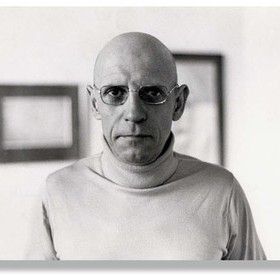
The Bleak Genius of Michel Foucault I
Sohrab Ahmari
Year 2024 marks the 40th anniversary of the death of Michel Foucault. Four decades since complications from AIDS brought his career to a premature end, the French philosopher—a role he both embraced and pushed away—continues to top rankings of the most-cited scholars in the humanities. This is to the chagrin of conservative critics of higher education, for whom his influence is synonymous with the perversions, figurative as well as literal, of the academy and of modern life. His vast authority is equally lamented by many orthodox Marxists, who hold him responsible for the shift away from class as the central fact of social organization and the proper locus of radical activism—and toward boutique “identitarian” causes and the emancipation of the self from normative structures of all kinds.
To even mention Foucault these days is to get tangled in these crisscrossing lines of critique. Not only that, but it is increasingly difficult to assess his body of work on its own terms, independent of the institutional structures that bear the imprint of his ideas, albeit in bowdlerized form. From third-rate college courses in which students who can barely read a novel are taught to “problematize” and “interrogate” this or that classic; to dormitory sexual-safety workshops that reject “normativities” and welcome subaltern “sexualities” (always with the silly pluralizations); to sundry h.r. trainings and corporate Pride messages that present even more rudimentary versions of the same rhetoric and conceptual framework—our institutional landscape can often look like it was designed by the Frenchman.
But if so, then it is all the more reason to consider these discourses in the light of Foucault’s own insights into the workings of discursive power. There, in his writings and lectures, we find a philosopher of unquestionable genius. Michel Foucault was perhaps the closest figure the 20th century offered to the European ideal of the Thinker Who Had Read Everything. He philosophized with a healthy and daring disregard for disciplinary boundaries, drawing freely—and commandingly—from history, theology, classics, literature, jurisprudence, political economy, anthropology, medicine, and psychiatry, among other branches of study.
Unlike most of his academic imitators and putative heirs, moreover, Foucault was capable of crafting sparkling, highly ironic prose (“my aim is to examine the case of a society … which speaks verbosely of its own silence”). Roger Scruton, of all people, was a fan of his style. And it is right and just that Foucault should be posthumously crowned the citation king of the humanities: After all, he inaugurated a systematic and highly original science of modern power, one that was bound to catalyze new fields of inquiry, even if many of those who took them up weren’t up to the task. This new science benefited greatly from Foucault’s refusal to be confined to philosophical abstraction, from his limitless curiosity about power at the most concrete and granular levels.
His, however, was a bleak genius. The normative and metaphysical void at the heart of his science of power created the conditions for the bastardization of his thought. The result is that today, some of the most powerful institutions in our society deploy his concepts and vernacular to perpetuate themselves in a manner that is downright, well, Foucauldian. Or put another way, Foucault’s ingenious methods for analyzing power have now emerged as but one more strategy for the maintenance and expansion of existing institutional power. This, even as these institutions themselves remain susceptible to his critique of what he called the “devious and supple mechanisms of power.”
“It is right and just that Foucault should be posthumously crowned the citation king.”
“Foucault was elusive when it came to defining the objects of his investigations.”
When I first encountered Foucault, I was an undergrad Trotskyist just beginning to tire of street activism (George W. Bush’s war machine rolled on, no matter how many issues of our newspaper we hawked on the quad). Bored with orthodox Marxism’s formulas of socially necessary labor and surplus value, I gravitated to the usual names on the “theory” shelves of the university bookstore: Freud and Lacan, Deleuze and Guattari, Virilio, Baudrillard, Lyotard—and Foucault. Of these, Foucault made the slightest impression on me at the time and Jacques Lacan the strongest, to the point that I seriously contemplated psychoanalytic training. While Lacan wasn’t a philosopher, his method promised to yield a general knowledge about the causes of things—a knowledge arising from the clinician’s practice of healing troubled minds.
By contrast, Foucault, though ostensibly the philosopher, seemed to be doing history … or something like it. As a historian, he wasn’t telling traditional stories of great men, of course. But nor was he concerned—not principally, at any rate—with the class-based patterns of subjugation and resistance that, according to my Marxist education, condition what actors believe, constrain their range of actions at any given historical moment, and finally generate social change. Instead, Foucault was obsessed with the micro-histories of institutions dealing with the sinful and the aberrant: the confessional, the mental hospital, the prison, the family magistrate’s chamber, the schoolhouse punishment room, and so on.
Not the grand things in history but the seemingly marginal in human affairs interested him most. He wasn’t so much preoccupied with the power differentials and conflicts embedded in the mode and relations of production, as with the production of power in the hidden and embarrassing little corners of ordinary life—in the interplay between, for example, the young boy or girl just discovering masturbation and the Victorian governess charged with interdicting such behavior.
More peculiar still, Foucault was elusive when it came to defining the objects of his investigations. You could never pin him down to spell out just what, say, madness or perversion is, as a thing in itself. Nor would he identify the immanent sources of these phenomena, whether in the psyche, prevailing social conditions, or some nexus of the two, as historicism would have it. Indeed, he wasn’t engaged in a historicist project—that is, beginning with what is conventionally taken to be a universal (“justice,” “beauty,” “rights and duties”) and then charting its alterations and contouring by contingent historical forces.
Foucault’s method was far more radical and discomfiting than that. As he explained in The Birth of Biopolitics—his 1978-1979 lecture at the Collège de France and one of the rare instances in which he pulled back the curtain, as it were, on his lifelong methodology—Foucault asked history to tell the story of a given universal as if the universals don’t exist at all. Foucauldian historiography would trace the “concatenations” of institutional structures and discursive practices that surrounded a given human field—be it sex, psyche, family, or what have you—developing “knowledges” regarding it, transposing their grids on it, invading the field, and ultimately generating, distributing, and redistributing power between the various nodes of the social order.
To take one example: What is monstrosity? Or who is the social monster? In his 1974-1975 lecture on the Abnormal—in which he previewed many of the major themes of his monumental History of Sexuality—Foucault tracked how the monster came to be defined in the course of an exchange between a well-established judicial power and a rising psychiatric power. Faced with cases of defendants who killed innocents for no legible motive, a desperate judicial system in the early-modern age turned to the apostles of the new sciences of the mind to ask (in a sort of dialogue between the disciplines staged by Foucault):
I am confronted by a motiveless act. So I beg you, either find some reasons for this act, and then my punitive power can be exercised, or, if you don’t find any reasons, the act will be mad. Give me a proof of dementia, and I will not apply my right to punish.
To this plea, psychiatry proudly responded:
See how indispensable my science is, since I can perceive danger where no motive reveals it. Show me your crimes, and I will be able to show you that for many of them there is no motive. That is to say, I can show you that there is potential crime in all madness and thus justification for my own power.
The motiveless crime is as old as time immemorial. But the discursive figure of the “criminal monster”—who was dangerously present in the social body wherever madness was found, which is to say, everywhere—could only be defined in the terms of this power exchange between law and medicine (with much of the advantage accruing to the latter). One crucial implication is that power isn’t an imposition from the outside on the otherwise “neutral,” “objective” pursuit of knowledge. Nor can power ever be banished from these other domains, which are, in fact, domains of power. “Relations of power,” as he wrote in the first volume of his History of Sexuality, published in 1976, “are not in a position of exteriority with other types of relationships (economic processes, knowledge relationships, sexual relations), but are immanent in the latter.”
Since the agents of this “power-knowledge”—priests and spiritual directors, educators and disciplinarians, scientists, physicians, psychoanalysts, judges, social workers, etc.—inevitably examine and categorize their subjects relative to the often-moralistic norms of their expertise, the “normal” and normativity must be seen as outgrowths of, and legitimating buttresses for, this very power. Following his academic mentor Georges Canguilhem, who outlived him by a decade, Foucault mounted a potent critique of the entire apparatus of social normalization. Imbued with a pseudo-scientific prestige, “normal” and “abnormal” had been used in the early-modern age to exert hitherto unprecedented levels of discipline over people with marginal sexual habits, racial minorities, the mentally ill, the disabled, those who simply didn’t fit in for one reason or another. Normalization was a grave crime by Foucault’s reckoning—perhaps the only one he recognized and condemned, insofar as he was capable of condemning anything.
Today, a version of this set of propositions—about knowledge as itself an imposition of power, and “normality” as one of its most oppressive features—animates much of American higher education and our elite institutions more generally. It impels your average museum director to agonize over how the visual forms and curatorial lingo used to represent indigenous communities might perpetuate colonial domination; or a prestigious medical association to stage interminable critiques of its own long-standing role in upholding racism and patriarchy; and on and on.
However much allowance we might make for the wages of vulgarization, such tendencies clearly bear some connection to Foucault’s own work, with its constant injunction to be wary of power-knowledge, its assault on normalization in the “order of knowledge.” Ironically, as the case of today’s “Foucauldian” museum and medical association suggest, Foucault’s suspicion of normality has itself come to function as an instrument of normalization and a source of self-legitimation for power: We should continue to dominate this field—for who else could offer a more stringent critique of our complicity in oppression than we ourselves?
More on all that, anon. What matters at this point is to name the deeper philosophical operation at the heart of Foucault’s method—nominalism: the belief, originating with medieval thought, that the things we observe in the world are too different from another to permit any kind of essential classification or the assertion of universals. Foucault didn’t hide the ball when it came to his nominalism. “One needs to be nominalistic,” he declared early on in the History.
The Australian scholar Carol Bacchi has described this as Foucault’s “critical nominalism”: Let’s pretend the essential thing or the universal doesn’t exist and see what we can learn about the workings of the powers that treat of this supposed universal. Less a deep metaphysical commitment than a kind of experimental wager, according to Bacchi, Foucauldian nominalism shifts our focus away from things as they “are” or are conventionally taken to simply “be,” and toward how they “become” through the institutional practices and force relations that call them forth and subject them in the order of knowledge, magnifying their own power along the way. (This, however, didn’t mean giving in to a full-blown anti-realism, since for Foucault, the practices and force relations in question, though encircling nonexistent universals, were themselves all too real.)
In this way, as Foucault himself wrote in the second volume of the History, published in France in 1984, the year of his death, we can “endeavor to know how and to what extent it might be possible to think differently, instead of legitimating what is already known.” The answer, it must be admitted 40 years later, is that we can learn a great deal by this means. Foucault’s critical nominalism yielded numerous counterintuitive insights that are indispensable for understanding our current predicament. It was the basis of the bleak genius that would earn him enormous influence over the course of his life and afterlives.
Published on Compactmag.com, June 25, 2024.
The Right to Evil
But women are not only vulnerable; they are also agents. They make decisions that are neither morally spotless nor self-sacrificial, decisions that may be pragmatic, ambiguous, or driven by interests that do not align with idealized images of feminist virtue.
The Digital Laboratory of Hate
The content circulating in the manosphere rests on three pillars: narratives of a masculinity crisis, pseudoscientific theories of sex and gender, and motivational advice on how to get rich and “win” women.
Academic Freedom in a Time of Destruction
The protection of extramural speech is crucial for understanding the relationship of democracy to higher education.