LGBT in 19th-Century Serbia
Ivan Janković
For the sake of completeness, and also out of fear of being accused of disregarding gender equality and being declared grossly politically incorrect, we must emphasize that, alongside female sex workers, there were also male sex workers operating in Serbia. Unfortunately, in the first half of the 19th century, they hid their sexuality as a snake hides its legs, so their traces in the archives are barely discernible, and our Benefactors, the Spirit of the Town and his uncle the Spirit of the Times, refused to speak of them at length, due to their innate tact and shyness. Still, dear Readeress, we assure you that Lesbians, Gays, Bisexual, and Transgender people existed even then — only they were brutally discriminated against in every aspect of life, and the idea of organizing a Pride Parade in Belgrade at that time was utterly unthinkable. And one more thing: we know (and approve) that sex and violence do not go together, but in those days, that distinction was not always maintained, so this section will also discuss some homosexual rapes.
In Serbian public discourse, homosexual relations were mostly mentioned in the context of Turkish atrocities. If certain sources are to be believed, the Turks were constantly on the lookout for opportunities to rape Serbian boys — especially notorious were the artillerymen (although these villains also raped old women). According to a report from 1820: “8. Last year the Turkish artillerymen raped an old woman in Vračar. 9. Again, last year, the artillerymen raped a boy. 10. The Turkish artillerymen tried to seize the late Guzonja’s son and two more tailor's children to rape them, who were barely rescued with the help of other Turkish sipahis.”
Still, what was sought was more often obtained by persuasion than by force. Many Turks, especially the more respected and wealthy, kept Serbian young men as lovers, so-called adžuvans or đojlens, who served for money. Even the honorable vizier had a whole bunch of them, and they were overseen by a special official, ranked on par with, for example, the kafedžibaša or haremćehaja. The maintenance of these boys was a burden on the Serbian budget. That budget line, variably named “children,” “đojlens,” “daire children” or “đojle-egbi,” often amounted to ten thousand groš or more.
(And pay attention now, dear Readeress: the đojlens/adžuvans must not be confused with adums or adumcis, i.e., eunuchs — although the eunuchs in the vizier’s harem were also paid for by the suffering Serbian people, just through different budget items. Vuk Karadžić translates the word adum into Latin as expers pudendorum, meaning “lacking shameful organs,” and gives examples of its use: “I tell him I am an adumac, and he asks how many children I have!” (as a foolish man would say), and: “I tell him I am an adum, and he loosens his trousers to f***!” (as a man of action would behave). Inspired by a vision of a distant future ruled by gender equality — a future in which, thank God, we now live — Vuk included the word adumica in the second edition of his dictionary, with a perfectly vague German translation: Frauenzimmer ohne vollkommene Geschlechtsteile (a woman without complete sexual organs). So: adžuvans for adžuvans, adums for adums, and adumicas separately.)
Slightly annoyed with then Belgrade vizier Husein Pasha, Miloš once reproached him, saying he "knows nothing but drinking all night and playing with his adžuvans." And in one of the vilest and most offensive letters, Prince Miloš and his advisors advised Vuk Karadžić to seek precisely such a job: “As for the salary,” Vuk retells the letter, “they advise me to shave my mustache and go into service to the Pasha's son in Belgrade instead of someone named Kosta, who was his adžuvan […], adding that I would live easily and with little effort ‘for,’ they say, ‘since God has crippled you, one leg is already bent — bend the other, and you’ll be on all fours.’”
In short, there were young men in Belgrade who earned money by providing sexual services. A widow from Zemun sent her somewhat wayward son to her son-in-law in Belgrade in 1829 to learn trade and be under stricter supervision, “for in a city with freer and more luxurious life, discipline is much greater there [i.e., in Belgrade] than here.” But soon she heard that “my unfortunate son Jovan not only associates with Turks but stays with them day and night and has a lot of money on him, which he surely didn’t receive from me or my son-in-law […]; consequently […] what else can one think but that the Turks have used their unlawful customs with him,” and she now begs the city authorities to return her son to Zemun. Similar to Jovan, Đorđe Lazarević from Smederevo came to Belgrade in 1842 without a passport and “wandered around the city with Turks and engaged in sodomitical acts contrary to our [Orthodox Christian] law.”
And what about non-commercial homosexual relationships? They were punishable. For example, Mihailo Spasojević and Petko Stojićević, one married and the other a bachelor, both goatherds from Savamala, were caught committing sodomy. The former was punished with 20, and the latter with 15 lashes, and “were strictly warned not to do such things again.” Those willing to risk corporal punishment went to public baths, although there they faced another risk. Namely, the Belgrade physicus (city physician) in 1852 found out “that in the newly opened bathhouse in Savamala, during bathing, acts of debauchery occur, which have caused venereal infectious disease among young people [and] are also corrupting the generation to a greater extent.”
Surprisingly, consensual homosexual relations also occurred in the proverbially patriarchal village. In Baroševac, Kolubara county, Belgrade district, in the autumn of 1833, a scandal came to light that had long been hushed up. Villager Pantelija Vukadinović, about 35 years old, unmarried, had been corrupting the village youth — males — for fifteen years, “laying with them and engaging in carnal relations.” Everyone in the village knew about it but tacitly accepted it, because the boys, once married, would end relations with Pantelija and become upstanding members of the patriarchal village community. But the excessive zeal of the district captain brought complications and tarnished the village’s reputation. Pantelija was arrested and held in Belgrade prison for three months. All villagers who had been involved with Pantelija were questioned — thirteen of them, not counting two deceased and those “many youths who still do it but won’t admit.” It turned out Pantelija had sodomized them for years, usually at his home on holidays or at the pasture during workdays, and that he gave them socks, garters, and embroidered slippers, fed and watered them. “The lads said that once they marry, they quit, and he continues with the unmarried ones and [said] that when he wants to seduce a boy, he brings wine and rakija, so the lads can’t leave until they’re done with him.” Pantelija was sentenced to 50 lashes and banishment from the village, with his property to be sold. After release, he settled in nearby Zeoke, and the specter of "Pantelism" continued to haunt Kolubara county, to the horror of local officials. Based on such complaints, Pantelija was arrested multiple times — for instance, in 1837 — but was usually released for lack of evidence. Finally, in 1838, he was banished to the Jagodina district, where he vanished from records.
Homophobia was not uncommon and could lead to tragic consequences. Soldier Živko Savić repeatedly complained to superiors that Turkish bathhouse workers mocked and even beat him. On June 30, 1851, by then a sergeant, Živko entered the duty officer’s room, placed a bloody bayonet on the table, and said that the previous night he had killed a Turk. This Turk, he claimed, met him at Kalemegdan and demanded to “have unnatural and unlawful sexual relations with him.” Živko rejected this vile request with noble, knightly words: “I am a soldier, and I value my honor more than life. Therefore, Turk, stay away from me. Your demand offends both natural and military law, and know well that I shall avenge your dishonorable words.” And indeed, only hours later, Živko found the shameless man in a Dorćol alley and killed him. According to the police report, the deceased was Hadži Ahmet, son of Bilal-aga from Dorćol, married and father of two, an honest man of good conduct.
In Belgrade, surprisingly many accusations of homosexual rape were made. In general, all rape accusations — regardless of gender — were approached with skepticism. Contemporary medical science, represented here by Belgrade doctor Karl Beloni, believed that the rape of a woman, strictly speaking, was impossible: “medically, it has been proven that even the strongest man cannot force even the weakest woman to complete the act.” This rule applied even more to men as rape victims. Dr. Beloni did not comment on whether “the strongest man” could rape a child, but such cases did occur. Patroller Kosta Kuzmanović, with the help of Luka Banković, raped an eleven-year-old boy in the bell tower of the Cathedral Church, where the boy slept. Luka spent 66 days in jail before being released due to illness, while Kosta served over nine months and was fully released. It seems they suffered no further punishment!
As for lesbians, dear Readeress, we found little of note. As you know, in those times, women and their affairs were paid little attention. Things were somewhat different in the first women’s prison, founded in 1848 in Požarevac, where inmates made gunpowder cartridges for the military. The commander noted astutely that “the female sex, when given minimal freedom and proper treatment, becomes forgetful and easily debauched.” Even when the warden was nearby, inmates “often loudly chatter, shout, and start singing,” prompting the matron to scold them: “Work and be quiet! Have you no shame when our Commander is in the next room?” The boldest would reply: “Oh well, what can our Commander do to us — punish us, perhaps?” According to the medical science of the day, as represented by Požarevac doctor Medović, prison life encouraged depravity, especially among women already “living depraved lives.” No one — not even science — could help: “It is impossible to physically suppress the moral arousal provoked in constant social contact at the worksite through mutual, habitually learned intimate conversations.” Therefore, prisoners should be separated: no more than four or five per room. Still, misconduct happened. Inmate Ljubica was punished “for a great and filthy insolence” with three days on bread and water. She was already “publicly and privately spiteful, stubborn, disobedient, and insolent.”
Bisexual and transgender persons left no trace in the archives, but that doesn’t mean they didn’t exist. On the contrary, the Spirit of the Town and his Uncle assure us they did. As for the Turkish elite in Belgrade, other sources show that the honorable vizier spent equally on his female and male harems. For the Serbian elite, however, there’s no evidence, and we don’t intend to insinuate anything — we don't want to risk our immortal souls.
We found only one documented case of situational cross-dressing, though there must have been more. Jovana, wife of Cvetko Brkić from near Smederevo, fled with the servant Petar. In Belgrade, both found work — Jovana, dressed as a man, worked as a servant to a tailor. The wanted notice describes her: “with cropped hair, a red fez on her head, red jemenijas on her feet, belted with a sash, wearing men’s shirts, a colorful vest, and a blue woolen jacket.” The two fled to Austria, which refused extradition, so poor Brkić lost both his wife and his servant.
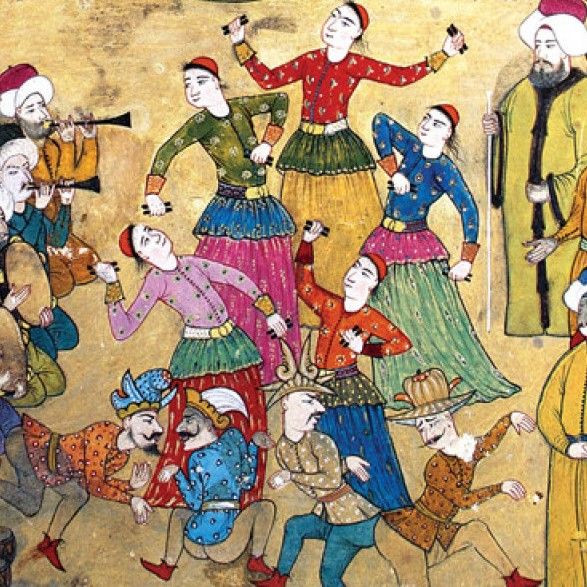
But there is rich material on non-situational, in fact, professional transsexuals — or, as they might be called today, drag queens. We are referring, of course, to the ever-present čočecks (Turkish: köçek) — without whom no proper tavern celebration or sevdah, let alone kara-sevdah, could take place in the Ottoman Empire and its provinces. Čočecks, dressed in women’s clothes, performed more or less complex erotic dances in taverns and inns across the empire. Their presence often provoked knife fights and cost mustachioed heads wrapped in turbans.They were boys between the ages of 10 and 18, whose training began in early childhood and included dancing and playing traditional instruments. They were recruited almost exclusively from the Neo-Ottoman population (especially Roma, Armenian, and Greek, but also Slavic, including Serbian), and they belonged to the guild of acrobats, fire-eaters, illusionists, and similar entertainers—not the musicians’ guild.
The traveling čočeks moved in small groups (ćok), led by an older man, the “master” (ćok-baša), and would stay for days, weeks, or even months in taverns of provincial towns across the Empire, depending on the size and type of audience they encountered. And that audience could be more passionate than today’s football fan groups in stadiums and just as prone to violence. Bloody brawls among tavern toughs over the favor of the most popular čočeks were a daily occurrence—so much so that in 1857, Sultan Abdulmejid I banned any public performance of čočeks, at least in Constantinople. Like all similar bans, this one, however wise, was not entirely effective, and the čočeks continued to sway around their admirers for a long time, especially in the provincial taverns of Anatolia and the Balkans. That the čočeks truly posed a threat to morality, public order, and safety is attested by the following gruesome scene of dancing, singing, and shooting, from a tavern in Dorćol.
Čoček and the Chibouk-Smoker
In the winter of 1853, shortly after Orthodox Christmas, much to the joy of the local revelers of every faith and law, a group of particularly seductive čočeks arrived in Belgrade. With their ćok-baša (troupe leader), they entrenched themselves in the Visoka Tavern in Dorćol, run by a fierce Albanian (Arnaut), but they also performed in other nearby taverns and inns. Perfumed and made-up, their very presence transformed the shabby Dorćol dives into the true, "poisonous" Levant, where—as Andrić says—“coffee, alcohol, tobacco, and base sensuality create a separate world of sluggish thoughts, murky emotions, and a restless but motionless spirit.” There were three of them, and their star was sixteen-year-old Đorđe Stefanović from Leskovac, then in Turkish territory, whose beauty and skills were the subject of whispered legends throughout the town. It is precisely this Đorđe who is the tragic hero of this Dorćol drama.
At roughly the same time, another strange visitor found himself in Belgrade—so strange, in fact, that our modest, plastic keyboard (S520) can hardly describe him properly, so we’ll borrow Ivo Andrić’s pen again. Among the guests at the Višegrad inn, where Alija Đerzelez spent the night during his journey, was, Andrić writes, “a perverse individual who claimed to be a hodja from Bihać, though in truth he seemed to travel the world led by murky and terrifying impulses.” Well, this one we can’t quite describe was just like that—except he did not claim to be a hodja from Bihać, but rather introduced himself as “the ćehaja čibukčija from Kabataş in Anatolia.” (Ćehaja čibukčija means he supposedly was the elder of the guild of craftsmen—makers of chibouks and other smoking paraphernalia—in that now obscure town, which has only 9,211 residents and where, say the spiteful, there's not a tourist in sight, wolves carry the mail, and foxes ring the noon bell. As for their chibouks, if they’re even still made, we don't know what they’re like.) Our mysterious character was named Jusuf Ismail, and in his life, he had loved many čočeks, with a passion that never lasted long but brooked not the slightest resistance. We imagine him as physically strong, heavy, and very corpulent. And we know, as will become clear, that he was skilled with weapons.
The third protagonist of this Dorćol tragedy was the tavern keeper of the Visoka Tavern—the fierce Albanian whose name we don’t know, but whose two ugly traits we certainly do: he was consumed by envy and jealousy. And it seems he had a third flaw: cowardice. Because of this inherent cowardice, he never started a brawl alone, but only in the company of his sworn Albanian comrades, preferably fiercer than he and always as numerous as possible. (In general, Albanians in Belgrade at the time stuck tightly together and were not well liked—neither by Serbs nor Turks, who saw them as a wild, tribal element.)
As in so many stage plays, jealousy—bitter Albanian jealousy, spiced with envy—set the tragedy in motion. The mysterious newcomer from Anatolia had great experience with debauchery and čočeks, and he always had a full purse, being generous with it. So it’s no surprise that, according to the police report: “Đorđe Stefanović the čoček would always, during merrymaking and dancing, linger about the said Jusuf the čibukčija, sit by him, and smoke from his chibouk.” (And we can only imagine how large and ornate the chibouk of a master čibukčija must have been!) This did not sit well with the tavern keeper—especially since this lingering, sitting, and smoking happened repeatedly at each occasion of “festivity, music, and dance, both in his and in nearby taverns.” And into the tavern keeper entered envy and jealousy, and they began to gnaw at him. He felt like that rat in the pantry—yes, Reader, that one from Radović's story, who ate cheese regardless, and in him came an illness, and began to derange him, and derange him, and derange him daily. That’s exactly how it was in the Albanian's belly: as if he had a hard lump and thought he might die immediately. That’s what the green-eyed monster can do to a man!
In this state of disturbed mind, the tavern keeper could think of nothing better than to “incite a few more Albanians, so they began to threaten [the čoček Đorđe] that, if he didn’t shake off the čibukčija, they would kill him.” These threats, the police report states, were repeated several times, but—fortunately—“the said Albanian tavern keeper with his group undertook nothing against him—the čoček—nor against the čibukčija Jusuf.” Empty threats—you might think, Reader, knowing the tavern keeper's cowardly nature, which we, in a moment of co-authorial indiscretion, prematurely revealed. But the pitcher goes to the well until it breaks. In acute fits of jealousy, people do things they would otherwise never dare even to imagine.
On that fateful January 30th, 1853 (Julian calendar), or the 9th of Rabi’ al-Tani, 1269 (Hijri calendar), the gallant čibukčija Jusuf took Đorđe, another čoček, and their master to the hamam (Turkish bath). It was Friday, the day of prayer (Jumu'ah), but Jusuf’s murky and terrible impulses rarely led him to the mosque—more often they led him elsewhere, to places where people, when they fall to their knees and bow, do so not for prayer. Informed of this hammam excursion, the tavern keeper sprang into action. He “took the third čoček with the rest of his group and led them to the same hammam, with the intention of killing the oft-mentioned čibukčija.” And for added assurance, he placed one of his companions—an infamous cutthroat—in ambush near the butcher's shop, as a sniper avant la lettre, with instructions to shoot Jusuf if, by some miracle, he emerged alive from the hammam.
The police report dryly states that the Albanian tavern keeper “somehow found no opportunity there [i.e., in the hammam].” Naturally, one should not expect a policeman to delve into the whirlwind of feelings—or rather passions—that tore through the tavern keeper’s soul as he, shrouded in the steam from the damp hot-water pool, took aim at the naked, limp, and hairy čibukčija. Even we can only dimly sense that colossal inner struggle—of desire, hatred, and fear—that made the tavern keeper’s hand tremble and caused the hammam assassination to fail.
Still blissfully ignorant, unaware of the dangers looming over him, Jusuf the chibouk-smoker emerged from the hammam with his entourage not only alive but in high spirits—especially because his mind was still spinning with the scandalous image of the dancer Đorđe bending over to retrieve the soap from the slippery floor. But alas! No sooner had the freshly bathed group stepped into the snow-covered Dorćol alley, still steaming from the hammam’s heat and making their way back to the kafana along the narrow path broken through the snow that morning, than a virtual sniper, hidden behind a drift in front of the butcher’s shop across the street, raised his rifle, put his finger on the trigger, and prepared to end Jusuf’s days once and for all. However, the butcher and some of his customers noticed the Arnaut’s preparations just in time, rushed him, disarmed him, and dragged him into the butcher shop.
Thus, Jusuf narrowly escaped certain death twice in a single day—not so much due to divine mercy as to a momentary lapse in the Almighty’s attention. It seems that Allah, glorified be He, had forgotten that Jusuf had not prayed in the mosque that Friday, but in the hammam, and such a "namaz," as even the lowest-ranking imam knows, doesn’t count for much—in fact, it can often backfire. Still, divine justice may be slow, but it is always inevitable, and if one doesn’t pay at the bridge, he’ll pay at the crossing. Surely that will be the case with the licentious chibouk-smoker (and hopefully also with his cowardly Arnaut antagonist).
When the second would-be assassin lunged and missed his mark, Jusuf finally caught on to what was happening—he snapped, as the saying goes. Or, as recorded in the police report: “Seeing that another Arnaut, who also intended to kill the aforementioned chibouk-smoker on his way to the kafana, had his plan thwarted by some who seized him and dragged him into the butcher shop, the chibouk-smoker continued somewhat undisturbed, and upon realizing that the Arnauts were after his life, he returned to his quarters, armed himself, and went back to the same kafana where the dancers were seated.”
It was there, in the Visoka kafana, that the final scene of this Dorćol drama unfolded. Heavily armed, with two pistols and a yataghan at his belt, the scowling Jusuf Ismail burst through the kafana’s low doors, greeted by a stunned silence from the terrified dancers huddled in a corner around their equally terrified dance-master. Though all freshly bathed, a sour scent of existential fear lingered about them—and perhaps something even more corporeal. There was no sign of the kafedžija Arnaut and his crew—they had been detained by the Turkish police over the hammam incident, and in any case would not have dared to face Jusuf. Only bewildered waiters milled about the empty kafana, rushing to serve the fearsome guest. Jusuf sat at his usual spot by the brazier and, even before the rakija was brought and before he reached for his legendary chibouk, ordered dancer Đorđe to come forward.
Given the limitations of our keyboard when describing complex events and emotions, perhaps it’s best to quote the dry prose of the police report, letting fact take precedence over fiction:
“And as soon as [Jusuf] sat down, he called Đorđe the dancer to come to him, but Đorđe replied that he could not. When asked why not, Đorđe responded that the kafedžija had threatened to kill him if he approached Jusuf. Upon hearing this, seeing that the dancer was brushing him off, Jusuf, enraged by the interference, pulled a small pistol from his belt and fired at Đorđe, mortally wounding him. But seeing that he hadn’t killed him instantly, he drew another and fired again. Having done what he had done, Jusuf dropped the pistols and shouted: ‘Where is the guard? Let them do with me what they will.’”
And so, enraged by interference, Jusuf Ismail did what he came to do (as for what became of the dancer—who cares!).
In a flash, the kafana was full. Among the crowd was a džerak (a Turkish surgeon), who extracted a “chain bullet” (sindžirli kuršum) from the chest of the wounded dancer and packed the wound with some kind of wick. Chain bullets, or sindžirlije, were more deadly than regular ones because they consisted of two or more musket balls linked together. (“He had overpacked the damned musket, / Two bullets and two chain shots.”) The one removed from Đorđe’s chest was preserved and attached to the Serbian Belgrade police report.
The Serbian police also took care of the wounded Đorđe—he was transferred to the hospital, “where he died in the evening of the 31st, as confirmed by the attached medical testimony.” That testimony, handwritten by city physician Dr. Anđelković, states: “It is evident that he was killed by a pistol shot. The bullet that passed through the chest must have punctured both the white liver on the right side and the black liver, causing severe and fatal internal bleeding.”
Thus ended the life of the dancer Đorđe. And as for the chibouk-smoker Jusuf Ismail? He was tied up on the spot by the Turkish patrol and taken to the city. What happened to him afterward within the fortress remains forever hidden from Christian eyes—and even from the immaterial eyes of the city’s Spirit. Perhaps he was, by the vizier’s order, strangled in the patrol commander’s room, as once befell an anonymous sejmen Arnaut who caused bloodshed at the Saka Fountain in 1834.
Perhaps, we say—but more likely, the case was hushed up. After all, his victim, though a Christian, was just a lowly, insignificant dancer, for whom no one in the Serbian community would mourn, let alone seek justice. It’s more probable that Jusuf was simply exiled to his native Kabataş, where he returned to his chibouks and his harem. The kafedžija Arnaut was certainly not prosecuted for the hammam scandal but likely continued to run his den of vice in Dorćol profitably, bringing in more and more dancers—and even a few young boys to round out the selection.
If that’s how it went, then the morally repugnant antiheroes of this story—the kafedžija and the chibouk-smoker—went more or less unpunished, while the price, paid with his life, was borne by a socially stigmatized and insignificant little dancer. And now, Wise Reader, you may rightly ask why we thunderously proclaimed divine punishment for the villains and raved about slow but inevitable divine justice? Ah, we were not raving. Divine justice is carried out in the next world, and by that justice, little Đorđe will surely take his deserved place in paradise, “on the right hand” (perhaps even promoted to a little angel), while the chibouk-smoker and the kafedžija will never see heaven nor enjoy the company of houris (though, to be honest, the way they were, they wouldn’t much mind that).
And here, in this Vale of Tears, we are left only with human justice—which is like Swiss cheese: hole after hole. As Borislav Pekić once said, in this world, justice can be achieved only if three conditions are met: that we are truly right, that others acknowledge it, and that we have a lot of money. Dancers and queers almost never meet all three.
So it’s been since time immemorial, and so it shall be forever. Need proof? Exactly 150 years after Đorđe’s death, another transsexual was murdered in Belgrade—Vjeran Miladinović Merlinka, the star of Žilnik’s film Marble Ass. Merlinka saw little justice in life. Her killer was never punished. Today, she’s called “the trans legend of the Balkans,” and at the corner of Gavrilo Princip and Zagrebačka streets stands a pink sign that reads: “Merlinka’s Street.”
This posthumous fame of victims like Đorđe and Merlinka is perhaps a roundabout sign that they did receive heavenly justice when earthly justice failed them.
"From the author's new book on prostitution in 19th-century Serbia, Kata Nesiba and Comments, Fabrika knjiga, Belgrade, 2017.
The Dolphin Who Loved Me
In the 1960s, Margaret Lovatt was part of a Nasa-funded project to communicate with dolphins. Soon she was living with ‘Peter’ 24 hours a day in a converted house.
The Homosexual Role
The current conceptualization of homosexuality as a condition is a false one, resulting from ethnocentric bias. Homosexuality should be seen instead as a social role.
Van Gogh’s ‘The Starry Night’ Aligns With Science
A new analysis by physicists based in China and France suggests the artist had a deep, intuitive understanding of the mathematical structure of turbulent flow.