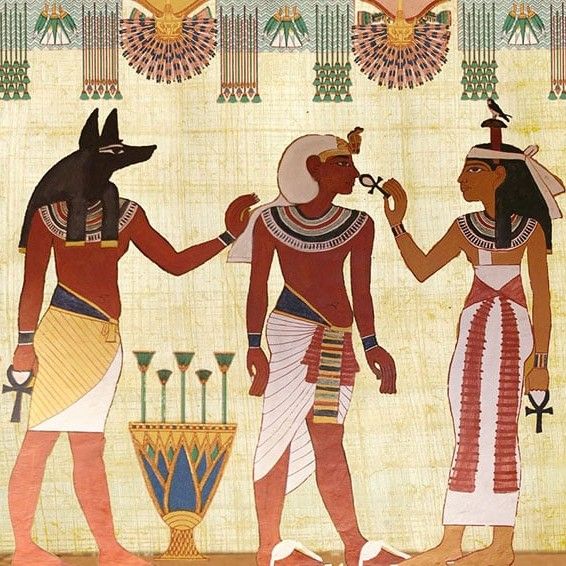
The (Un)Dressing of Disobedience
Dušica Popović
Esse est percipi.
— G. Berkeley
Throughout the history of human societies, clothing has always been an important element of (self)representation. This indispensable visual topos of humanity has long served as a social and cultural "shortcut" for recognizing and positioning different individuals into their designated places within hierarchically organized social systems. Clothing, hairstyles, jewelry, and accompanying accessories could—or had to—display: class belonging, profession, age, ethnicity, political orientation, marital status, moral (un)suitability, altered states of consciousness,[1] and of course, gender identity.
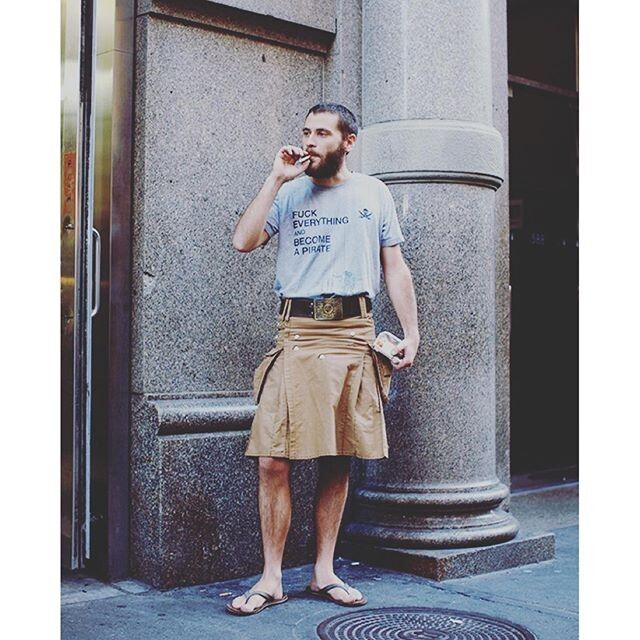 Scott Shuman – The Sartorialist, New York, 2015
Nevertheless, from antiquity until the late Middle Ages, both genders wore relatively similar clothing, differing mainly in details.[²] Around the mid-14th century, with the emergence of fashion in the (proto)modern sense, costume became more differentiated. From then on, fashion began to highlight and eroticize the body: men started wearing tight pants, while women wore dresses and corsets. However, until the end of the 18th century, male and female fashion still partially overlapped (e.g., in the 16th century, men were the first to wear high heels and expensive lace, which women later adopted; in the 18th century, everyone wore beauty spots, powdered wigs, lead-based face whiteners, etc.). Often, male aristocratic attire was more lavish and expensive than women’s.
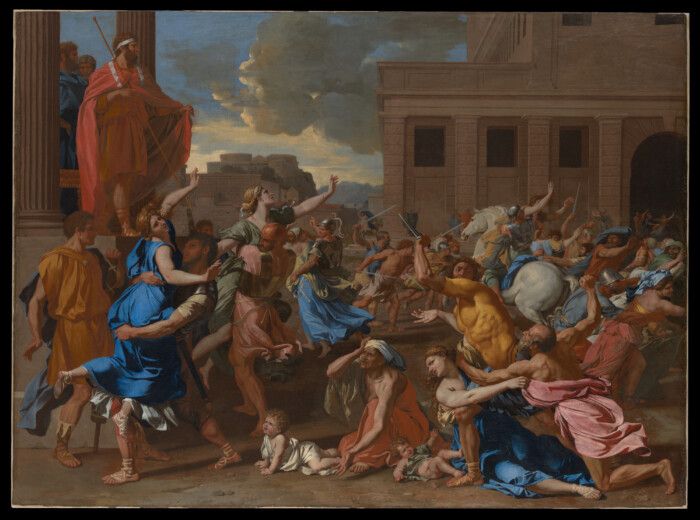 Nicolas Poussin, The Rape of the Sabine Women, 1633–34, oil on canvas
But in the 19th century, a real rupture between male and female appearance emerged. With the political and scientific rise of bourgeois society, and its rigid spirit of entrepreneurship, pragmatism, and efficiency, the aesthetic dimension of life—including fashion—was declared supposedly irrelevant and left to women. From then on, women's inferiority was no longer justified through tradition, the Bible, myths, or physiology,[³] but through anatomy, biology, psychology—and aesthetics (which became discredited as an incompetent phenomenology). Ironically, in this era of universal historicism, the difference in clothing between genders began to be perceived in a non-historical and essentialist manner: men were seen as “naturally” suited to dark suits, while women were expected to have elaborate hairstyles and wear opulent, colorful dresses. Prince Lazar and Princess Milica, reconstructed donor portrait, Ravanica Monastery
Thus, men were expected to embody the articulated discretion of culture, while women were expected to embody the inarticulate vibrancy of nature. Yet, even though women were henceforth left to the whims of fashion—and fashion was relegated to a minor social preoccupation—it still managed, from the second half of the 19th to the first half of the 20th century, to reach the very center of epochal gender debates. In the words of Gilles Lipovetsky:
"Perfect fashion lives off paradox: its unconscious supports consciousness, its follies nourish the spirit of tolerance, its imitation fuels individualism, its frivolity serves respect for human rights."[4]
Seemingly harmless, disguised as frivolous beautification strategies of "female" nature/matter opposed to "male" spirit/culture, women's fashion in this period began to change rapidly. And with each subsequent transformation—through seemingly ephemeral gestures such as discarding corsets, shortening hair and skirts, simplifying clothing, etc.—fashion gradually, indirectly, yet irreversibly transformed social customs, and thus the cultural-anthropological profile of the era.
A truly radical change occurred only with the introduction of "antimodern" (unchanging) male clothing into women's fashion. During the first wave of feminism, focused on political rights and women’s education, adopting male clothing became an act of emancipation with an ironically mimetic character: for women to advance in those fields, they had to look (and act) less like women. Appearance itself was discredited as sheer immanence, shallow immediacy that could not be transcended; because of it, women were condemned to private, mute expressions, preventing them from attaining lofty universal categories (like ideas, history, politics, etc.). Men, in contrast, were perceived—supposedly unburdened by appearance—as the active historical subjects who routinely transcended their existence.
Thus, this first (explicit) rebellion against gender order—i.e., wearing men's suits and pants—was initially promoted only by prominent, avant-garde women: writers, artists,[5] later actresses, and often lesbians or gender-fluid individuals. It was a quest for equality under the sign of masculinity. Anatomically female individuals had to prove in every way that they were not "just women" but full-fledged human beings aspiring to universality—which remained masculine in grammatical gender, if not necessarily in biological sex.
Of course, as women became increasingly integrated into public life, the practice of women wearing so-called male attire evolved from a politically provocative act into commonplace fashion. Today, all women have adopted and adapted it, erasing its former effect of travesty.
Still, progress was slow. The 1960s hippie movement somewhat softened the sartorial gender apartheid by promoting long hair, floral shirts, and platform shoes for all genders. Yet even in 1972, in his book Ways of Seeing, art critic John Berger could still write:
"Men act and women appear. Men look at women. Women watch themselves being looked at. This determines not only most relations between men and women but also women's relation to themselves. The surveyor of woman in herself is male: the surveyed is female. Thus she turns herself into an object—and particularly an object of vision: a sight."[6]
Such views were also shared by the then-prevailing second-wave feminism, which focused on reproductive and personal rights. Women, too, began to be blamed for focusing on (feminine) appearance, which "inevitably" turned them into sexual objects—guinea pigs of male erotic fantasy. Berger, somewhat cynically (perhaps unintentionally), described meticulous female self-observation as the ideal technique of (self)objectification, although self-observation in the "male key," at least since Descartes, had always been associated with self-knowledge or subjectivation.
To symbolically abolish this (self)objectification, feminists of the time staged public protests, ritually discarding self-proclaimed "symbols of oppression"—false eyelashes, high heels, garters, bras, etc. It was believed that women should act, and to do so, they had to stop "appearing" (feminine). Furthermore, it was thought that once women occupied all prestigious professional and social positions, they would themselves desire to "not appear," since appearance was still seen as a trivial, humiliating compensation for the lack of personal achievement.
Later, however, third- and fourth-wave feminism cured these early feminist "childhood diseases," recognizing and rejecting their implicit androcentrism as the standard of humanity. Something significant happened: once women conquered most social positions and proved themselves in previously male professions, they not only did not abandon their appearance—they doubled their attention to it. It became clear that the problem was never appearance itself, nor were women's bodies and self-observation inherently destructive or corrupting of their spirit, inevitably turning them into objects. The issue lay not in "excessive" concern with appearance, but in the fact that women's appearance was not historically their own asset, but that of their husbands, fathers, pimps... They were rarely the authors or owners of themselves. If they mostly had nothing—or were expected to appear to have nothing—to "say," it was because repressive socialization made them that way.
Moreover, visual art shows that the split between exterior and interior is, in fact, a false Cartesian ideological construct. Visual art often uses its appearance as a kind of barometer, a sensitive tool for recording, interpreting, and sometimes circumventing the ever-changing social and cultural currents. In the meantime, contemporary fashion has significantly approached art by abandoning strict trends (just as art abandoned strict movements and styles) and becoming polymorphic and (self)referential, open to authorship and various aesthetic orientations.
Therefore, women are no longer forced merely to "radiate" with their "mute" presence while men rule the world with their "sonorous" actions. Today, all women (and those who feel as such) have the opportunity to self-create and to discover and test their own semantic potential through appearance.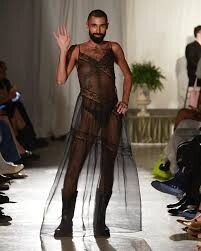 Tanner Fletcher, Spring 2024, ready-to-wear
However, even though contemporary fashion (or what’s left of it) seems to have discarded class, race, ethnicity, age, profession, and morality markers, the gender demarcation line persists. Men are still not invited to "appear"—to explore and visually embody their individuality; they are still "forbidden" from wearing so-called women's clothing unless they declare themselves non-binary, gay, trans, or otherwise gender-fluid—analogous to how women in suits were once perceived as lesbians or bisexuals.
There’s an important difference, though: when women used to adopt male attire, it was seen (whether welcomed or not) as the awakening of their self-awareness,[⁷] whereas today, men who wear so-called female attire are perceived as in some way relinquishing (their) power. So-called female clothing, footwear, cosmetics, etc., remain one of the last refuges of contemporary "politically correct" misogyny. Both today’s left and right assume that "women’s clothing" is permitted only for masculine individuals who want to be—or resemble—women, but not for heterosexual (cis) men who do not. For the latter, women’s clothing is at best a parodic marker of gender fluidity, and at worst offensive and grotesque.
This is also reflected in drag culture.[8] While drag queens help expand tolerance for non-normative gender orientations, they simultaneously, paradoxically, and contrary to their intentions, help sustain existing misogyny. There is an uncomfortable, unrecognized compromise: despite occasional backsliding on women’s rights, open misogyny is no longer acceptable to the right either. Instead, there now exists a spectrum of visually recognizable pro-feminine identities onto which right-wingers project misogynistic hatred and fears, while left-wingers project sympathy—thus allowing both groups (cis men) to maintain a supposedly safe distance from misogyny.
These stances implicitly confirm that even in contemporary culture, there persists a notion of a certain "metaphysics of femininity"—symbolically irredeemable, contagious, and unsuitable for heterosexual men.
Throughout the history of dress, there has been a lively exchange between male and female codes, but never complete equality. Today, there are a few avant-garde heterosexual individuals who wear so-called women's clothing. But to create a truly just society, especially now when we are again burdened by neo-conservative currents, heterosexual men would need to initiate a second explicit rebellion against the gender order. By wearing women’s clothing, they could express civil disobedience against the unwritten but dominant "law" whereby the (male) collective unconscious indirectly devalues women.
This is not about some forced androgyny or “emancipated” uniformity, but about expanding and recognizing new (conditionally speaking) areas of struggle. Just as women once adopted men's clothing without renouncing femininity, so too can heterosexual men adopt women’s clothing without renouncing masculinity.
Instead of abolishing anyone’s right to "look" a certain way, it would be better, for example, to eliminate the division of stores into men's and women's sections and produce all garments (and other items) in all sizes. Furthermore, such gestures should be socially and responsibly promoted across all media.
This is not mere aesthetic whimsy—it is a political and moral imperative to end discrimination. In other words, women’s clothing on men should undergo the same decontamination and desemanticization that men’s clothing underwent on women. Only when this happens will everyone have the opportunity and responsibility to define and resemanticize their own (visual) existence without prejudice or pre-established codes. For being a man will no longer mean simply not wearing "women's" clothing, and men will have to prove that, like women, they are complete individuals—not just men.
Fotnotes:
For example, in Western Europe during the Middle Ages, the combination of yellow and green was considered the ugliest and most conspicuous, which is why beggars, prostitutes, vagrants, and other marginalized social groups were forced to wear clothing in those colors—as a kind of warning to respectable citizens. In 16th-century England, torn clothing and neglect of one's appearance were believed to indicate that a person was in love, which was considered a form of illness (a belief that is reflected in Shakespeare’s Hamlet).
Thus, in ancient Egypt, both genders wore makeup and wigs, but women wore long transparent dresses, while men wore short skirts; in Rome, both genders wore long tunics, stolas, and togas; in the Middle Ages, both genders wore long robes, differing mainly in jewelry and crowns (as can be seen in Serbian medieval donor portraits), etc.
From antiquity up until the late Middle Ages, gender difference was not primarily based on reproductive organs but rather on the so-called humoral medicine. This system explained the differences between sexes through the quantity and quality of bodily fluids and the porosity of tissues. Masculinity was defined by a greater degree of dryness, warmth, firmness, strength, etc., while femininity was characterized by higher levels of moisture, coldness, softness, weakness, and the like.
Gilles Lipovetsky, The Empire of the Fleeting, Zoran Stojanović Publishing Bookstore, Sremski Karlovci / Novi Sad, 1992, p. 16.
There is an anecdote that in the first decade of the 20th century, the well-known painter Beta Vukanović painted murals on the walls of the art school she ran—wearing trousers (though for purely technical reasons, since it would have been impossible to do so in the long skirts and petticoats of the time). However, she did this at night when there were the fewest people around, because the sight of a woman in trousers (on scaffolding, and "small" at that) was scandalous to the bourgeois public of the time.
John Berger, Ways of Seeing, Fabrika knjiga and Non-Aligned Books, Belgrade, 2019, p. 47.
This book is mentioned here because it is still part of the regular curriculum in the art history department, within the museology group of courses, at the Faculty of Philosophy in Belgrade. Despite some of its still valid insights, such views certainly require historical contextualization.A suit (on a woman) is still called a "power suit" in the fashion press—that is, a suit that brings or embodies power.
Although reducing drag culture to "men dressing up as women" is actually a mistaken and reductionist view, because it is not merely about disguise but about the hypertrophization of femininity as a cultural trope, staged in the form of cabaret, variety shows, burlesque, etc. These performance forms can have both entertaining and socially critical character.
We Were Supposed to Become Feminist Cyborgs. Instead, We Got ChatGPT.
It’s hard not to see contemporary AI as a strategic effort to contain and control the latitude of political possibilities, offering brainstorming companions that steer users toward familiar solutions and writing tools that reduce communication to a series of ready-made template.
University Bans Plato: “Promotes Gender Ideology and Homosexuality”
At a U.S. university, orders were issued to remove passages from Plato’s "Symposium".
Zohran Mamdani, Mayor of New York
Zohran Mamdani is one of the most recognizable young politicians of the progressive left in the contemporary American political landscape.