
Proposal for a New Flag of Serbia
Dušica Popović
Thanks to the protests of the past few months, the official state flag is more visible to us than ever before. Thus, it cannot escape our notice how, at first glance, its symbolism is in collision with current events and society as a whole. If we live in a (secular) democratic republic, the monarchical symbols of the two-headed white eagle with a crown and lilies appear quite absurd. However, upon closer inspection, it becomes evident that our national flag does not actually represent a formal state order, even less so society, but rather the prevailing spirit and character of the ruling power that has always been present in these regions. This spirit is embodied by the figure of the autocratic (pseudo)king, surrounded by a court clique and the church and/or party. It seems that ideological commitments and beliefs can always be changed and treated as colorful lies and consumer goods—provided we find the next paterfamilias who will take on the role of guardian of an imposed collective amnesia (currently represented by the Holy Ignorance of Serbia).* Thus, the surviving constituents of the royalist imagination on the flag evoke a state that rests on a cheap historical-revisionist pastiche. It is a state haunted by the ghosts of a chosen past while promising and pursuing (economically) stable future; a state whose present lacks significance and weight, a kind of transitional "non-place" (Marc Auge), destined for both an impossible return to the past (in cultural and political terms) as well as an unfathomable transition to a prosperous future (in economic terms), and so on.
However, there has always been a different social perspective of Serbia, which is today manifested in civil disobedience towards static institutions of all kinds. Such a Serbia, representing all those people who do not accept its mediocre position between the overly "conservative" East (which cannot shake off its own dogmas) and the insufficiently liberal West (which cannot reach its own ideals), demands its own symbolic mark. Therefore, on the occasion of March 15, 2025, we created the flag of the Unyielding Serbia in the photograph. It consists of a black background, as an emblem of anarchism, on which the Serbian coat of arms is stripped of monarchical features. On the surface, this seems to be an oxymoron, since the black flag, an anarchist symbol of anti-statehood and internationalism opposed to all (mental) provincialism, is here combined with the coat of arms of a nation. In fact, it symbolizes the contextualization of civil freedoms of a society: the Serbian coat of arms gives the black libertarian and yet abstract to an arbitrary flag a specific anchorage, while the black flag grants the coat of arms of a nation the necessary moral and intellectual breadth and depth. In this way, the flag simultaneously negates nihilism and narrow-mindedness, as well as the so-called autochauvinism and national chauvinism, two sides of the same coin that are permanently present in public discourse. 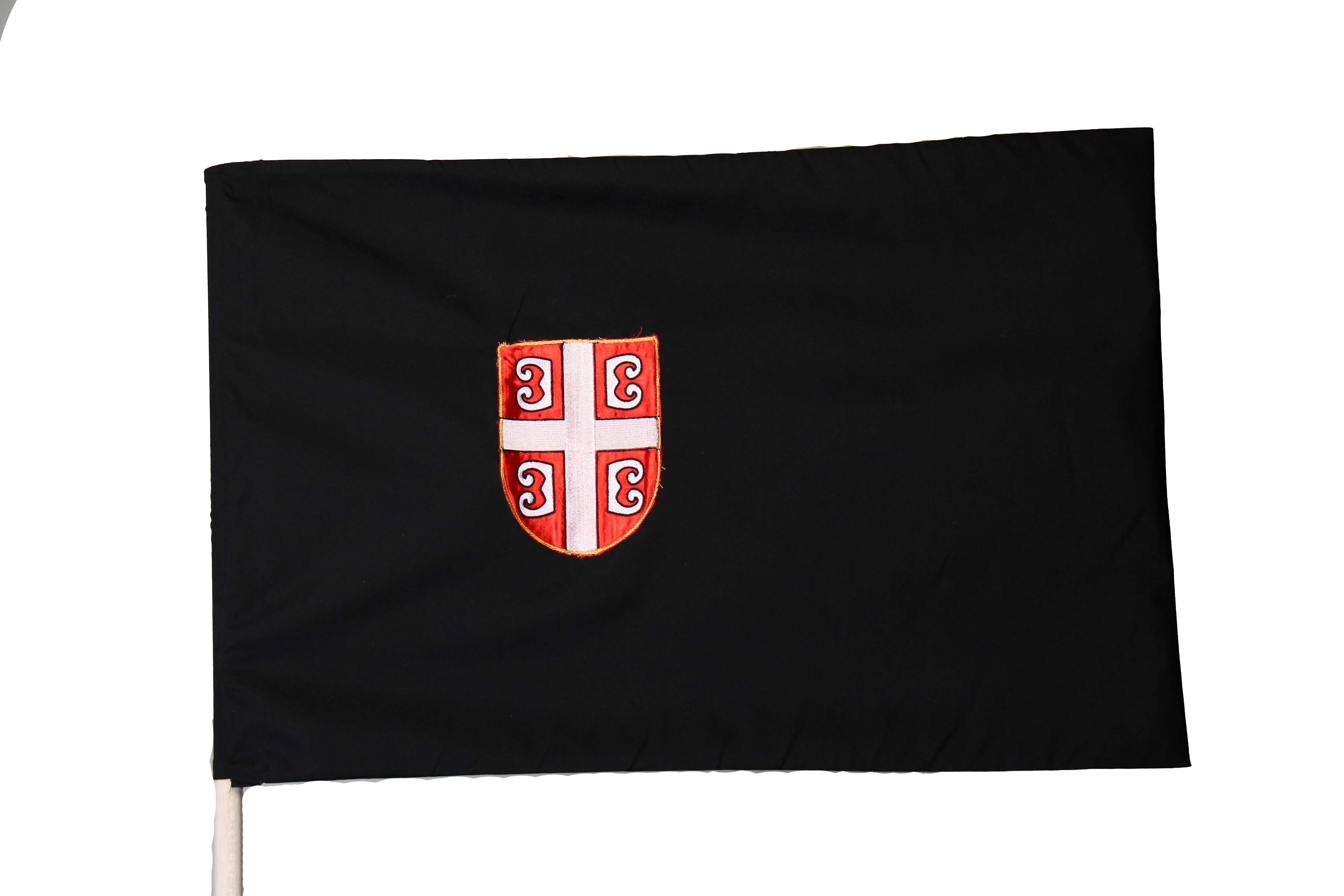
Moreover, such a banner can be understood as the death of any petrified (state) system in favor of a society without God and masters, i.e., any unverified authorities. For only unity can save Serbia—a precondition for emerging from the darkness of authoritarianism, ignorance, stupidity, greed, prejudice, clericalism, and so on. Likewise, the black banner serves as a symbol of mourning, bitterness, and compassion for all victims of inhumane policies: from stigmatized minorities of all kinds, through those affected by political repression, to the unemployed and beyond. Although the black banner can also be understood as a symbol of the self-pitying and mysterious enthusiasm of a people, amidst all the miseries surrounding them and (literally) pouring down upon them. The dramatic contrast of black, white, and red can seem ominous and cautionary—for any authority that refuses to be accountable to those in whose name it governs. Certainly, the possibility of different interpretations remains open, as the coat of arms is a seed thrown into fertile soil, the embryo of responsibility and risk-taking in creating oneself and one's environment...
*One of the things that well illustrates the capacities and priorities of the ruling regime is the endangering of the entire resources of the main institution of culture and education, the National Library of Serbia, and its staff, merely for the sake of constructing a mere commercial object—an underground garage (sic)!
We Were Supposed to Become Feminist Cyborgs. Instead, We Got ChatGPT.
It’s hard not to see contemporary AI as a strategic effort to contain and control the latitude of political possibilities, offering brainstorming companions that steer users toward familiar solutions and writing tools that reduce communication to a series of ready-made template.
University Bans Plato: “Promotes Gender Ideology and Homosexuality”
At a U.S. university, orders were issued to remove passages from Plato’s "Symposium".
Zohran Mamdani, Mayor of New York
Zohran Mamdani is one of the most recognizable young politicians of the progressive left in the contemporary American political landscape.