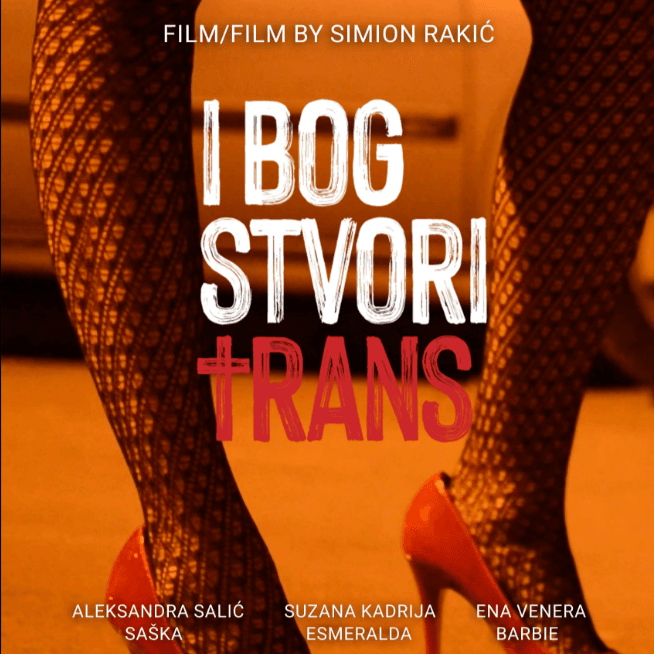
And God Created Trans: Boldening the Margin
Vladan Đukanović
The representation of queerness in domestic popular culture and art is still scarce in the mainstream; by contrast, we could say that it has been flourishing on the independent scene in recent years. However, just as there is still a lack of understanding of trans people within what we might call the community, artistic works too often maintain a distance that chooses to exoticize rather than bring people closer.
The documentary film And God Created Trans, directed by Simion Rakić, promises a great deal with its pretentious title; however, its superficial provocativeness does not cross the line of stereotyping that local queer artistic production has already moved beyond some time ago.
The film features three trans sex workers from Belgrade: Aleksandra Salić Saška, Suzana Kadrija Esmeralda, and Ena Venera Barbie. Within the first few minutes of the film, it becomes clear that its starting point is not transgender identity but sex work, with trans identity subsequently inseparably bound to it. If the director had started from transgender identity, we would have been given insight into the lives of three trans women for whom their work is merely one aspect of their lives. Instead, the director chooses to reduce two separate characteristics to a single inseparable one. The reason not to abandon the screening is the extraordinary charm of the interviewees, their honesty and spontaneity, which both move and amuse us, and ultimately delight us.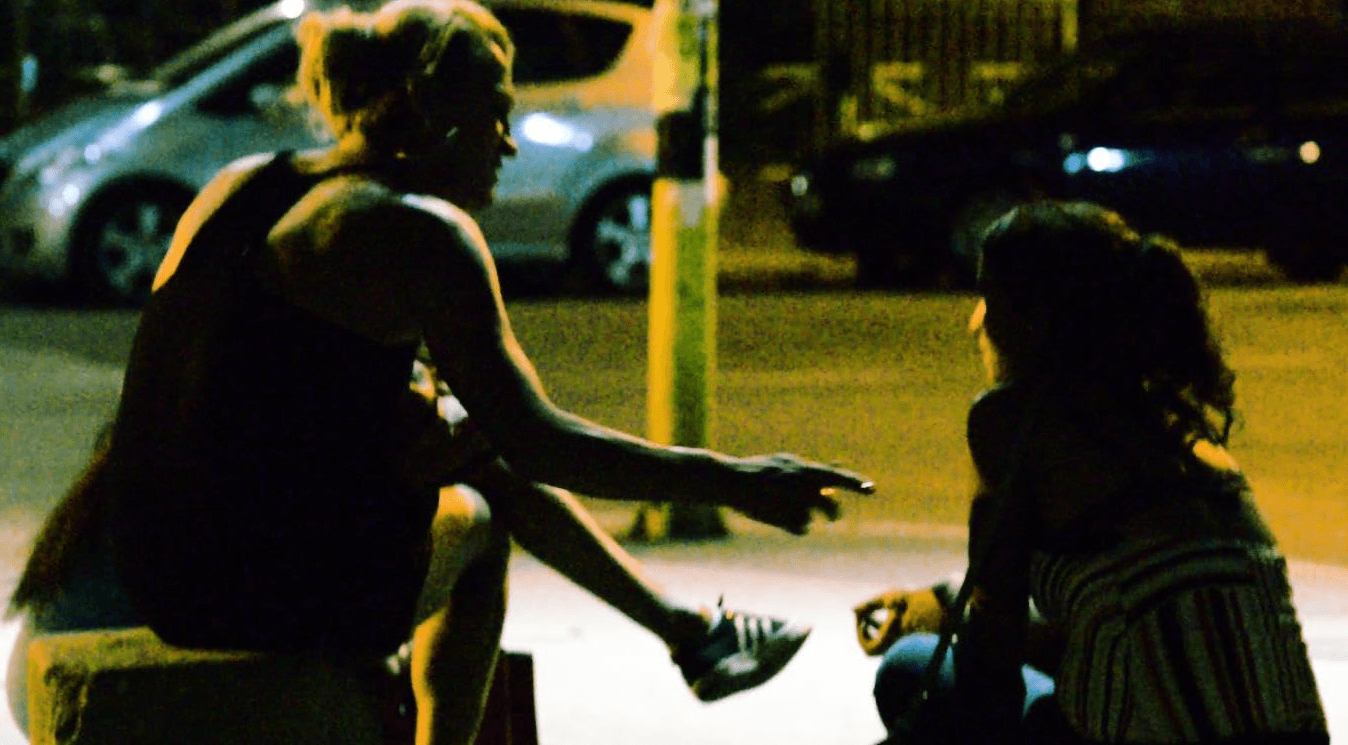
We can compare the film with the Spanish documentary Vestida de Azul (Dressed in Blue), directed by Antonio Giménez-Rico in 1983, which was recently screened again at the Berlinale and follows six trans sex workers during Spain's transition to democracy. What these films have in common are their fantastic interviewees; what separates them is the director's awareness of the distinction between transgender identity and sex work. In the Spanish film, we can see the fullness of these women's personalities through precisely what is chronically missing from Rakić's film—their everyday lives. The difference could perhaps be justified by budgetary constraints, but judging from what we can infer from And God Created Trans, the interviewees seem to have provided enough material; the issue, therefore, appears to lie in the director's choices.
At the beginning, we meet Saška, Esmeralda, and Barbie on the street during the evening. There, they introduce themselves and their work to us, directly and unapologetically. This setup seems typical and meaningful until we learn that Barbie does not actually work on the street and that her scenes were filmed while she was walking her dog. The realization that, even when reality itself shows otherwise, the director imposes upon us the stereotype of trans–sex work–street life gives the film a bizarre quality. At one point, the film shifts to daytime, to daylight, to conversations inside a house and in a yard, but that does not mean an end to the discussion of work. During the day, all three women are shown only at home, isolated from society.
Throughout the film, the interviewees do not hesitate to share with us their insights into gender, sex, sexuality, religion, ethnicity, family, their surroundings, and society as a whole. The director exploits this, however, and we are shown close-ups of their breasts and missing teeth. Although they continue to give us everything we need to see them as human beings, to understand and respect them, these choices dehumanize them, encouraging the audience to perceive transness as something exotic and sensational. There is, of course, also the familiar trope of the makeup scene, which we constantly encounter in representations of trans women, as if to convince the audience that becoming a woman means accepting imposed aesthetic norms.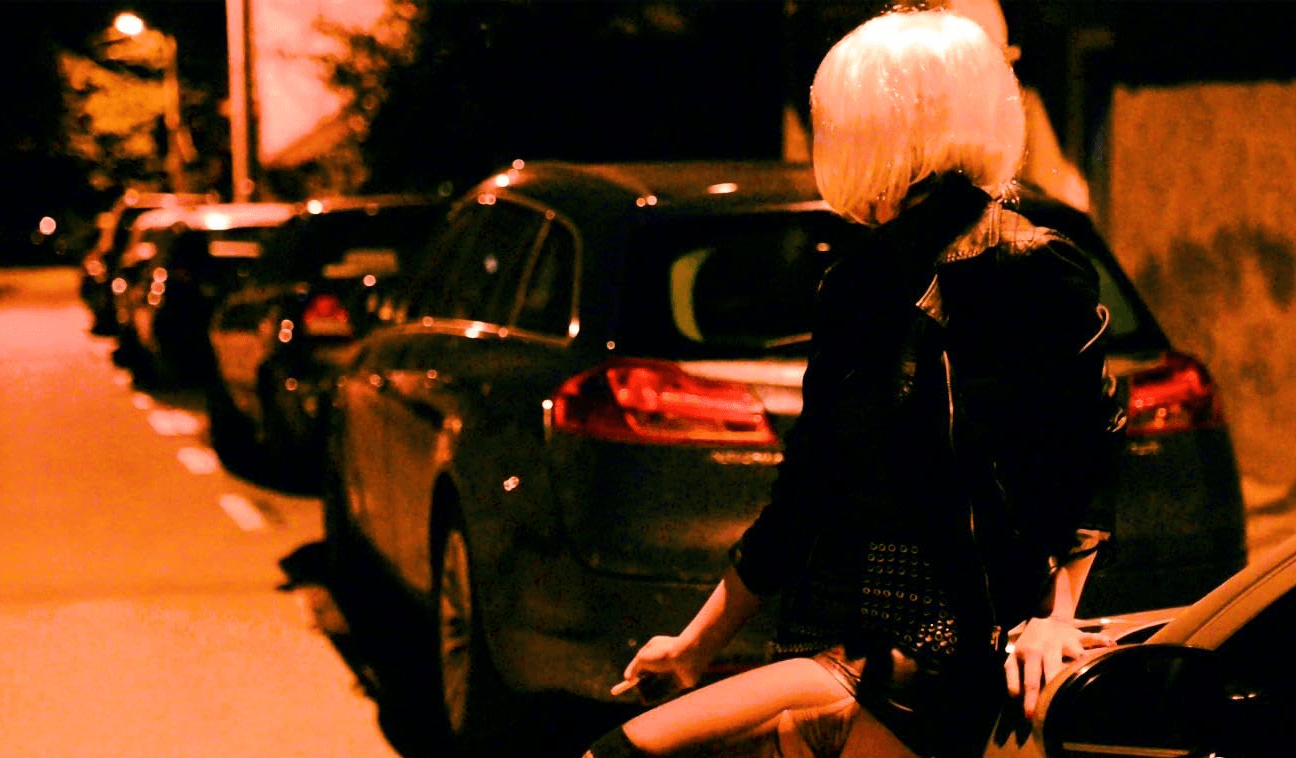
The film's very title, which Ivan Medenica says hits the bull's-eye, is taken from something said in the film. The choice to foreground religion out of everything that is said seems like an unnecessary insistence on a right-wing and religious discourse. By accepting this discourse, queerness is forced continually to subordinate itself, to seek justification for its existence in the gaps of patriarchal heteronormative norms, and to relinquish self-determination. This discourse, however, perfectly explains the objectification of the interviewees.
At the screening I attended, the moderator said in her introduction to the discussion with the audience that something like this had been done for the first time, and the director did not contradict her. We had Žilnik's films in the 1980s and 1990s, sensationalist television programs in the 1990s and 2000s, followed by Vajs's documentaries in the 2010s. In recent years, we have had excellent performances by Eva Voštinić that, without pathos, allow us to use personal stories to question both our own and society's relationship to gender, as well as works by other trans and queer artists who, with far less pretension, actually hit the mark.
Pier Paolo Pasolini and the Renunciation of (the Trilogy of) Life
There is a certain discomfort we encounter when attempting a discursive or essayistic—bounded by predefined norms—illumination of the life and work of a great figure.
Identity and Religious “Coming Outs”
Two Basque films — "Maspalomas" and "Sundays" — have already won over both audiences and critics, while the French film "Couture" has brought together Jolie and Garrel.
'In Every Theatre, People Would Leave"
How 'gay cowboy movie' "Brokeback Mountain" challenged Hollywood – and the US.