Sara Ahmed: Killjoy as a Queer Project
Dušan Maljković
As part of Pride Weekend in June 2024 in Skopje—a cultural event through which the LGBT+ community marks the month of June, commemorating the 1969 Stonewall riots in New York, which sparked the global gay liberation movement—Sara Ahmed was a guest. Ahmed is a philosopher, feminist, and activist of international renown whose work spans postcolonial and queer theory as well as race studies. Her book The Cultural Politics of Emotion is recognized as one of the foundational texts in affect theory, exploring the connection between emotions and social movements.
In her talk titled "Killjoy as a Queer Project," drawing on Husserl's phenomenology, she examined the mechanisms of exclusion based on non-heterosexuality, femininity, race, and other factors, as well as the possibilities for resisting these processes. Beyond offering fascinating insights, her talk resembled a support workshop, leaving the audience feeling supported and accepted. I can confidently say it had as much of a therapeutic dimension as a political one, an extraordinarily rare achievement.
Since Sara Ahmed often emphasizes the importance of friendship and intimacy, I wish to express my gratitude to my friends Slavčo Dimitrov and Manja Veličkovska, co-organizers of Pride Weekend in Skopje, without whom this text would not have been written. I dedicate this reflection to Ivana Pražić, a friend and postcolonial feminist, who introduced me to Sara Ahmed more than a decade ago, marking the beginning of my long-standing theoretical admiration for her work.
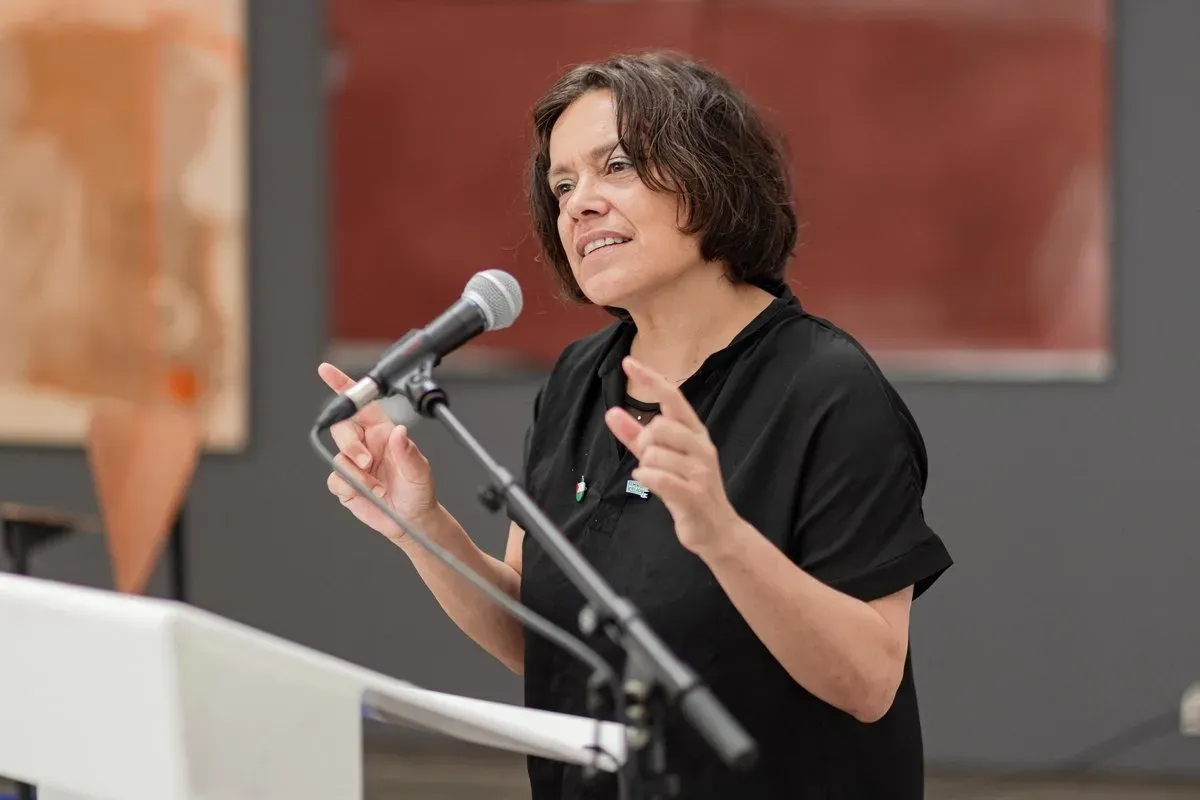 Photo: Sonja Stavrova / Skopje Pride Weekend
I understood that your lecture was primarily a critique of the university in its current state, especially when it comes to racism, misogyny and transphobia. You left your post, which was an inspiring moment for me because I also work outside of academia but closely cooperate with it. So how can this corporation be fruitful, if it can be at all? We still need science to combat, for example, the anti-trans rhetoric of common sense that there are only two sexes and genders. On the other hand, with the inclusion of universities into neoliberalism, where knowledge is no longer the primary output but hyper-production of works, we also feel we need new resources for the production of science. So what kind of stance should we take towards the university?
I think there are many possible ways of thinking about collaboration between those who are working within the university and outside of it. And I think all of the subjects I've been involved in—gender studies, cultural studies, race studies—have all depended on the movement of people and ideas between universities and other worlds. It's never been about knowledge for its own sake. We've always thought of the relationship between the university and social critical movements that have pressed the university so that knowledge that otherwise wouldn't have been there is now there. So I think of the role of gender studies, especially as pushing the university to take seriously questions of power and difference that otherwise the university might not have investigated.
So for me, I suppose leaving the university, it didn't feel like I was leaving my politics behind or my community even, because we were always coming and going, different groups of us. It's just that now I've gone from being a professor to being an independent scholar, but I'm still in conversation with so many other people. And many of the writers that most influenced me weren't based in universities. They were librarians, poets, and activists who didn't have a house there. So I feel that there's obviously a very big difference to no longer be receiving a salary, basically to find my means for survival, my means to fund my life differently using other me. That's a change. But in a way, the work has continued, and it's being sustained. And I feel like I'm more able to do certain kinds of work at the university because I'm no longer working for it. And a lot of the work I've done on complaints, I think, was possible because people could talk to me.
And by talking to me, they were talking to someone who wasn't in the institution where they've had that difficult experience. So that's in some sense and they're being outside actually allows us to generate a different kind of knowledge that otherwise might have been made very difficult by the great institution we're critiquing. So I felt there's always been this, this web, this flow of people and ideas, and that dynamism matters because universities are one place we go to know. There are so many other places as well.
You analyzed a lot of ways of how Killjoy works. Some of them are our very queer presence, and one of them is just saying things that bother us but are left unnoticed. It involves courage, but also a lot of energy and effort. How do we prevent burnout? Or should we burn again and again for the right cause?
I think it's a really good question. And I often get asked by students, especially actually when I go and talk to people at university, student activists who are studying but also committed to the task of world change. Ask me this: how do we keep going? Where do we get our energy from? And I think very much that my answer to that is, is to say that there's only so much each of us can do. And that even as the work of the killjoy becomes life-affirming, there are also other things that we do. It's not all of us there. There's more to life, even I would say than being a killjoy. I would also say that sometimes actually being a killjoy, it feels like a, a negative project or push, push, push. And it is. But it's also how you find people who've been there, who've done that and we therefore get something.
There's a connection and with that connection comes relief, actually lightness, sometimes even humor as you begin to laugh at that world that you recognize but that so often gets overlooked and not noticed by those who are invested in its reproductions. But I think, you know, it is important to say there's only so much you can do. It is important to think about life as holistically as possible, that, you know, to draw on our other communities, our many communities, to think of the knowledge that gets passed down to us even through queer lines of transmission. But it's also important to think of the work, the actual institutional work, the world-changing work, as not simply taking something from us but giving thanks to us. Ways of seeing, ways of knowing, and ways of connecting with others.
The politics of emotion is a subject you dealt with a lot. Coming from one of my theoretical backgrounds that is psychoanalysis, I have noticed that there can be a bad politicization of emotions too where our unsolved personal matters can often be masked as something political (for example, gender critical approaches). Many queer and or leftist group face this problem in their only work resulting in splits and fragmentation of activism. How would you approach this matter?
Yes, that’s a very interesting set of observations. And I think that there's also a way in which some of the political work we do, I'm thinking particularly of diversity work, you know, when you're trying to transform the institution, is seen by conservative people as masking a kind of will. So I've already noticed, for example, that whenever you talk about say, let's say, sexual harassment as an example, when, when we did the work working on sexual harassment at the university, there was a perception, I think that we were just doing that because we were envious and we wanted the professor's jobs and we wanted what they had. And so, there's one way in which the presumption that there's one way in which social activism is seen to mask an ulterior motive that we have to be critical of. How people try and read behind that mask to some sort of ulterior motive and apologize to the person who protests as having the willpower to use that language. So there, there's that. But of course, that doesn't mean that there can't be complicated emotional dynamics to what brings us to the work of trying to change the world that we're in. And I think that one of the first theorists I turn to on this is Audrey Lorde because when she talks about anger as loaded with information and energy, it's just a very simple sentence.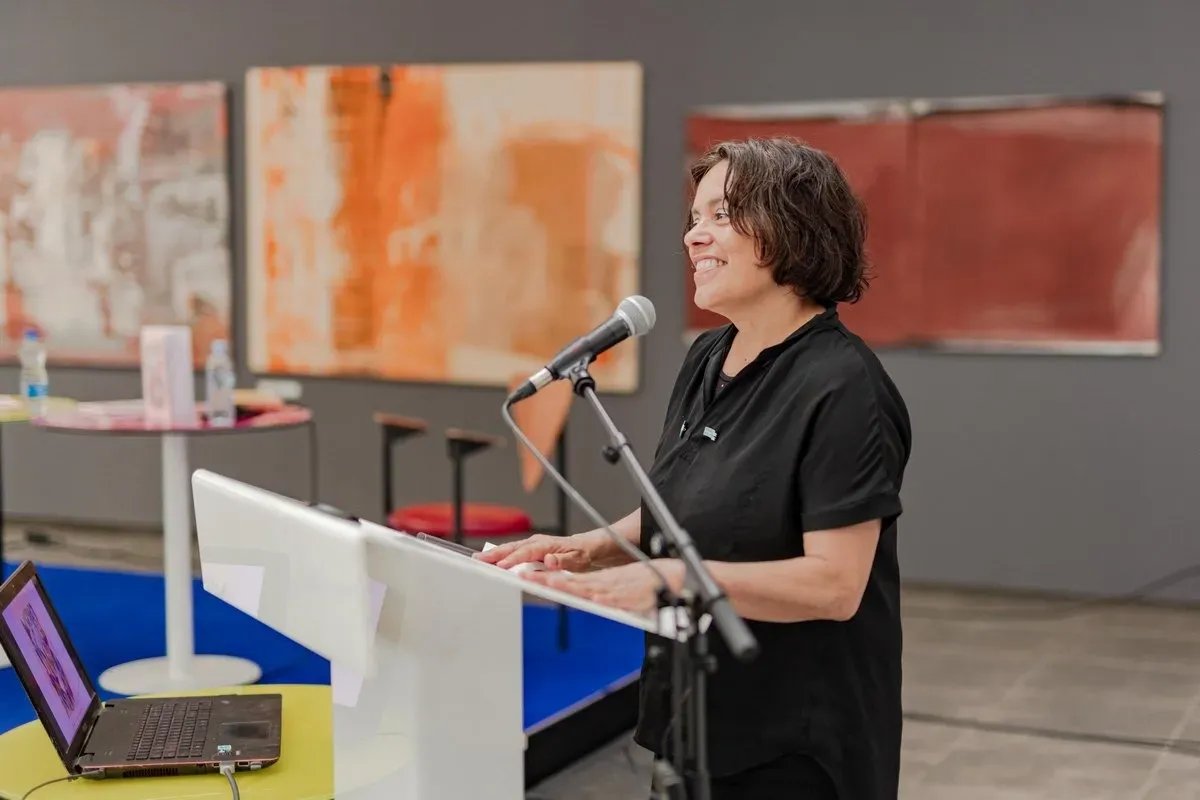 Photo: Sonja Stavrova / Skopje Pride Weekend
Anger is loaded with information and energy. And that helps me because it, while I'm thinking about it, I am right because I feel angry or my anger allows me to see X is wrong. You simply look at the emotion itself as telling you something about yourself, but also the world that you're in, loaded with information, but also being a source of energy or energizing. Maybe it's that feeling that takes you to the street to say no to something. So to me, that's quite a helpful way of looking at emotions. So it's not that that's something that that some we're, we're fully present to ourselves. Like I I understand the need not to presume that we know that we are fully present to ourselves, let alone present to others, and that there's something opaque and difficult about being in the world, and even our relationships to our communities can be full of uncertainty and doubt.
So when we do have these feelings of rage or anger about injustices, we don't make them the basis of kind of righteousness, but we turn them into something to investigate and analyze and work through collectively. And I think in a way, there's a history of queer activism that has done that that's turned emotions such as anger into resources that take you into spaces that are not into resolutions or solutions, but means to get somewhere. That's how I see it. What was it, however? Oh, yeah. And, and I think I think the killed was quite helpful as a way of thinking through the difficulty of conflict amongst our communities. I think, you know, one of the things I like doing when I do research is to look back. And I was struck by one of the classic collections in black British feminism. It's called Sharp on the Journey. And it was this contribution by Aftabra, who's a black feminist, black British feminist who's influenced me.
And she was talking about how she was at the International Women's Conference in Bristol, you know, back in the 70s, and there was a group of women of color, and they were talking about race. And they were at this meeting and they were talking about race. We need to make race one of the core demands that women make men. But they were blanked and that demand was not recorded. And it was as if they weren't there. And it reminded me of how like the killed Joe was there already in that room. The cool didn't come later. They were already there. It's just they weren't recorded as being there. And so if you begin to think of it like that, but the killed Joe is already in the room before anyone gets there. But there's a history that means we're not in the same. We don't bring, we're going to enter the same room because we bring different histories to it. Then you begin to think of like that antagonism, that difference, that question of who's reporting is in the communities that we're in and that therefore negativity, conflict, disagreement becomes part of the work of doing communities. It's not a sign that we fail, but it's what we're doing.
It can be hard when you are in a queer space, for example, and there's transphobia or there's racism and you no longer feel at home and feel safe. It's very, very hard because they're the space you go to when the rest of the world feels shipped. But, you know, I think it's important to know that those spaces aren't always safe and to do what we can to listen to each other, to work out what it would take to enable as many people as possible to assemble without feeling that their being is in some way in danger.
We're currently facing a world where genocide in Gaza is happening, which is recognized by international institutions and the UN, etcetera. But it is still taking place with very little hope for a humanitarian catastrophe to be avoided, despite many activist actions and a change in global opinion when it comes to Israel's actions towards Palestine. What is to be done with this situation, to ask Lenin’s question? When everything seems hopeless? What kind of future is to be expected?
I mean this, this is a very, very painful question for those of us who are committed to peace and justice to be bearing witness in the full sense of that word, not just looking idly, but allowing in the absolute truth, the horror of a genocide happening whilst I'm sitting here with you at this table someday. It's really hard. But I, I also think that, you know, I was at an event in Barcelona and Angela Davis was speaking and she was talking about activism and what it meant to be committed to activist life, like to commit your life to the change that you believe in and the movement that you're part of. And she was sort of talking about time. She was talking about how much of the change that might come about as a result of our participation and collective action, we ourselves weren't seen.
And whenever I've sort of been engaged with people about Palestine, including on social media, people in Gaza or Palestinian politics as follows, the thing that's struck me is hope. Like that, they have hope that they will rebuild Palestine, that there will be Palestine, that there will be a free Palestine. And I always feel like my response to that, even though there is this sort of weariness and, and doubt about it, is that I almost feel like I have a political duty to share that home. And that's something that you commit to when you go to the streets or when you speak to people, when you teach students, when you give a lecture, you say the name, you say the words, you put it in the room. You don't know who's in the room with you, but if you put it out there. I think if that's one thing that we, we need to give in our commitment to Palestine is hope. Hope in the sense that Mariame Kaba talks about hope as a discipline, hope as a hard work of keeping going in the face of such extraordinary injustice.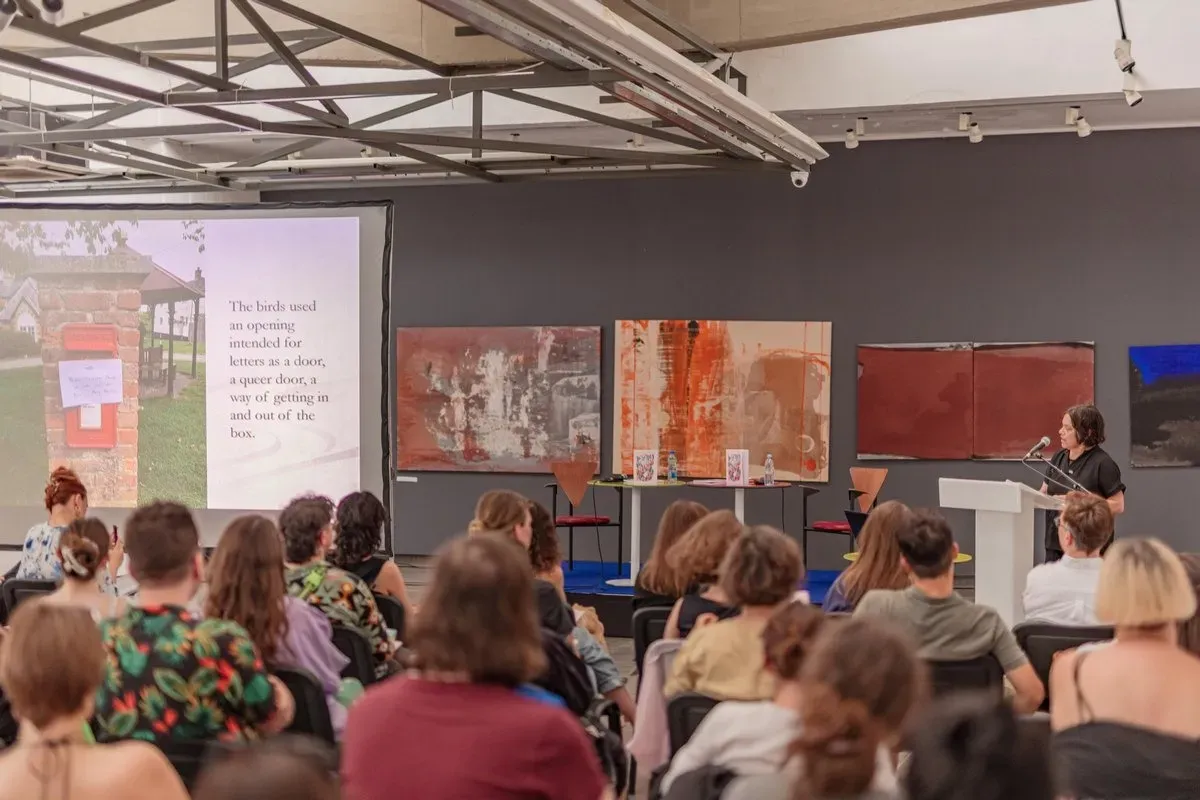 Photo: Sonja Stavrova / Skopje Pride Weekend
And a very last and very personal question. I quoted your relationship with your mother in my thesis, and that created the small incident because I was criticized for involving personal emotion in the philosophical text, despite the fact that very traditional philosophy doe it too, for example in the works like Augustine's "Confessions". But currently, my mother is dying, she has progressive dementia, and I feel like I'm losing the only source of unconditional love in this world, which makes me feel desperate. What should I do? Love more? Run away, cry and write all of it? Nothing?
I think you probably are better able to answer that question. I'm sorry to hear about your mother. I was at when I was writing with them is Killjoy handbook, which is the first time I've written for a trade press. So it's a different kind of book. I write about my mother again and in my mother's in a nursing home.
She doesn't have progressive dementia, but she's been ill all my life and I've lived with her disability all my life. It's been a very big part of my life. But my mother also has said and done some pretty shitty things, and I wanted to be able to write about them in the living famous Killjoy Handbook. And I had a really difficult kind of sort of existential crisis about it because it was a really important part of my journey as a kill. Drew was dealing with some of the things my mom said to me because with my father, I could just tell him to fuck off. But my mother, she was very vulnerable. And I knew that if I said what I thought, she would shatter. And so it was more important to me that she didn't shock her. So there was a lot that I was never able to say to her, even when she had said things that would be problematic to me. So I think, you know, I think we work it through the people that matter to us, where the relationships are part of our survival. And that sort of losing those, those people and losing ourselves, they're very hard to untangle.
So I think I find that writing is really helpful to me, like writing that through how I feel about these things and that whenever I think about insight or how do we acquire insights, I do think about my relationships. But they've given me a lot to think through and to think about how to be in the world safely with other people and how to survive our family sometimes, and then how to create our own that gives us room to be who we think we are.
So I just hope that you find a way to stay, stay connected with your mother in whatever way you can.
First published on the portal Masina.rs, August 16, 2024.
Dina Bajrektarević: On Conversion Practices
The first study on conversion practices in Serbia shows that they are most often carried out within families, educational institutions, and informal communities, frequently under the guise of care, counseling, or assistance.
Miloš Lolić: There Will Be a Bitef, but a Guerrilla One
If we find a suitable venue, this will almost certainly happen, and with that the vision my team and I have long hoped for will be fully realized—a free, libertarian Bitef.
Klara Vlasakova: The End of the World, the End of Imagination
One of the many fine events prepared by the Czech Center in Belgrade was the visit of Klara Vlasakova, a young Czech writer, playwright, publicist, and author of film scripts, as well as radio plays and comics.