
Sara Ahmed: Feel Everything, Including Killjoy Joy!
Manja Veličkovska
Sara Ahmed is an independent brown queer feminist and theorist that works at the intersection of feminism, queer studies, and race studies. In her works, she focuses on the experience of power and the way it gets challenged in everyday life and institutional cultures. She has just released her first work aimed for the general public, The Feminist Killjoy Handbook, with Allen Lane. Her previous works (all published by Duke University Press) include Complaint! (2021), What’s The Use? On the Uses of Use (2019), Living a Feminist Life (2017),_ Willful Subjects_ (2014), On Being Included: Racism and Diversity in Institutional Life (2012), The Promise of Happiness (2010) and Queer Phenomenology: Orientations, Objects, Others (2006). Her anthology, The Cultural Politics of Emotion, examines the emotions as cultural practices with political implications.
Even though Sara Ahmed is known to shift between methods and styles of writing, it seems as though all of her work delineates one continuous thought process, as if one book builds momentum for the next one. She is known to delve deeply into a particular subject or theme throughout her work, but is also flexible and able to navigate different writing landscapes. Ahmed manages to bring forth versatile topics and directly communicate with her readers, all the while staying faithful to the embodiment of the feminist killjoy, in theory and in practice. In her words – It is what she does, it is how she thinks. She is the “killjoy shoulder” next to ours, to lean on while transforming the world for our joint survival.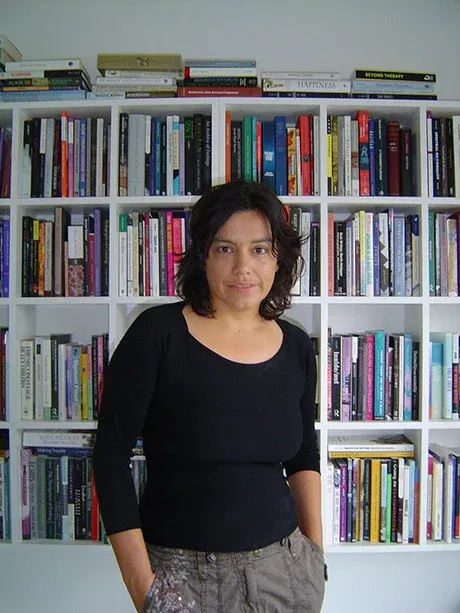
M: As a warm up for our readers, Sara, could you briefly tell us what originally inspired you to explore the intricate relation between emotions and politics? You have explained in The Cultural Politics of Emotion how various works have shaped your thinking, but could you briefly elaborate on why affect theory holds such significance for you and, in general, for critical analysis, as well as for feminist theory, critical race theory, queer theory, and the critique of capitalism?
S: I was writing about strangers – it was for the book Strange Encounters, which came out four years before The Cultural Politics of Emotion. I was interested in how the stranger was a rather familiar figure. We are told that if we don’t recognise someone, then they are a stranger. But I wanted to show we recognise some people as strangers, as not belonging here. The discourse of stranger danger tells us to fear strangers. It also tells us who to fear – the dark body passing by at the edge of social experience.
That is how I became interested in emotions – and right from the beginning that interest was more about objects, what we are told is frightening, who we are told is frightening, or later, what we are told will make us happy, than subjects. I was very influenced by Audre Lorde’s discussion of hate as well as Frantz Fanon’s discussion of fear. During this period in the late 1990s and early 2000s, there were a group of feminist scholars working on public emotions – including Lauren Berlant who came to Lancaster on a number of occasions. So, this interest in what emotions do, how they create spaces, and how they circulate, was shared. I don’t think we thought of ourselves then as doing “affect theory,” and I don’t think of myself now as doing affect theory in part because the influences on me came more from Black feminism and decolonial praxis. But I remain interested in the questions of investment and the public lives of feelings which overlap with affect theory. And for me, reflecting on emotions and what they do is also about thinking of the materiality of bodies, work, and the exhaustion of capacities central to understanding late capitalism and settler colonialism.
M: Upon recalling past killjoy experiences, I realized that even in moments when we barely succeed in holding ourselves back and remaining silent while someone is winding us up, we are still remembered as killjoys, even before we snap, especially if we have been known to snap before. People seem to identify sister killjoys even when they are not saying anything, whether by the very appearance of our body language, poised stance, quick breaths, and restless demeanor that often unnerves others. Our piercing gaze seems to unsettle them the most. Simply being in the room during discussions hits the nerve because it exposes vile and evil intentions lurking beneath seemingly innocent comments. You also explain how this phenomenon of killing joy without verbalizing our thoughts can also liberate us from certain burdens and make us realize that we’re not always accountable for how others perceive us. How empowering this momentary stillness can be? How resourceful and revealing are these mean-spirited remarks that are testing our feelings and the limits of what one can get away with?
S: Some of us can just turn up and remind people of a history that gets in the way of their occupation of space. bell hooks taught me that especially – her description of how a woman of colour by entering the room can cause discomfort, getting in the way of the solidarity felt in the room. It does release us from certain burdens to know we can cause discomfort without saying anything! But then we still have to deal with the discomfort! That is when finding others who get it as they have been there really matters. Because even when we are not responsible for how we are perceived, we live with the perceptions, and some of the work you end up doing is “managing them” perhaps by trying to minimize the signs of difference (a labour I called “institutional passing”).
Sometimes, though, we might try and pass our way into spaces by not saying anything and it works. Sometimes it doesn’t. I think of coming out and all the times I have been in conversation with someone I don’t know and they have referred to my partner as “he.” You might say, “he” is “she.” Or you might use a more delicate maneuver, sliding a “she” into a sentence, cautiously awaiting the response (and there are many responses, including no obvious one to embarrassment, annoyance, or a warm acknowledgment). Or you might let it pass, that “he” lingering, so you end up in a mini-closet of your own making, which can sometimes feel like giving yourself a little room, a break from the light of being seen, and at other times, can be painful because of how you have allowed yourself to be passed over. So, I guess my answer is that in time we learn from our own reactions what we need to do. And we need to be patient with ourselves as if what works at one time might not work at another.
M: It seems like people often equate being a killjoy with being a know-it-all, particularly when this logical fallacy forces us to explain our stance on each rising (non)issue, particularly when the inquiry’s goal is to divert attention from more pressing subjects like war, migration, poverty, inequality, etc. In_ The Feminist Killjoy Handbook_ and Living a Feminist Life you give us a deep insight into how it feels to be a feminist killjoy and how exhausting it can become at times. What do you think about the extra weight placed on feminists when certain circles grow accustomed to our “inconvenient” attitude? How often do you want to shout: “Screw that, don’t we all have more significant matters to address collectively”?
S: I think by the time I wrote the second of these books, I gave a different weight to exhaustion. Yes, it can be tiring, always being “on it.” It can be tiring what we are expected to know or to say. And yes, it can be exhausting having to keep saying it because they keep doing it. But we learn so much. Our wisdom is weary. And it is how we find other people who give us energy. It remains fascinating to me that the killjoy is a rather electric figure. Whenever I speak of feminist killjoys, there is a bit of a snap, snap, sizzle in the audience. It helps to have the figure as it gives us a handle on experiences that would otherwise be just plain old wearing.
M: I found it very interesting that in On being Included you talk about the phenomenon of “diversity fatigue” as an example of a term that causes tiredness because it becomes “part of a loop of repetition” on our end. The noun gender on the other hand has acquired a similar status of a notorious buzzword that is in “linguistic fashion” as a result of the frequent usage of it by the traditionally conservative and anti-gender mobilizations. How can we continue to bring sore points out when someone takes over the meaning of basic terms of expression and develops a public feeling of fatigue towards them? How to proceed when those feelings trigger actions of resistance that enter institutions and become yet another “institutional habit”?
S: So much of our learning is about what comes back at us. Even the feminist killjoy can be appropriated and neutralized and made not to do anything (or even put as a sign on the door by a harasser – an example from the Handbook). But we keep doing the work because it matters. We are trying to create space for each other. So, we keep going. And we don’t know who might in the future find the work – even if we don’t get through, even if the words get turned into water or mush, they come back and ignite fires later on. That uncertainty about what our words and work can do I think of as rather marvellous.
M: Troublesome, inconvenient bodies that are anyhow softening their appearances upon entering an institution, are nevertheless reprimanded because they tend to break, what you in Complaint! described as, “institutional happiness”. It is devastating to witness that while consumed by the task of rejection or redirection, institutions fail to understand the incredibly imaginative worldviews and experiences of those who turn to them. They fail to offer solutions because the pace of development and complexity of the human condition exceeds the institutional capacity to ever gain an advantage. One might even think that if an institution were personified, it might resemble a tragicomic figure, heinous and malicious while incompetent and absurd at the same time. Can we envision a radical institutional turn on our own terms, not relying on “the master’s tools” (as Lorde would say), or are the institutional capacities to embrace diversity limited to merely “folding” people back into their initial norms, considering their power stems from putting things to halt?
S: I think of institutions as very complex histories. Sometimes it is by disidentifying from them that people can do pretty shitty things – I think how sometimes “institutional racism” is used by individuals to say the institution is racist so I am not because I am against the institution. We are implicated in them in complex ways. I am trying to learn how people with radical political identities for instance become institutionally quite conservative – it’s something I observed when doing the research for Complaint!. They get invested in the institution even when they don’t identify with it because of what it provides. They are willing to be silent about institutional violence to keep their resources. I guess for me it is just working out these reproductive mechanisms. We need to find a way to stop those of us fighting for less hostile institutions from being stopped by that very hostility.
M: Due to a series of unfortunate socio-political circumstances and developments after the breakup of Yugoslavia and the fast decline to neoliberalism, it’s common here (and generally in the Balkans) to often express feelings of sadness rather than joy, to overly dwell on the past, or in some cases – to be stuck in a non-existent past of nationalistic pride. Consequently, when someone, particularly from the queer community, displays signs of happiness, they’re often met with criticism, as their joy is seen as excessive self-praise. This sentiment is particularly evident when transphobic or homophobic people use the excuse that “too much celebration” is why they avoid showing support. There’s an underlying expectation, especially among straight people, that feminists and queers should remain only miserable or discontent. The ambivalent display of a variety of emotions confuses and angers them even more, which in turns makes us the killjoy critic that keeps pointing out to their failure to grasp the meaning behind it all.
S: I think there is an intimate connection between queer joy and being a killjoy: happiness is meant to be deserved, a reward for doing the right thing. To say “Fuck that”, and to have fun and enjoyment because you are who you are with whom you want to be, is to kill the joy of others so invested in getting returns for their sacrifice. I do not think of sadness or misery as duty or even as inevitable in the face of oppression, though sometimes being the cause of other people’s misery can be miserable. But I am just as resistant to making joy or happiness an aim or a duty– as if you have to justify being trans or queer by being happy. That would have such unhappy effects. I think of queer happiness as about putting the hap back into happiness. When happiness happens, we are happy. But that’s neither the goal nor the point. In fact, I want to think of feelings outside of the moral realm of duty altogether. Hence my last tip for killjoys is to “feel everything (including killjoy joy)”!
M: You speak at length of how we can transform negativity into a tool in order to persist and keep fighting back. Where do you find ongoing hope that people’s attitude can shift to feel the affects and emotions of the oppressed, knowing that solidarity and support are not conditional even on the displayed mass scale misfortune of Others (case in point the genocide in Palestine, amongst the many)?
S: The project that left me the most hopeful was the project that brought me closest to other people’s trauma and pain – the empirical project I did on Complaint!. It taught me that people are willing to fight really hard so that other people do not have to go through what they went through. And when you fight, you find out so much about other people, about yourself, about institutions and their methods for shutting the violence out. It is politicizing. We are witnessing the politicizing effects of seeing the violence that has been ongoing in Palestine. The awful fact is that it will be too late for too many and that it has taken too long. It is a shattering, devastating reality.
It was a killjoy joy to attend recently the Palestinian solidarity encampment at Oxford, to listen to students, to hear the how of their resistance to the genocide; the collective effort to force their institution to recognise its complicity, to divest from Israel and other imperial-war machines, as they were working out how to care for each other, and for the camp, for the tents, tents for cooking, for welcoming, for reading, for quiet times, for wellness, for shouting, for saying no, to business as usual. To assemble, to say no, to do no, throws so much open. We throw ourselves into projects that are urgent, necessary, doing what we can, being there, in the wear and the tear, for as long as it takes.
Maja Veličkovska, May 30th, 2024. @ https://meduza.mk/
Dina Bajrektarević: On Conversion Practices
The first study on conversion practices in Serbia shows that they are most often carried out within families, educational institutions, and informal communities, frequently under the guise of care, counseling, or assistance.
Miloš Lolić: There Will Be a Bitef, but a Guerrilla One
If we find a suitable venue, this will almost certainly happen, and with that the vision my team and I have long hoped for will be fully realized—a free, libertarian Bitef.
Klara Vlasakova: The End of the World, the End of Imagination
One of the many fine events prepared by the Czech Center in Belgrade was the visit of Klara Vlasakova, a young Czech writer, playwright, publicist, and author of film scripts, as well as radio plays and comics.