Radim Vizváry: Let's Talk About Taboos
Dragan Jovićević
Besides revealing new names, troupes, and styles, the Belgrade Dance Festival also brings forth some forgotten and even never-before-seen stage forms. In this case – pantomime. Through ten scenes, Czech mime artist Radim Vizvari presented a series of incredible images in which we recognized numerous references – from the films of Pedro Almodovar and Michel Hazanavicius, through poetry, butoh dance, to upgraded pantomimes of Marcel Marceau. As a globally recognized mime artist, performer, director, choreographer, and educator, Vizvari is considered one of the most esteemed figures in contemporary European theater. And his piece, aptly named Solo, is regarded as an original work that takes us to distant worlds of pantomime, which somehow got lost in the age of modern technology...
"When I started working on the performance, everyone told me that pantomime, as an artistic form, was dead. I didn't want to believe that because I love pantomime a lot. But I hesitated for a long time whether to engage in this performance or not. Perhaps to focus on opera or movement theater, which I know have an audience? I decided to take the risk. And so I conceived this show, which is a journey from classical to contemporary pantomime," says Radim Vizvari at the beginning of the interview for Radar, after the first of two evenings during which he performed in Belgrade.
How did you create the diversities we saw in the performance?
The mental preparation lasted about a year. This process is very important to me because during that period, I collect and assemble parts of what will later become the performance. That's when I seek inspirations. The physical work on the performance lasts about two months, and during that process, I devise choreographies, search for music, and work with my team. Solo is therefore my manifesto. If I were to only do contemporary pantomime, then I wouldn't preserve the tradition. And in that case, I wouldn't offer the audience the complete history of pantomime.
What would be the key difference between classical and modern pantomime?
The classical is about dance, technique. The modern is more narrative. But the real question is what classical pantomime is today. That's what I'm still exploring. The new performance, which I've recently been performing, deals precisely with that. For example, in classical dramaturgy, if you want to create a comical situation in pantomime, you can do it through the love relationship between a man and a woman. But I decided to use two men, and I created a scene as a gay relationship. That hadn't been seen in pantomime before. That's my innovation. I wanted my performance to be progressive in thinking. Because I think many authors have gotten stuck in the past. Sometimes when I perform the show, I feel young people looking at it with surprise. For them, pantomime is pure exoticism, something original they would watch again and again from the beginning. That's why I want to believe that pantomime is making a comeback.
How is it possible that this hadn't been done earlier in pantomime?
There were pantomimes where men dressed as women, which is a kind of travesty. But it wasn't a theatrical message; it was usually done for comedic effect, for mockery. And that effect would be used to make people laugh, not to delve into the intimacy of gay and queer people. That's why I introduced questions of LGBT individuals into pantomime. But again, on the other hand, I don't want to be an artist who only deals with those issues. I want to open them up and discuss them, but I don't want queer themes to be the center of my creativity. I don't want to pressure society to talk about them, but if I get an invitation for a discussion, then I want to open up those topics from various aspects and push them to the limits.
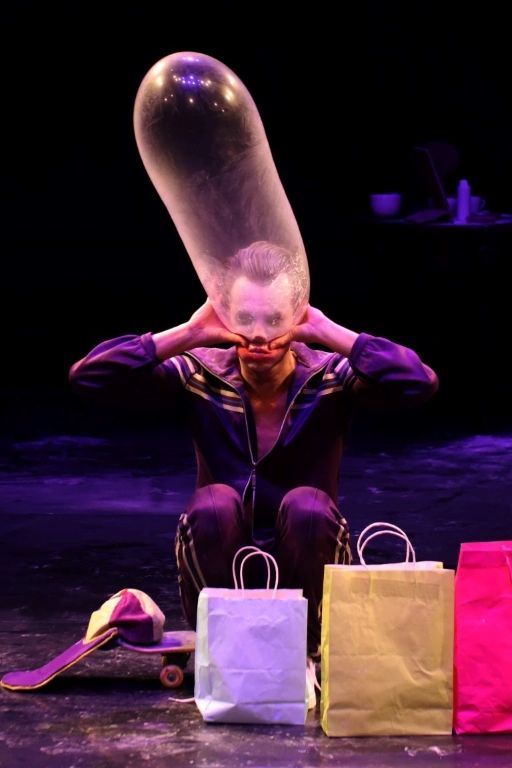
In the performance we saw, there's a very provocative scene with a condom? That clown discovers a condom he gets for his birthday and initially uses it as gum, then plays with it and turns it into a balloon...
Yes, that scene is very provocative. Of course, you understand, in some countries, I couldn't perform that. In China, Russia, or Egypt, it wasn't possible. It wasn't even conceivable to perform that segment in Poland. They are either extremely religious or extreme atheists, but in any case, they are extremely conservative. Art has changed, time has changed, societies have changed. Some have become more open, while others haven't. But every society has its taboos. In some parts of the performance, I wanted to show what is normal in our lives but not perceived that way. What we practice while within our four walls but is unacceptable for the public eye. Because to be accepted, people recoil from what they are. And that's why I wanted to provoke. Condoms are not a taboo at all; you can buy them anywhere. But we don't talk about condoms. By the way, the inspiration for that scene came from a real event. My sister has three sons, and the youngest really took and chewed a condom, thinking it was gum (laughs). I had to explain to him that it's not gum, but also what it's actually for. Anyway, it was a very good inspiration.
What makes people so conservative today?
Definitely social media. They are what closed people off. They were created for us to have a more comfortable life, and with them, the world is faster but at the same time smaller. However, people have lost values, like humanity, honesty, modesty. They are no longer able to wait. And just waiting is important in life because thanks to waiting, a person becomes a spiritual being. Waiting forces them to stop, to think, to contemplate, to evaluate the world around them. In principle, the aspiration for spirituality has disappeared. Everything has turned into consumerism. The real god of today is marketing. And because of that, our brain becomes confused. Marketing is a dictatorship. If we look into our own souls or what is deep within us, into our own interior, that's where we find the archetype of humanity. And for that, nonverbal language is good. Because languages change, as does technology. But it's hard to change the nature of physical movement. And that's why it's incredible when just one small movement becomes a provocation. And that today, in the 21st century. Simply unbelievable!
At the core of your performance is actually the story of loneliness. Each character in the ten parts strives for something. It's a story of how much a person can be alone and lonely in this world. Am I right?
You are. That's my personal story. But when I'm on stage telling the story of loneliness, it becomes existential. It becomes touching. Purer and more understandable. In any case, although I'm the author of all parts of the piece, I don't actually think about them that way. They naturally become like that. Because loneliness is my natural state. Of course, it's also my choice. I feel comfortable being alone. Being alone is sad, but feeling lonely is necessary for me as an author. It's my mental space where I create undisturbed. That's why I put the solitary processes of my characters at the center of all stories. We all feel like that, but we don't talk about it. And loneliness is the taboo of our time.
What I liked about the end of the performance is that you give hope for the future of humanity. What do you think, is there hope at all?
Well, that's a philosophical question, not really for someone expressing themselves through pantomime (laughs). I think today the future is in our hands. It starts within all of us. We must engage in society; we must act on it. Half of our brains are made up of mobile phones. And the future lies in reconnecting while technology, which has overwhelmed us, must become just a part of our normalcy. People must return to humanity; a way must be found to equalize man and technology. For me, artificial intelligence is not the future. The future is only human.
And pantomime? Is it part of that future?
Sometimes when I perform pantomime, I feel young people looking at it with surprise. For them, pantomime is pure exoticism, something original they would watch again and again from the beginning. That's why I want to believe that pantomime is making a comeback. Some disciplines are parts of a trend, then after some time, others take precedence. But I believe the era of pantomime will return. People need a new experience. Because in the whole noise of the world, that silence is necessary. You need to be in silence with others, to feel that movement, honesty, and nonverbal expression of feelings and emotions. And for that future to be possible, creators who will create it are needed. And those are the ones who have disappeared. Because it's impossible to sustain just with this art alone.
Dina Bajrektarević: On Conversion Practices
The first study on conversion practices in Serbia shows that they are most often carried out within families, educational institutions, and informal communities, frequently under the guise of care, counseling, or assistance.
Miloš Lolić: There Will Be a Bitef, but a Guerrilla One
If we find a suitable venue, this will almost certainly happen, and with that the vision my team and I have long hoped for will be fully realized—a free, libertarian Bitef.
Klara Vlasakova: The End of the World, the End of Imagination
One of the many fine events prepared by the Czech Center in Belgrade was the visit of Klara Vlasakova, a young Czech writer, playwright, publicist, and author of film scripts, as well as radio plays and comics.