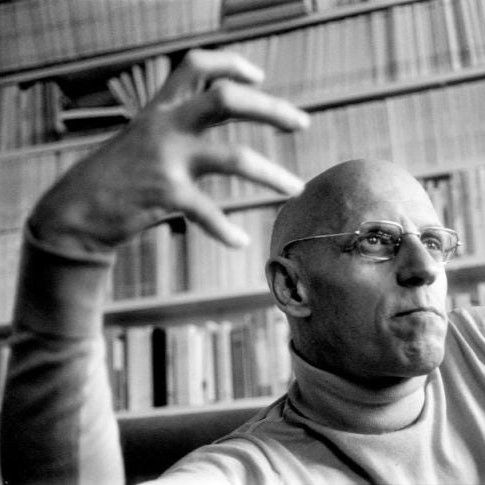
Michel Foucault: Being Good is Not Enough
Jelena Stakić
The prominent French philosopher Michel Foucault, author of a series of works in the field of social philosophy, agreed to an interview, albeit busy because he is about to start his annual lecture series at the Collège de France, focusing on liberalism. In his small office, surrounded by friends and colleagues (including his Italian translator), Foucault soon becomes quite relaxed.
Initially, he is a bit surprised that his "History of Sexuality" has appeared in Serbo-Croatian language. "Is it interesting for you, who do not belong to the capitalist world? It would be worth establishing whether the problem of power relations regarding sexuality matters only in developed Western societies where many major problems have been overcome, leaving only the issue of excess power."
We respond that a second edition is already in the works, which, for a book of that kind, is a remarkable success, and we hurry to ask about the sequels.
A Certain Relationship with Truth
JS: You announced six volumes of The History of Sexuality. How far have you progressed? Do you intend to deepen what was said in The Will to Knowledge, or to present some new aspects of the power-sexuality relationship?
– That's a joke – Michel Foucault laughs – I never said I would write those six volumes. It is true that it says so on the cover of the first book, but that's not a contract! I hoped that someone would say to me, "Obviously, you're not able to write the fourth volume, I'll do it for you!" Or: "I have an idea for the sixth volume, and I want to write it myself." And so, I wrote the first book, hoping that someone else would write the rest. But no one suggested anything, so all those books will remain unwritten – which is certainly easier for the translators… I might write one or two more, but not to deepen what I said in The Will to Knowledge – because that's already too deep, and at the same time, quite superficial; so I'll step aside a bit, in other words – I'll do something quite different. I primarily mean the history of recognition.
– So, I will deal with recognition, as it seems very significant to me. Recognition is, in fact, a practice that was not known to the Greeks and Romans. In certain philosophical schools of ancient Greece, the Roman Empire, the Hellenistic era, it is only faintly discernible – in the form of conscience examination, consciousness direction, teachers to whom certain things are said – but it was, in fact, a way to master oneself. The idea that truth is owed to someone else, that someone else has the right to elicit it from us, completely, without reservation – that is an idea that I believe is relatively recent in Western civilization. It does not even date back to the beginning of Christianity, but rather from the middle ages.
– The practice of recognition is enormously important, not only because it has enabled the attainment of certain knowledge related to sexuality but also because it has, in a way, enabled the education of our subjectivity. We have a certain relationship with ourselves that must go through truth. It is not enough to be morally good, it is not enough to just respect the laws, it is not enough to just have a lawful, valid, or respectful relationship with others, but one must also have a certain relationship with truth concerning oneself.
I Didn't Want a Philanthropic Book
– So, for now, I am mainly interested in that, now I am attracted to writing a History of Truth. That is something historians do not deal with because it is not strictly speaking history, nor is it just philosophy.
JS: Your book The History of Sexuality has aroused great interest in Yugoslavia. How was it received in France?
– Very poorly! – exclaims the author of the "poorly" received book, almost cheerfully. – Very poorly! As far as readers are concerned, not so much: I received quite a few interesting letters from unknown people, more than on many of my other books. But as for the critics and people who write for newspapers, the book was poorly received. One of the main reasons was that The History of Sexuality, like most of my previous books, was considered a kind of participation in the great noble struggle for mental patients, prisoners, the disenfranchised… However, the book I wrote has such effects, it is possible, but my task was not to write a philanthropic book. On the other hand, we all know that there was a movement in Europe for the liberation of sexuality which started from the principle that sexuality was suppressed and needed to be allowed to express itself as it was, despite all prohibitions, hypocrisy, and forced silence. My book tried to show not that sexuality was not suppressed – of course, it was suppressed – but how in the West, concerning sexuality, there emerged a much more complex attitude than mere suppression, an attitude of increasing curiosity towards sexuality. The further you go, the more you realize that sexuality becomes a subject of curiosity, concern, preoccupation, speech, analysis, a subject of expanding knowledge. This, on the one hand, leads to what could be called liberation, and on the other hand, to control. Nothing, for example, proves that the libertines of the seventeenth and eighteenth centuries were more or less suppressed than people of our time who go to psychoanalysts to ultimately bring their sexuality into line.
JS: But let's now return to this recognition of sexuality, bringing sexuality to light, let's return to the problem in its ambiguity and complexity. Because it turned out that the book appeared in France at a time when the struggle for sexual liberation was still in its early stages and, in a sense, somewhat naive?
– My book irritated people, as if they hadn't fought against the suppression of sexuality, as if they hadn't fought to have the right to speak, to show, to express their sexuality. But I was surprised that the same book, which was quickly translated into English, was much better received in the United States than in France, and much better than my other books. Obviously, the movement for sexual liberation, which originated in the United States, began to reflect on itself, to go deeper. There began to be an understanding that it is perfectly fine to affirm, to express one's sexuality, but at the same time, questions began to arise about what sexuality actually is. Isn't our willingness to affirm the natural, primal rights of sexuality, rights that do not expire, starting to entrap us a little?
JS: Your book The History of Madness in the Age of Reason, perhaps your most famous work, will soon appear in our language. In excerpts and interpretations, it is already somewhat familiar to us. But after it, some categorize you as "anti-psychiatrists"?
– When I wrote The History of Madness, anti-psychiatry did not exist, nor did it emerge because I wrote that book. Anti-psychiatry was essentially invented, formulated, and initiated by Laing and Cooper in England, and I wrote my book completely independently of them, not even knowing of their existence. My task was to conduct a historical investigation into the set of practical procedures through which mental illness was ultimately established as a subject. Not only as a subject of knowledge for doctors but also as a kind of behavior, a way individuals react to themselves. I was interested not only in how psychiatry was constituted but also in how people in a society like ours could become, in their own eyes, mentally ill. It's about the status of madness.
Psychiatrists Recognize Themselves
– And so I wrote that book. It stops somewhere around 1815. Now, what is interesting is that French psychiatrists, after some time, declared that this book was an attack on them. This means that they recognized themselves in what I was saying about the seventeenth and eighteenth centuries because I never said it applied to them. This means that they constituted that book as an "anti-psychiatric" work, undoubtedly because they themselves began to feel some apprehension and discomfort about their own practice. It was a way for them to question themselves. The psychiatrists themselves thus established a connection between what I was saying and what they themselves were doing!
JS: And if you were to write a history of madness in the modern era characterized by the rise of neuroses, what would that history look like?
He shrugs, sighs, and finally concludes: "No comment!"
Michel Foucault studied at the Sorbonne, graduated in philosophy in 1948, psychology in 1950, psychopathology in 1952. He was interested in the history of madness, the emergence of mental hospitals, the history of sexuality, prisons, "archeology of knowledge."
JS: After all these historical reviews, would Foucault apply a structuralist approach to any problem of our time?
– I am not a structuralist, I never have been! Yes, of course, I am classified as a structuralist, but that's irrelevant, it's completely wrong. From me, moreover, nothing more should be expected. I have said what I had to say. These young people – he points to his friends – it's their turn to speak.
Time-Shifted Reactions
JS: And the history of recognition, the history of truth?
– Yes, I will write that, but it will be, in a way, reactions shifted in time. My reactions to phenomena are somewhat reactions shifted in time. Some phenomena, in the contemporary context, begin to shimmer, to draw attention to themselves – and I respond to the challenge, but I shift the problem in time, in context. And my operation is successful when that type of analysis, slightly shifted in relation to the current problem, returns to the current problem and contributes to its different formulation. Around the year 1955, I worked in a psychiatric hospital. Various problems were being posed there… It is impossible to cross the threshold of asylums and stay in them without feeling certain things. I wrote The History of Madness in the Age of Reason when I left psychiatric hospitals, as an echo of a certain discomfort I felt, as a way to deal with it differently. If the book succeeded in the only sense that interests me, it's because it returns to the current problem, to French psychiatric hospitals, ultimately. French psychiatrists perceived it as a rejection, a reproach. The book was solemnly condemned by a psychiatric association; psychiatrists used my book to bother their superiors, patients, on the other hand, to bother psychiatrists, which is fine, isn't it? But that's all, I don't think I created a work. I reacted, and that's all. And now… when there's nothing around me to stimulate me, then I have nothing to say.
Uncertainty – the Robe of Power
Pasquale Pasquino, Foucault's Italian translator, agrees that the fabric of Foucault's discourse is very dense, that it is difficult to penetrate it at first.
Foucault interrupts us:
– There is something that gives me a lot of trouble and that I hold dear, and that is: that what I write should be clear. Even when the most serious topics are concerned, I would like what I write to be entirely clear because I believe that uncertainty is the robe of power. In every uncertainty, there is a certain coercion, as if to say, "Since you don't understand, admit to yourself that you are foolish." I'm not talking about poetry, I'm talking about novelists, about those who write about things. There, uncertainty seems to me absolutely unacceptable, and clarity, on the other hand, is inconvenient in two ways: first, it causes the writer a lot, a lot of trouble, and second – the writer is completely exposed. He is completely exposed, and yet not protected from misunderstanding. The clearer some text is, the more critics strive: first, to give the impression that they understood it, and second, to give the highest possible recognition to the text and then, in a way, leave it to fate. On the other hand, when you write clearly, then you are, in relation to the reader, in a position I could say is pure, clear, and noble. But, in relation to the critics, you are in a position that he cannot stand. Because what are you then leaving him as a possibility? Nothing! Not even the possibility to say to himself, "How smart I am to have understood!" That does not flatter his narcissism. I know a man who writes for the most serious journals and who, after reading my book on the history of sexuality, said that I was turning sexuality into infrastructure in a Marxist sense of the word. How can such nonsense even be uttered? And in the "International Sociology Journals"! There's no point in arguing about it, except that my book, having said what I had to say, leaves nothing else for the critics but to invent something new and then fight against what they invented.
Then he suddenly woke up: "Won't you ask these young scientists, researchers anything? Their time is coming, I've finished mine…"
He assures us, but we don't believe him.
Originally published in the magazine NIN, no. 1467, Belgrade, February 18, 1979.
Dina Bajrektarević: On Conversion Practices
The first study on conversion practices in Serbia shows that they are most often carried out within families, educational institutions, and informal communities, frequently under the guise of care, counseling, or assistance.
Miloš Lolić: There Will Be a Bitef, but a Guerrilla One
If we find a suitable venue, this will almost certainly happen, and with that the vision my team and I have long hoped for will be fully realized—a free, libertarian Bitef.
Klara Vlasakova: The End of the World, the End of Imagination
One of the many fine events prepared by the Czech Center in Belgrade was the visit of Klara Vlasakova, a young Czech writer, playwright, publicist, and author of film scripts, as well as radio plays and comics.