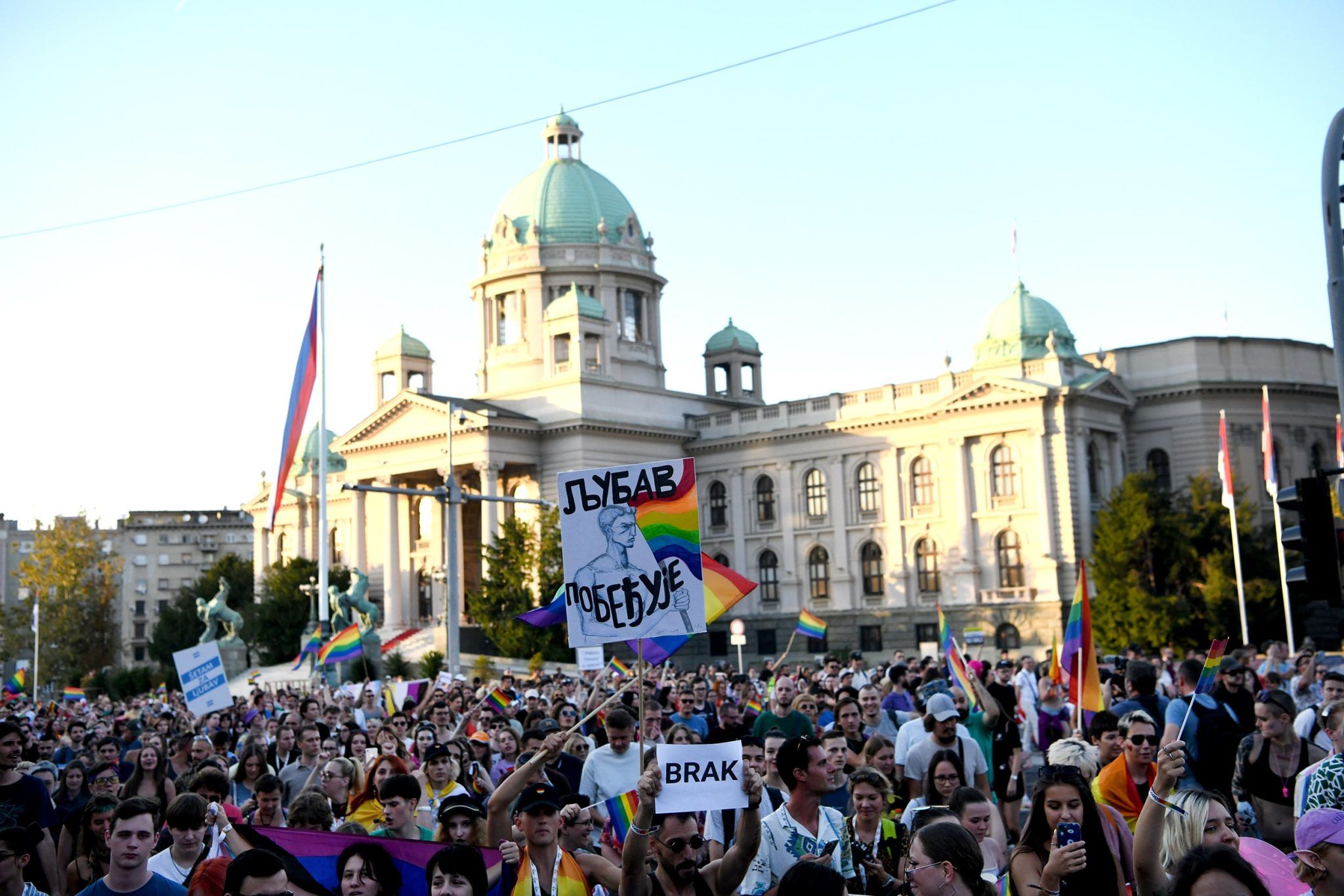
What Is Pride Still For?
CQS
Belgrade, June 21, 2025. A public panel titled What Is Pride Still For? was held at the European House in Belgrade, organized by the Center for Queer Studies and the Heinrich Böll Foundation. The occasion was the launch of the Serbian edition of the study Coming In: Sexual Politics and EU Accession in Serbia by British political sociologist Kun Slotmakers, Associate Professor at City St. George College, University of London. However, the panel evolved into much more than a book promotion and became a multilayered debate on the state of the LGBT+ movement in Serbia, the political and cultural meaning of Pride today, its contradictions, limits, and potential. The event gathered numerous actors from the LGBT+ movement, including former and current Belgrade Pride organizers, feminist activists, theorists, artists, and representatives of the student movement.
Pride Between Visibility and Passivity
The panel raised numerous questions about the current meaning, format, and purpose of Pride in Serbia — from its depoliticization and commercialization, through the loss of wider community support, to its relationship with the European Union and the student protests.
The event was opened by Dušan Maljković, coordinator of the Center for Queer Studies:
“Pride is less and less visible in the media — which can mean acceptance, but also passivity. And the level of homophobia and transphobia in Serbia remains very high,” he said, also addressing the broader context of stagnation in the queer movement: shrinking funding, the closing of spaces like the Pride Info Center, the disappearance of independent publications, declining attendance at the Merlinka film festival, and the rise of the global right.
In this landscape, Pride — once perceived as a symbol of resistance — is increasingly taking the form of a routine event, something that “happens,” but rarely provokes, mobilizes, or changes.
Commercialization and Internal Disillusionment
One of the sharpest critiques came from trans activist and artist Sonja Sajzor, who previously participated in Pride organizing but has since withdrawn.
“Pride has become an entertainment festival with no connection to human rights. It's all about expensive parties organized by the same people. Volunteers work for free, while the same performers show up year after year. That’s not a struggle — that’s exploitation,” said Sajzor.
Her remarks were echoed by Mina Hagen, one of the organizers of earlier Prides in 2009 and 2011, now an assistant professor at the Department of Psychology, Faculty of Media and Communications (FMK).
“Sixteen years ago, we tried to replicate European models. Today, I think that’s not the best path. We need to ask the community how it wants Pride to look — whether it should be a protest or a celebration. We can’t live in the assumption that we know what’s best anymore,” Hagen said, adding that Pride now feels “like an orphan, abandoned by both the EU and the people.”
This sentiment was not isolated. Many confirmed a growing sense of alienation within the community itself from what is supposed to be a collective political event. Participants spoke of unpaid labor, lack of financial transparency, the closed-off nature of Pride’s cultural scene, and personal exhaustion.
Can Pride Be a Tool for Social Change?
On the other hand, Nikola Brkljač, who has been involved in organizing Belgrade Pride for years, tried to shed light on the working reality of the organizers:
“Pride is for the community, to the extent that the community wants to create it. I’m not talking about parties, but about dozens of cultural and artistic events during Pride Week. We have a commission, a selection process, open calls. And yes — we have volunteers, but we lack systemic support from the city and state, like in Ljubljana.”
Still, Brkljač admitted that it’s difficult to maintain the protest potential in a political environment where institutions are not even willing to meet the basic demands of the LGBT community:
“Would I like Pride to become a powerful tool for struggle again? Of course. But I don’t believe that’s possible under the current government.”
Dušanka Tomašević from Labris, an organization for lesbian human rights, warned of the systemic exhaustion of activists and the community’s dwindling capacity to organize its own content:
“Last year, there wasn’t a single event dedicated to lesbians. Not because there wasn’t a need, but because we didn’t have the strength. That doesn’t mean such content isn’t necessary.”
The Question of Alliances: Students, the EU, “Ours and Theirs”
A large portion of the discussion was dedicated to the possibility of connecting the LGBT movement with the student protests. Maljković proposed the idea that students publicly invite citizens to join the Pride Parade on September 6.
Can Pride find new strength through alliances with other social struggles? Can the student movement — which today gathers thousands of young people — see Pride as a legitimate ally? Several speakers expressed doubt, primarily due to the perception that Pride is an “imported value,” imposed through European integration.
“We are not a tool that will bring students closer to the people. Unfortunately, the majority of Serbia is still not with us,” said Tomašević. She also pointed out that trans issues, Roma issues, and other marginalized experiences remain invisible, even within the student movement.
Nikola Brkljač, on the other hand, expressed cautious optimism:
“I don’t think support between students and Pride is impossible. There is room for connection, especially if trust is built and values are clearly communicated — not just ‘European’ values, but our own.”
Slotmakers also spoke about the ambivalent place of Pride in EU integration:
“Pride was never a real condition for EU membership. It was a symbol used by the government and the EU when it suited them. But did it actually bring about change? That’s the question.”
Exploitation, Institutions, and the Possibility of Change
One particularly sensitive topic was financing and the relationship with sponsors and corporations. A discussion unfolded about problematic multinational sponsors of Pride like Coca-Cola and Grindr, as well as the practice of donations in exchange for T-shirts and badges. While some spoke of “merchandising as a form of pinkwashing,” others defended the practice as a necessary evil in conditions of chronic financial instability.
“You can’t call people volunteers while charging for every party. That’s not volunteering, that’s exploitation,” Sajzor emphasized.
Brkljač replied:
“I wish we had support from the city and funds like Ljubljana does. But we don’t. And we do what we can with what we have.” He emphasized that Pride is not simply a “machine,” but a space where the community can still propose, participate, and create change — but only if it actively gets involved.
Conclusions: Between Hope and Disappointment
The panel ended without a definitive answer to the question posed in the title — “What is Pride still for?” — but with a strengthened awareness that these are questions that must continue to be asked. Participants agreed that Pride, whatever form it takes, must be a site of both internal and external critique, but also a potential space for transformation.
In a climate of saturation, institutional weakness, and an identity struggle between authenticity and “European values,” perhaps the most important task of today’s Pride is precisely this: to find, once again, a language that speaks to the community — and beyond. Whether this will happen already this fall, on September 6, 2025, remains to be seen.
Audio recording of the panel: https://www.youtube.com/watch?v=j2i2EBLjRto&t=4s
Protocol of Selective Visibility
Marking twenty-five years since the first attempt to organise a Pride Parade in Belgrade (2001–2026).
Dead Inside, But Still Horny!
An Open Discussion on Dating in the Age of Grindr, Hookup Culture, and Mental Health
Queer Studies 2026
Lecture announcements for the first semester.