Pride Queer Studies 2025
Author
This Year’s Program of Pride Queer Studies
at the Human Rights House, September 2–4
As part of Pride Week 2025 the Pride Queer Studies program brings three consecutive days of discussions and lectures dedicated to contemporary theoretical, social, and artistic practices.
The focus will be on topics of neoliberalism, emancipation, and queer art, explored from different perspectives and contexts.
On the first day, the focus is on a critical dialogue with Foucault’s reflections on neoliberalism and its influence on the construction of subjectivity in late capitalism. The discussion raises questions about how the idea of the individual as an “entrepreneur of the self” is constructed in contemporary society, as well as how much room remains for resistance and critical thought under the dominance of market logic.
On the second day, the conversation shifts to religious and theological frameworks, focusing on the position and roles of women in the Christian church, particularly in the Orthodox context. It examines the historical dynamics of women’s roles — from early Christian pedagogy to contemporary forms of engagement — while critically questioning the limits and possibilities of emancipation within religious communities today.
The third day is dedicated to queer art as a space for questioning identity, sexuality, and normative frameworks. The discussion opens questions of the aesthetics and politics of queer expression, ranging from explicitly activist to more subtle and poetic practices, collectively exploring how art can destabilize rigid views of gender, sexuality, and collective identities.
Pride Queer Studies 2025 thus connects theory, art, and social critique, creating a space for the exchange of ideas and dialogue on contemporary forms of resistance, creativity, and emancipation.
HUMAN RIGHTS HOUSE
Kneza Miloša 4
Every day from 5:00 PM to 6:30 PM
Tuesday, September 2
IDENTITY AND DOMINATION: A DIALOGUE WITH MICHEL FOUCAULT ON THE CONSTRUCTION OF THE SELF IN LATE CAPITALISM
This lecture examines Michel Foucault’s thought in relation to neoliberalism, particularly in the context of the recent popularization of his work. Although omnipresent in academic and public discourses, neoliberalism remains a theoretically elusive and polysemous concept, while Foucault’s analysis — especially through his 1979 course The Birth of Biopolitics — provides a specific framework for understanding it.
Starting from different theoretical paradigms — neoliberalism as an ideology, processes of neoliberalization, cultural hegemony, and governance — the lecture situates Foucault’s position as a founder of the so-called “governmentality studies.” It analyzes the context of his turn toward neoliberalism: from his ties with the radical left and criticism of capitalism to abandoning a Marxist framework and exploring alternative political rationalities.
Special emphasis will be placed on Foucault’s understanding of neoliberalism as a form of “governmentality” that positions the individual as an “entrepreneur of the self,” and the controversies arising from this, including interpretations that his relationship with neoliberalism was affirmative. In the final part, the lecture will consider critiques and extensions of Foucault’s understanding, especially those pointing to the limitations of his framework in confronting the neoliberal order. This raises the question of whether neoliberalism has successfully co-opted the ideal of individual autonomy, and to what extent contemporary critique is possible beyond that horizon.
Milan Urošević is a research associate at the Institute for Philosophy and Social Theory, University of Belgrade, where he also coordinates the Laboratory for Social Critique. He teaches Sociology of Culture at the Faculty of Music, University of Arts in Belgrade. He earned his PhD in sociology at the Faculty of Philosophy, University of Belgrade. He is the author of the monograph The Neoliberal Culture of the Self and co-editor of the volume Pierre Bourdieu: Radical Thought and Praxis. His work has been published in Sociologija, Sociološki pregled, Etnoantropološki problemi, Kultura, Filozofija i društvo, Philosophy and Social Criticism, and Patterns of Prejudice.
Wednesday, September 3
CONTEMPORARY DISCOURSE ON THE STATUS AND ROLE OF WOMEN IN THE CHRISTIAN CHURCH
This lecture will discuss the role (service) of women in Christian teaching, as educators in the early and contemporary Church, with reference to the social and ecclesiastical status of women in Byzantium and their place in literature and society.
A woman oriented toward Orthodoxy should be what she already is: a human being. The point is that liberation is never solely about women, but about the liberation of the Person, which is only part of the larger process of human liberation. In today’s society, the mission of women with theological education finds its formal expression in the call to organize and participate in the mission of the Church — that is, in the service of catechists, those who teach about (and within) the faith. However, even without formal theological education, every Orthodox-believing woman is competent enough to be a teacher of spiritual ontological tenderness and to continuously engage in an informal Christian school of refined sensitivity to this world.
With this lecture, the CQS opens up a neglected — yet theologically and especially politically important and provocative — topic of women’s participation in the Christian Church, primarily within the Orthodox cultural sphere. As an organization committed to the unconditional emancipation of women and all historically marginalized social groups, the CQS seeks to critically examine the social, cultural, and political evolution of women’s roles in (Eastern) Christianity — from former deaconesses to the (im)possibility of introducing matriarchs in the future.
Danijela Marković (b. 1969) graduated from the Faculty of Orthodox Theology and completed religious studies at the University of Belgrade. She works on the study of Christian culture and the promotion of intercultural dialogue and tolerance. At the Institute for the Study of Culture and Christianity, she participates in projects in the fields of contemporary culture, religious studies, and theology. She has organized and participated in numerous national and international conferences, and is the author of international exhibitions, panels, and academic gatherings. She has edited books such as Contemporary Readings of the Grand Inquisitor, Contemporary Readings of the Apocalypse, and Culture of Encounter, as well as various publications, catalogues, and collections of papers.
Moderator: Dušica Popović (b. 1981), coordinator of the Center for Queer Studies. She graduated in art history from the Faculty of Philosophy in Belgrade. She writes on (visual) culture and (cultural) politics, and continuously develops the theory and practice of her own artistic direction called Otogriphism.
Thursday, September 4
WAS IST QUEER ART? WHAT IS QUEER ART?
Queer art refers to artistic practices that explore and challenge gender, sexuality, and other seemingly “unquestionable” individual and collective identities and norms — often from perspectives critical of heteronormative and binary worldviews. Queer art can be overtly political, but also subtle, ironic, or poetic. There is no single style of queer art; it can appear in painting, performance, film, photography, installation, and beyond.
We will discuss what queer art is with the following artists:
Biljana Kosmogina is a prominent figure of the regional art scene, known as the “uncrowned” Balkan queer queen. She has published two short story collections, F Book (2009) and Krug Dojke (2023). Her performances have been featured at numerous festivals across Europe and the U.S. She has won four literary awards and has been included in anthologies translated into several languages. She combines liberated eros with feminist and minority activism, fighting against patriarchal norms and prejudices. Don’t Get Angry, Man Photo: Marko Matić
Dušica Popović graduated in art history from the Faculty of Philosophy in Belgrade. She writes on (visual) culture and (cultural) politics and continuously develops the theory and practice of her own artistic direction, Otogriphism.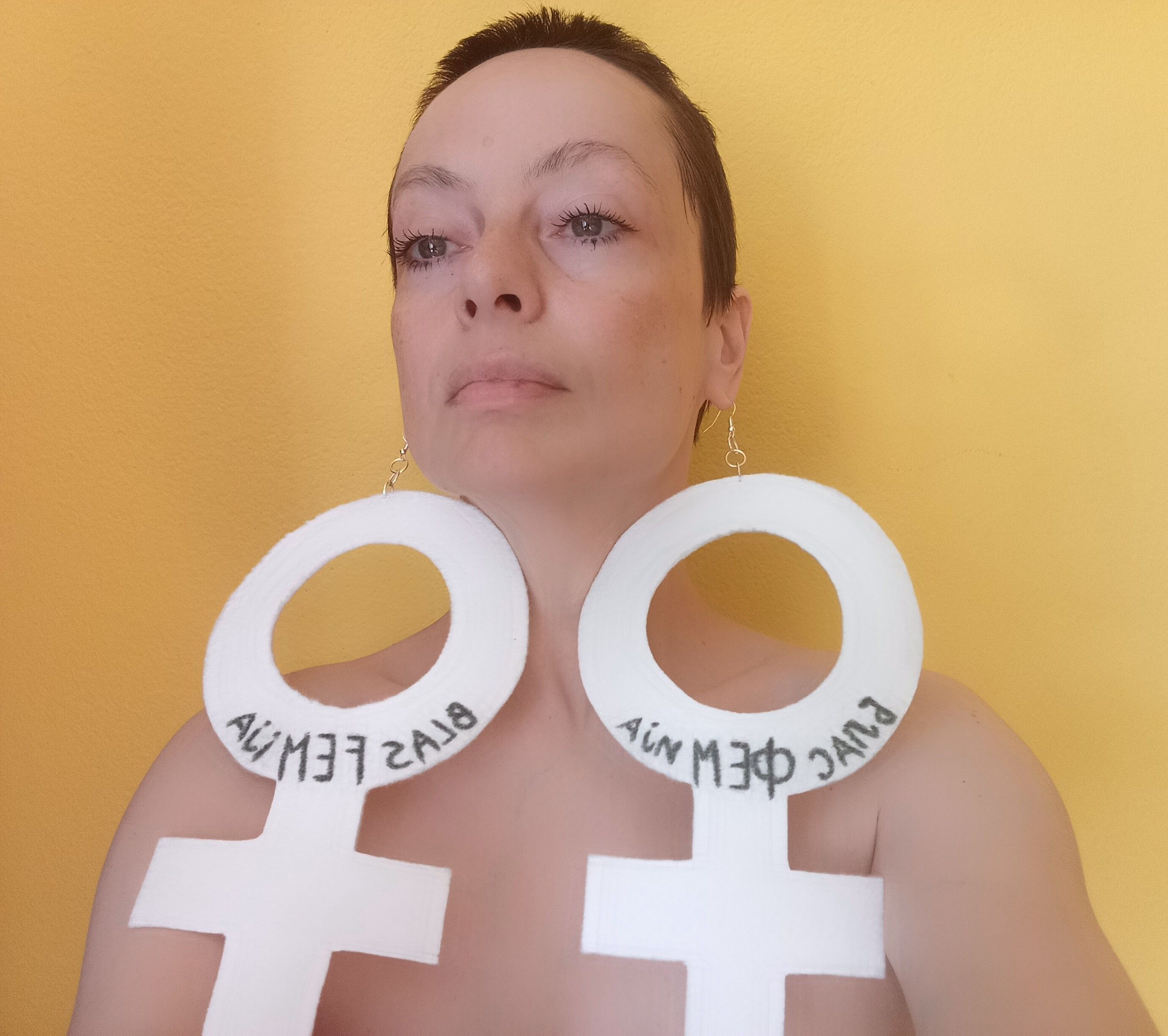 Blasphemy is Feminine. Photo: Dušica Popović
Danilo Prnjat is an artist whose work spans visual art, performance, and artivist practices. He explores alternative economies, progressive social models of cultural work, participatory practices, collective work, and self-organization. He has participated in numerous exhibitions, conferences, and art discussions, realizing various projects and workshops in the region and beyond, including the platform DeMaterialization of Art (2018–2021), the collective Dodatno-dopunska nastava (2017–2018), and Minipogon (2018–2023).
The discussion will be moderated by Dušan Maljković, coordinator of the Center for Queer Studies, an independent cultural worker, and a doctoral candidate in the philosophy of psychoanalysis at the University of Belgrade.
Pride Queer Studies 2025 is jointly organized by
the Center for Queer Studies and the Heinrich Böll Foundation, Belgrade.
Dead Inside, But Still Horny!
An Open Discussion on Dating in the Age of Grindr, Hookup Culture, and Mental Health
Queer Studies 2026
Lecture announcements for the first semester.
Queer Studies 2026. First semester.
In the 2026 academic year, Queer Studies will once again be a two-semester course consisting of 24 lectures, held at the Institute for Philosophy and Social Theory.