The Reconstruction of the Architectural King Kong
Bojan Jevtić
The long-announced and repeatedly postponed closure of the Centre Georges Pompidou for years-long renovation will finally take place this month. If you had the chance to visit the Centre this summer, you would have seen that the “closure” had already begun. In fact, even the last major exhibition, the carte blanche given to German photographer Wolfgang Tillmans, is being held in what used to be the library space; all other parts of this enormous building have already been shut down. Ahead of this multi-year pause (at least five years), many international media have published retrospectives and reflections on the museum’s history and its role in the development of contemporary art — particularly on how this museum democratized and brought modern art closer to the general public.
From today’s perspective, it is hard to grasp just how revolutionary the idea of creating such a centre was for its time. The vision of building a new kind of museum in the very heart of Paris — open to everyone and interdisciplinary in nature — came from President Georges Pompidou, a great connoisseur and lover of contemporary art, who began working on the project immediately after taking office in 1969. It’s important to understand that this was an era marked by heated debates worldwide, especially in France, about the distinction between “high” and “popular” art and about what role the state should play in their development and support. Pompidou advocated the idea that the state — the public sector — should act as a mediator in bringing diverse artistic practices closer to a wider audience. At the same time, this initiative was meant to encourage domestic artistic production, which had always been tied to national prestige and identity. Moreover, since World War II, Paris had been gradually losing its status as the world’s artistic capital, especially to New York; this museum was intended to help restore at least some of that lost prestige. Finally, Pompidou wanted the building to stand as his legacy — an enduring monument reflecting the spirit and tendencies of the latter half of the twentieth century.
The decision to establish the centre was made during the first year of Pompidou’s presidency, and the site of the former Beaubourg district — demolished in the 1930s for sanitary reasons — emerged as the ideal location. The only obstacle was that the site had already been designated for a public library, but this was solved simply by deciding that the library would be an integral part of the new museum. An open competition for the architectural design was announced, notably flexible — even beginner architects could apply, regardless of whether they were affiliated with a studio. Out of nearly 700 submissions, the jury selected the proposal by architects Renzo Piano, Richard Rogers, and Gianfranco Franchini.
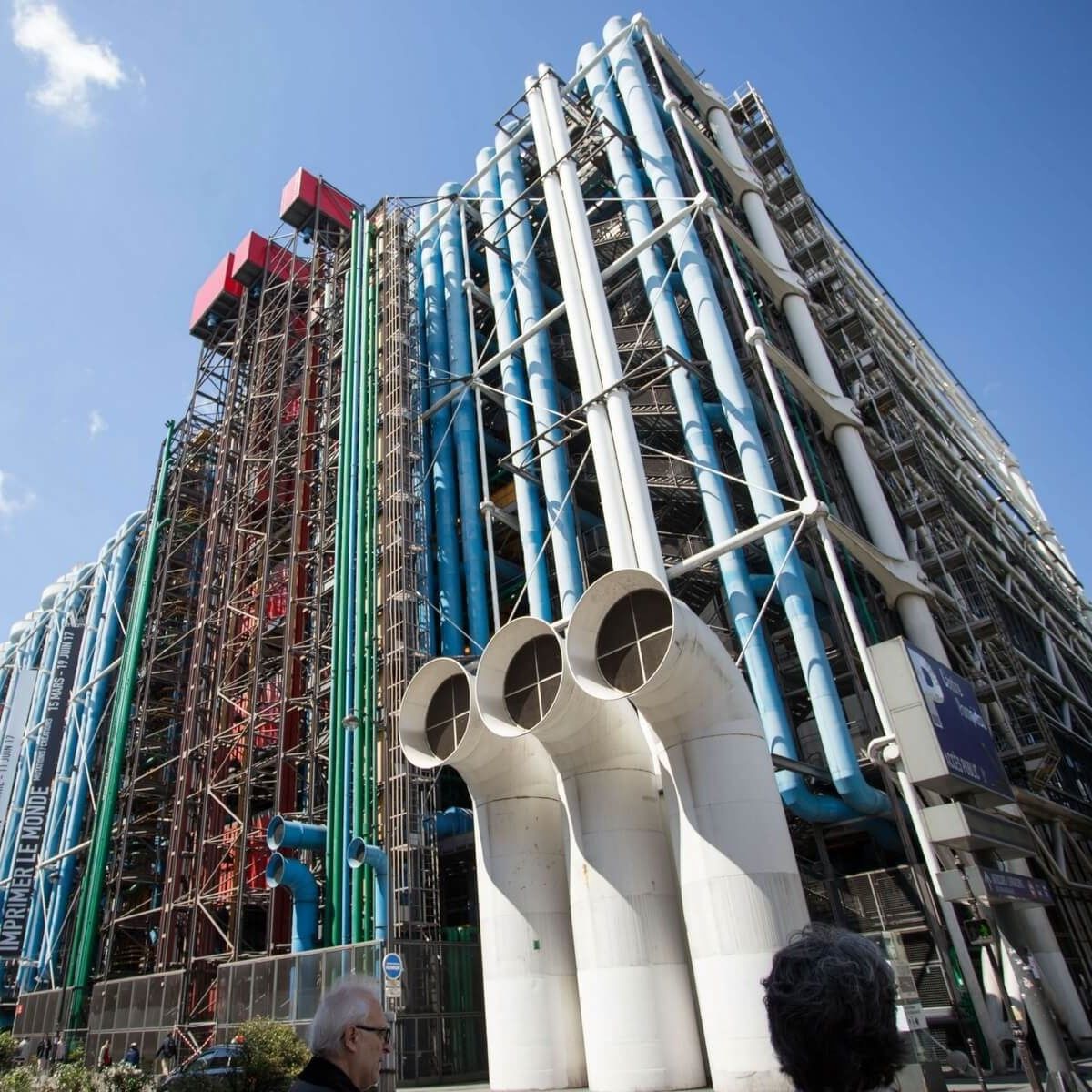
One of their most radical ideas lay in making visible all the infrastructural elements that traditional architecture hides: electrical wiring, ventilation ducts, water pipes, even sewage lines were placed prominently on the building’s exterior. This concept opened up the museum’s interior entirely to the public, while the exterior boldly set itself apart from its surroundings.
The eight floors (two of them underground) cover more than 100,000 square meters of usable space. Construction lasted until 1977 — not without problems (President Giscard d’Estaing even considered abandoning the project) — but the Centre finally opened on January 31, 1977. The reactions were, to put it mildly, divided. Le Monde called it “an architectural King Kong,” while Le Journal du Dimanche remarked that “it takes a genius to make something this ugly with so many complications.” Many critics simply referred to it as “a hangar” or “a gas station.” Yet the public loved and embraced it immediately: instead of the projected 5,000 daily visitors, the museum attracted five times that number in its first year and has remained one of the most visited museums in the world ever since.
The Pompidou Centre became best known for its permanent collection of modern and contemporary art, the richest in Europe. It contains over 100,000 works and lists around 6,000 artists in its catalogue. Beyond that, the “grand” exhibitions organized by the Centre have become milestones of artistic consecration — whether dedicated to the classics of modern art such as Picasso, Braque, or Matisse, or to contemporary artists like Tatiana Trouvé, Sophie Calle, or the aforementioned Tillmans. The Centre has also hosted major thematic exhibitions that have reinterpreted various artistic movements and trends in modern art. Particularly notable were the series focusing on the artistic exchanges and influences between Paris and New York, Moscow, or Berlin. The legendary Magiciens de la Terre exhibition of 1989 was the first on that scale to feature “non-Western” contemporary artists, from Africa to Latin America.
Equally significant were the two major exhibitions on Surrealism (2002 and 2024), the Over the Rainbow (2019) show dedicated to LGBT+ artists, and the major reconfiguration of the permanent collection (2009–2011), which placed women artists at its center. The museum’s most symbolically powerful gesture in recent years was the acceptance of collector Bruno Decharme’s donation of several hundred works belonging to what is now known as Art Brut — works created outside the “recognized” art world by self-taught artists. With this gesture, such works were finally inscribed into the broader history of modern art (a selection from this collection is currently on view at the Grand Palais in Paris).
Of course, once the museum closes its doors, the Centre will not cease its activities. Numerous international and local exhibitions have already been announced, and many of the world’s museums will borrow masterpieces from its collection. As has been emphasized, this will also be a time to redefine the Centre’s role as an institution of both national and global importance.
Published on Radar.rs, September 30, 2025.
Portrait of a Faith-Plumber
If science and technology have enabled the creation of a human being without sex through artificial insemination (‘immaculate conception’), one may expect that they will one day also enable the disappearance of the human being without death.
The Seductive Emptiness of Form
Wilde’s incisive reflections on false social morality perhaps have an even more piercing effect today, in a contemporary society where the boundaries between lies and truths have become still more fragile and porous, and where the obsession with bodily beauty and youth is far more tragic
Bolet and Marie – cryptoqueer Norwegian photography pioneers
The photography exhibition Bolette Berg and Marie Høeg, organised by the Center for Queer Studies, was held at the European House from 15 to 19 December 2025.