Michelangelo, Aretino, and the Sexual Revolution
Goran Gocić
The story begins in Florence, towards the end of the 15th century, when Lorenzo de' Medici founded the first art academy in the world. The Medici family was a bourgeois family, then the wealthiest and most powerful in the Republic. Lorenzo's grandfather, Cosimo, owner of the largest bank in Europe and ruler of Florence from the shadows, was already a patron and collector of art. Lorenzo willingly followed in his grandfather's footsteps: he amassed a collection of art numbering five thousand objects. The Florentine academy was partly inspired by Plato's, and the revival of Plato's teachings - known as Neoplatonism - was the peak of Renaissance intellectual fashion.
The key figure in the revival of interest in Plato in Florence was Marsilio Ficino. In the second half of the 15th century, he translated all known Platonic texts into Latin. It's unusual that a Catholic priest advocated so strongly for the rehabilitation of Plato, whose teachings were suppressed in the Middle Ages. But new times were on the horizon. Fleeing from the Ottomans, Greek scholars rushed to Italy, and Italians reckoned that the enemies of their enemies were their friends. Perhaps Ficino's ideology stemmed from his sexual orientation? If it's true that Ficino was homosexual, the fact that he coined the term "platonic love" speaks not only to how he expressed passions but also why he turned to Plato.
Michelangelo and Neoplatonists: the Florentine gay scene
Fate and luck brought young Michelangelo Buonarroti (1475–1564) to the Florentine Academy, where Ficino taught, when he was only fifteen years old. The Buonarrotis were an old but not particularly wealthy bourgeois Florentine family; his father was a civil servant. Luck that caught the eye of such a powerful patron eluded Leonardo da Vinci. Michelangelo, who lived with the Medici family for five full years, received the favor of the Medici, and his life changed.
Michelangelo studied art from 1490 to 1492. His last year of study was marked by three significant events. First, he carved the Crucifix in wood and gifted it to the Church of Santo Spirito in Florence. The gift was accepted, and it wasn't considered strange that Christ - contrary to church canons - was depicted completely naked. Second, Michelangelo showed an explosive temperament even as an adolescent: he received a blow from a fellow student that left him with a "boxer's nose" for the rest of his life. Finally, that year saw the death of his and Botticelli's patron, Lorenzo de' Medici.
Michelangelo found himself in Florence at the right time and place. Italy was the center of European finance. The Renaissance lasted almost 300 years, and its avant-garde - Dante, Boccaccio, Giotto, Donatello - hailed from Florence. A new, well-organized middle class ruled the republic and imposed its practicality and, it seems, quite worldly taste. Florence in Michelangelo's time was a political, economic, and educational center that nurtured new ideas and cultivated new trends in art.
In the same spirit - which was not insignificant for the temperamental Michelangelo - Florence was liberal regarding sexual orientation. Both he and his Florentine colleagues Leonardo, Sandro Botticelli, and Benvenuto Cellini were publicly accused of "sodomy." We also know that Leonardo, at the age of 24, faced trial for this offense. Before drawing any conclusions, it's important to note that "sodomy" in the Renaissance was still the ultimate slander - something like being accused of being a communist during McCarthyism. Much smoke was raised even when there was no fire; the fact that none of those listed or omitted faced consequences speaks volumes. They were all innocent enough, discreet enough, or sufficiently protected to avoid even symbolic punishment. Cellini, for example, was not only forgiven for sodomy but also for murder.
The sexual orientation of these prominent individuals would not mean much if they didn't have the space to sublimate sexuality through artistic works or, like Ficino, through intellectual work. In the art of the late Renaissance - especially when we speak of Florence and Rome - homoerotic tendencies often came to the forefront. Therefore, neither the practice of homosexuality nor its expression posed a threat to the reputation of artists of that time. The only problem lay in the extent to which Machiavellianism was employed in law enforcement. Michelangelo didn't have to worry about occasionally imbuing even his church commissions with eroticism. It was an occasional desire of his Florentine and Roman patrons, which he fulfilled with more or less enthusiasm: less when the models were women, more when they were men.
Michelangelo's main achievement, like that of the Florentines Masaccio, Donatello, Botticelli, and Cellini, as well as the Venetian Titian, was and remained a re-examination of the body. This aspect of art, suppressed and neglected since the pagan times of Rome, is in itself transcendent. As Bataille says, stripping down to the nude is a confrontation with death.
A matter of time: Pietà (1499)
Michelangelo faced several questions. The greatest demand was the synthesis of Renaissance practicality and Christian mysticism. And since he simultaneously engaged in religious art and strived to be recognizable, he had to reconcile his own subjectivity with the expression of the totality.
On Byzantine icons, figures were freely pasted onto a dazzling background, as if on a collage. Time neither flowed nor was it stopped; the icon gathered the entire lives of the saints and positioned them subjectively in relation to eternity. With the gradual introduction of Euclidean perspective into Western painting and the dominance of a captured moment in time over others - when, in short, "naturalism" prevailed - Christian art was automatically deprived of its most convincing argument. That eternity is above the moment, that eternal life is more important than any momentary pleasure.
Although Giordano Bruno scientifically formulated it only at the end of the 16th century, the "naturalistic" understanding of space and time was already a done deal in Michelangelo's time. Euclidean geometry and the so-called "photographic" compression of space might have still been a challenge for Giotto and his contemporaries in the 13th century; now they were already a standard.
The most acute issue in religious art is the question of time. Continuity is expressed through high stylization and an oath to immutability. Egypt didn't change its artistic canons for at least three millennia; Byzantium remained faithful to its own for a thousand years. It would seem that a glance at the Valley of the Kings or a Byzantine icon conjures eternity with ease. How to reconcile the projection of time into a single point with the demand that paintings and sculptures still be transcendent? That they evoke not only that moment but also a kind of infinity? Of course, Michelangelo wasn't the only one grappling with this practically unsolvable problem; he just positively resolved it. It's unlikely that he was aware of how the new canon of Western art was formed precisely during his lifetime and that he would play a crucial role in it; rather, he spontaneously built upon the work of his contemporaries and advanced it as much as he could. Naturalism in Western art has persisted continuously from the time of the early Renaissance to the present day. It confronted all figurative artists - that is, the decisive majority - with a drastic compression of time and, therefore, with the choice of the moment as the crucial decision. Very few of them - like Michelangelo - even attempted to overcome this inherent, and therefore tragic, limitation of naturalism: to express everything through a blink, to summon eternity through discontinuity.
To solve this practically unsolvable problem, artists were forced to come up with solutions. Michelangelo chose moments of calm before the storm, moments that seemed to extend because they announce something, moments after which a turning point, a significant event, follows. This was Michelangelo's, in accordance with his temperament, dramatic way of addressing myth, religion, and history, and through them, eternity. He brought his marble statues to life not only through mere imitation of nature, through naturalistic prowess, through details previously unseen on hard marble, but also through the critical choice of the moment.
The Pietà with Christ's body in her lap is peaceful, almost serene, as if confident in the resurrection - in the eternal life to come, which is just being announced. David, facing Goliath in a duel, has become still, almost petrified, as if he hypnotizes his opponent whom he will attack and kill in the next moment. Moses has stopped, paused to say something, as if a thunderstorm of God's laws awaits us in the next moment, of which he is the messenger.
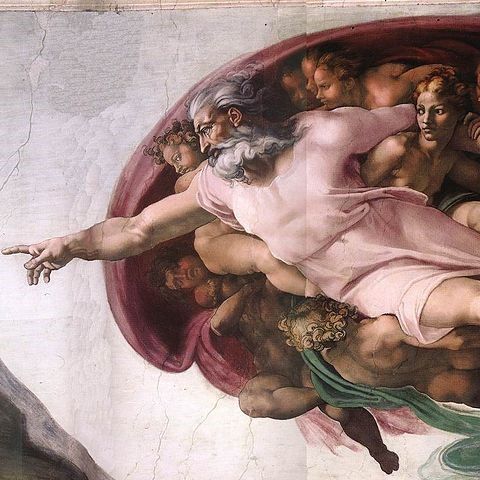
Finally, even God pauses to touch and bestow upon Adam the most precious thing in the Creation of Adam: around God is fullness, around man is emptiness. Michelangelo seems to have suspended time in his sculptures and frescoes, locating it before myth, before religion, even before existence.
David (1504)
Michelangelo first reached Rome through deception. On the advice of an art dealer, he carved the Sleeping Cupid, then patinated it and finally sold it to a Roman cardinal as an antique. The deception was eventually discovered but, as usual when it came to Buonarroti, instead of punishment, he received an enthusiastic invitation to Rome. The result of this trip was an order for the Pietà, the first in a series of Michelangelo's masterpieces. The statue exudes a demonstration of power: as if the young man wanted to show what he knew and what he was capable of. The fabric seems to sway around the two bodies. The ambition to constantly raise the stakes, to continuously surpass not only his colleagues and his time but also his own limits, did not leave him until death. As for his reputation, his future was assured: Michelangelo, who was only 24 years old at the time, immediately became famous. Upon returning to Florence, the city commissioned him to sculpt a statue of young David defeating the giant Goliath. The patrons envisioned the sculpture as a warning to the enemies of the Florentine republic. Michelangelo delivered a giant David defeating small souls. Instead of parading David's courage and severity, Michelangelo subtly shakes off the strong political potential of his subject. His David is not militantly boastful; in this regard, it's surprisingly modest, almost passive, seemingly uninterested in his mortal enemy whom he fixes with his gaze: completely naked, he holds a barely noticeable sling around his shoulder. The observer is confronted with David's much stronger weapon - his self-assuredness, his muscularity, his beauty.
In David, the aforementioned elements come together in a more convincing and aggressive way than in any of the previous or future, given or omitted examples. What's threatening about David is not his hidden weapon. The threat is his dimensions, his power, his potent masculinity; the threat is what the observer feels while standing tiny beneath the marble figure of a muscular naked body seven meters tall. It can be said that the real threat of David is not his dormant strength but his vibrant sexuality. Perhaps it's precisely this that startled his enemy, catching him off guard. Michelangelo didn't emphasize the political intent or the Old Testament lesson; instead, he confronted his contemporaries with what was his own obsession: active and attractive sexual threat. This is especially striking when Michelangelo's work is compared with that of his immediate predecessor, Donatello's entirely feminized David, also commissioned by the Medicis. While Michelangelo's exudes the confidence of a gigolo, Donatello's, in build, pose, and allusion, exudes the seductiveness of a maiden.
It's unclear what dominates in Michelangelo's later David: the moment of his planned attack, his powerful sexuality, his stunning beauty, or the extreme naturalism of his depiction. And David the hero, and David the symbol, and David the ideal of beauty, and David the sculptor's technique - all are simply perfect.
Erotically Charged Works: Battle of Cascina, Dying Slave, and the Medici Chapel
Eroticizing not only ancient but also Old Testament motifs was not solely Michelangelo's achievement but part of an artistic trend sanctioned by Florence at the time. However, he significantly elevated the stakes. Religious art of the late Renaissance, balancing on the edge of implicit eroticism, evidently walked a fine line. But even the most meticulous, if honest, would have to admit that some of the results were monumental. Immediately after David, the city commissioned Michelangelo to paint the Battle of Cascina. Since the soldiers were caught off guard while bathing, the work resembles more a scene from a Turkish bath than the motifs usually used to commemorate significant battles. It seems that Michelangelo had enough confidence to explore his own field of interest regardless of what the patrons requested. And they trusted him enough to give him free rein. In one contract, Michelangelo was given the choice not only of the subject but also the decision of whether to work in sculpture or canvas.
The disproportion between the original purpose and the final result might nowhere be more striking than in the case of Michelangelo's commissions for tombs. The paradox is that the patrons most likely themselves demanded erotic or homoerotic motifs. The sculpture Dying Slave, a marble figure of a muscular young man in a contrapposto pose, looks more like someone offering his half-naked body than someone on the brink of death. Intended for the tomb of the pope, the sculpture was just a tiny advance payment for the most ambitious project ever commissioned to Michelangelo. The tomb of Julius II – who was also rumored to engage in "pederasty" – was supposed to include, in addition to the monumental Moses, a total of 40 sculptures. This papal pantheon was never realized.
The Dying Slave is probably Michelangelo's most explicitly sexual statue – in posture more worthy of erotic sculptures and canvases where models strut, arch, and seduce the viewer, like Titian's Venus of Urbino. Sharing this wondrous vision, both artists were far ahead of their time: such works only became commonplace in the 19th century.
The tomb for the Medici family, commissioned to Michelangelo in 1520, on the other hand, was completed. Lorenzo's son, who became Pope Leo X, had both the resources and the patience to fulfill his and Michelangelo's grandiosity. It was a kind of total design. The room has two sarcophagi for the Medicis decorated with three statues each; the floor and walls are marble. The tomb is known as the New Sacristy.
Michelangelo's design also gives a sense of a betrayed genre – more akin to Hadrian's baths or the interior of an imaginary pyramid than a Christian tomb in the conventional sense of the word. The sculptures of two pairs of nude bodies – Night and Day, Dusk and Dawn – are carved in natural size from blue marble. The figures are muscular; the two women seem like athletes. Michelangelo was reportedly inclined to use male models even for sculptures representing women.
Nobody, however, has synthesized biblical themes and aesthetic ideals of ancient Greece to explore male beauty better than the sculptor, painter, architect, and poet Michelangelo. Probably this ambition would never have been considered so dangerous if it hadn't been so successful. Michelangelo, whose personal stamp secured him the title of the first mannerist in the history of art, was chosen for a practically impossible mission. Using multiple (and often opposing) symbols, he boldly explored questions that his patrons hardly had in mind when commissioning his works.
This was the time when canons and influences clashed and mixed unrestrainedly. When it seemed that art, torn by tensions between two opposing empires and epochs – perhaps came closer to the desired truth. The power of the two most potent artistic genres, which evoke the strongest reactions in us – erotic and religious – the late Renaissance merges and triumphantly elevates to a third, unexpected meaning and the volcanic, magnificent effect of Michelangelo's paintings and sculptures.
From Aretino's "public letters", The Royal Jockey, and Dialogues about Michelangelo's exciting life, we learn a lot from his contemporaries. Georgio Vasari is particularly informative. As the author of the first known art historical book Lives of the Most Excellent Painters, Sculptors, and Architects, he is also one of the Florentine pioneers who entered the history of the 16th century.
Truth be told, Vasari does not comment on the sexuality of Florentine masters. This sacred task will be taken over by a man named Pietro Aretino in Michelangelo's time. He was a writer, and a new type of writer, the inventor of a genre hitherto unseen in Italy. Aretino was – somewhat like Michelangelo – of a defiant character: he behaved as if the world owed him something. Moreover, he – albeit hiding behind powerful patrons – publicly confessed his homosexuality in Rome.
The same attitude could be noticed in his literary works. In the comedy The Royal Jockey, the hero, a homosexual man dressed as a woman, turns out, much to his delight, that the young person is actually a disguised young man. Aretino, a follower of Boccaccio, was one of the shrewdest and boldest self-promoters of the Renaissance and a precursor to parody writers without whom the intellectual life of Europe would become unthinkable – or at least dull.
Even in the Renaissance, rumors spread before him. But Aretino professionalized this activity. He was probably the first European to recognize the potential of the so-called "yellow" press – not only for mocking but also for blackmailing famous personalities, especially in politically sensitive issues and periods.
Aretino, in a way, turned private self-accusation in the confessional into public defamation of the famous and powerful. His first target in one of his attacks was none other than Michelangelo's client from the Medici family, Pope Leo X. Instead of stake, condemnation, or boycott, this made Aretino famous.
He continued to write his satirical pamphlets – a genre now called "open letters". The public was greatly entertained by such writings, and Aretino collected and printed them in periodic collections. The heroes of his brutal satires were powerful cardinals, high aristocrats, and famous artists. His motto, not without reason, was "truth breeds hatred." Often, Aretino used his gift of parody to work for one powerful patron at the expense of another or to resort to blackmail, which, besides hatred, also ensured him substantial income.
One of Aretino's targets was Michelangelo, who gained the nickname "Divine." Aretino allegedly addressed him with the words: "Perhaps you are truly divine, but you should not forget about the male part." However, it is not easy to imagine the Pope's or Medici's response to such allegations. And Aretino was smart enough not to cross certain boundaries. Such as to spoil the commission for one of the most influential families in Italy.
Still, Aretino's epistolary relationship with Michelangelo might serve as a more reliable source for assessing the artist's sexual preferences. In the famous dialogue, Aretino describes the erection of Michelangelo's sculptures in homoerotic terms. And the artist replies with a somewhat evasive remark about the purity of art. Yet, Aretino's letters about Michelangelo are mainly an example of an early modern "creeping tabloidization" – gossip literature for those hungry for scandalous details of the lives of the stars.
In the end, it is worth noting that Michelangelo's sexuality was a subject of rumors even during his lifetime. These rumors were fueled by his recluse character, his dedication to his art above all else, and his lack of interest in conventional romantic relationships. However, definitive evidence about his sexual orientation remains elusive, and scholars continue to debate the matter. Nevertheless, his works, with their sensuality and homoerotic undertones, have left an indelible mark on the history of art, influencing countless artists and thinkers through the centuries.
Erotically Infused Works: Battle at Cascina, Dying Slave, and Medici Chapel
Eroticizing not only ancient but also Old Testament motifs was not solely Michelangelo's merit, but rather part of an artistic manner that Florence had sanctioned at the time. However, he significantly elevated the stakes. Late Renaissance religious art, teetering on the edge of implicit eroticism, clearly walked a thin line. But even the most meticulous, if honest, would have to admit that some of the results achieved were monumental. Immediately after David, the city of Florence commissioned Michelangelo to paint one picture, the Battle at Cascina. As soldiers are caught off guard while bathing, the work resembles more a scene from a Turkish bath than motifs typically used to commemorate significant battles. It seems that Michelangelo had enough confidence to explore his own field of interest regardless of what the patrons requested. And they had enough trust in him to give him free rein. In one contract, Michelangelo was given the choice not only of the subject but also the decision to work in sculpture or canvas.
The disproportion between the original intention and the final result may nowhere be more striking than in Michelangelo's commissions for tombs. The paradox is that the patrons most likely demanded erotic or homoerotic motifs themselves. The sculpture Dying Slave, a marble figure of a muscular young man in contrapposto posture, appears more like someone offering his semi-nude body rather than someone at death's door. Intended for the pope's tomb, the sculpture was just a tiny advance for the most ambitious project ever commissioned to Michelangelo. The tomb of Julius II – who was also rumored to be involved in "pederasty" – was supposed to contain, in addition to the monumental Moses, a total of 40 sculptures. This papal Pantheon was never realized.
The Dying Slave is probably Michelangelo's most explicitly sexual statue – in posture more worthy of erotic sculptures and canvases where models strut, twist, and seduce the viewer, like Titian's Venus of Urbino. Sharing this wondrous vision, both artists were far ahead of their time: such works only became common in the 19th century.
The Medici family tomb, commissioned to Michelangelo in 1520, was, on the other hand, completed. Lorenzo's son, who became Pope Leo X, had the resources and patience to accompany his and Michelangelo's grandiosity. It was a kind of total design. The room has two sarcophagi for the Medicis adorned with three statues each; the floor and walls are in marble. The tomb is known as the New Sacristy.
Michelangelo's design also provides a sense of a disappointed genre – Hadrian's Baths or the interior of an imaginary pyramid rather than a Christian tomb in the conventional sense of the word. The sculptures of two pairs of naked bodies – Night and Day, Dawn and Dusk – are carved in natural size from blue marble. The figures are muscular; the two women appear as athletes. Michelangelo was reportedly inclined to use male models even for sculptures featuring women.
However, no one has synthesized biblical themes and aesthetic ideals of ancient Greece to explore male beauty better than the sculptor, painter, architect, and poet Michelangelo. Probably his ambition would never have been considered so dangerous if it hadn't been so successful. Michelangelo, whose personal stamp earned him the title of the first mannerist in the history of art, was chosen for a practically impossible mission. Using multiple (and often conflicting) symbols, he boldly explored questions that his patrons scarcely had in mind when commissioning his works.
That was the time when canons and influences clashed and mingled unrestrainedly. When art, torn between the tensions of two opposing empires and epochs – perhaps approached closer to the much-desired truth. The power of the two most potent artistic genres, which evoke the strongest reactions in us – erotic and religious – Renaissance art merges and triumphantly elevates to a third, unexpected meaning and the volcanic, magnificent effect of Michelangelo's paintings and sculptures.
Through Aretino's "public letters," The Royal Groom, and Dialogues About Michelangelo's Exciting Life, we learn a lot from his contemporaries. Giorgio Vasari is particularly informative. As the author of the first known art history book, "Lives of the Most Excellent Painters, Sculptors, and Architects," he also belongs to the Florentine pioneers who entered the history of the 16th century.
Indeed, Vasari does not comment on the sexuality of Florentine masters. This sacred task will be taken over in Michelangelo's time by a man named Pietro Aretino. He was a writer, and a new type of writer at that, the inventor of a genre hitherto unseen in Italy. Aretino had – somewhat like Michelangelo – a defiant character: he acted as if the world owed him something. Moreover, he – albeit hiding behind powerful patrons – publicly confessed his homosexuality in Rome.
The same attitude could be noticed in his literary works. In the comedy "The Royal Groom," a homosexual hero is forced into marriage, but to his great joy, it turns out that the young woman is actually a disguised young man. Aretino, a lover of Boccaccio, was one of the most cunning and boldest self-promoters of the Renaissance and a precursor of parody writers without whom Europe's intellectual life would become unthinkable – or at least dull.
Even in the Renaissance, rumors spread before him. But Aretino professionalized this activity. He was probably the first European to recognize the potential of so-called "yellow" print – not only ridiculing but also blackmailing famous personalities, especially in politically sensitive issues and periods.
Aretino, in a way, turned private self-accusation in the confessional into public defamation of the famous and powerful. His first target of attack was none other than Michelangelo's client from the Medici family, Pope Leo X. And instead of burning at the stake, ostracism, or boycott, this made Aretino famous.
He continued to write his satirical pamphlets – a genre now called "open letters." The public was greatly entertained by such writings, and Aretino collected and printed them in periodic collections. The heroes of his brutal satires were powerful cardinals, high aristocrats, and famous artists. His motto, not without reason, was "truth begets hatred." Often, Aretino used his gift of parody to work for one powerful patron against another, or to resort to blackmail, which, apart from hatred, also brought him considerable income.
One of Aretino's targets was also Michelangelo, who earned the nickname "Divine". Aretino allegedly addressed him with the words: "Perhaps you are truly divine, but you do not disdain male partners." He did not spare the neoplatonists either. His erotic novel Dialogues is a parody of popular neoplatonic writings. An experienced woman (possibly Aretino's parody of Socrates?) describes three career options for her young daughter: nun, wife, and prostitute. The Dialogues are set in a brothel, and the choice between the options offered is only nominal, as each provides an opportunity for sexual excess.
Aretino's and Romano's Positions (1527)
Together with the painter Giulio Romano, Aretino managed to approach the contemporary idea of pornographic literature in the 16th century, even to some extent the concept of men's magazines. As much as the rationality and naturalism of the late Renaissance clashed with the Christian mysticism of the Middle Ages, its commitment to nature and accurate proportions favored erotica. In other words, the less stylized and more true to nature, the more convincing, exciting, and sensual the erotica.
Turning towards eroticism, even in Christian or patriotic themes, was, so to speak, a logical outcome of the change in understanding of space and time in the Renaissance, the revival of antiquity, and the secular atmosphere fostered by the bourgeois class. Michelangelo, Romano, and Aretino applied this more openly in practice than others.
Drawings decorated the works of both good and worthless writers of erotic literature. In one paradigmatic case, namely, the process was – as it seems everything else with Aretino – reversed. At a time when he was sharpening his pen in the early 16th century, Raphael's pupil Romano made sixteen explicit engravings of couples in love embraces. The series was remembered under the name Positions.
Vasari informs us that after Raphael's death, Romano was celebrated as the best painter and designer in Italy. And for him, as for Michelangelo, it was said that he was "capricious and genius" and that he could paint religious themes as well as Venus, Eros, and Psyche bathing "as if they were alive".
According to some sources, hanging Positions on the walls of the Vatican was an act of mischief – alleged revenge by Romano for unpaid fees. Judging by today's standards, the drawings give a dignified, elegant impression. They seem to follow Michelangelo's motto that figures in paintings should look like good statues. And indeed, the heroes of Positions seem like Michelangelo's sculptures engaged in lewd acts. Romano just caught them in the act like a paparazzo.
Whether it was an order, caprice, or revenge, it doesn't matter – the drawings were quickly removed from the sacred walls of the smallest state in the world and destroyed. Romano remained unpunished, but printer Marcantonio Raimondi was imprisoned when he later attempted to sell copies in printed form.
The case fell under the jurisdiction of Renaissance parody as soon as it reached Aretino. He first managed to secure Raimondi's release from prison. The writer added one sonnet for each of the sixteen engravings whose heterosexual couples – Mars and Venus, Bacchus and Ariadne, and so on – all belonged to antiquity. The result was a new publication published in 1527, entirely in line with contemporary notions of erotic printing. This is probably the point where Renaissance art came closest to modern understanding of sexually exciting material.
Because of this book, Aretino had to flee from Rome. But that year was nevertheless the beginning of the end, and even those who behaved impeccably had to flee Rome. Charles V embarked on a military campaign against Pope Clement VII – the same Medici who had commissioned a design for the Laurentian Library in Florence from Michelangelo four years earlier. Michelangelo worked on the project until 1534 when he left the city.
Michelangelo himself would await a phase of Christian remorse and repentance, which again was entirely in keeping with the times. In 1542, the Inquisition resumed, censorship of the press was introduced the following year, and in 1555, an index of banned books was established. The Council of Trent in 1563 redefined Christian art and brought it back under the auspices of Catholic doctrine. No longer were genitalia, buttocks, or breasts allowed to be depicted, and all future painters employed by the church, like papal political commissars, would be overseen by theologians. Michelangelo died the following year, but in those conditions, the activities of people like him and Aretino would become impossible. But the spirit was out of the bottle. Behind them would remain a movement that fundamentally redefined the direction of Western painting.
Posthumous censorship of Michelangelo and the Renaissance
It may be that even Michelangelo's work alone gives us enough indications of his sexuality. When he speaks and sings about himself, he appears as a man of deep emotions, eager for proof and torn by passions. The fact that he was introverted, that he left behind such a body of work, and completed it with three hundred sonnets, perhaps suggests that all traces of his passion remained deeply buried in his art – that, in other words, Michelangelo privately resembled Ficino more than Cellini.
In the Buonarroti family archive in Florence, a message was found in the margin of Michelangelo's poems. It was written by Michelangelo the Younger, who was Michelangelo's great-nephew. He advises that the sonnets should not be published as they are because they express "male love." Furthermore, the great-nephew was not lazy; while preparing the manuscript for posthumous publication in 1623, he changed all the male pronouns to female ones.
This wasn't the first time the family, concerned about the reputation of their deceased prominent member, censored his legacy. One of the more extreme cases was that of the widow of Sir Richard Burton, the Victorian translator of Eastern erotic texts. Mrs. Barton was more radical than Michelangelo the Younger: she autonomously burned all her husband's unpublished manuscripts. Similarly, before his death, Michelangelo himself did the same with most of his. David was treated similarly to the sonnets. Initially, he was to be proudly displayed high above the ground, on one of the supporting columns of the city cathedral. The idea was abandoned, and he was first placed in front of the Old Palace of the Medici family as a symbol of Florence. Eventually, he ended up locked in a separate space in the Florentine Academy. Was the intention to protect David from the rain or from the gaze?
But even in his solitude, in the closet, so to speak, David's sexual threat is evidently still alive and well, so emphasized that it arouses passions even as a reproduction. A shop owner in Sydney, who hung a photograph of David in his shop window in 1970, was arrested. Similar incidents occurred in South Africa in 1973. And when the city of Florence offered a copy of Michelangelo's statue to Jerusalem as a gift in 1995, Israeli city authorities politely declined the Italian kindness. True, the British accepted an identical gift in the mid-19th century, but they regularly "dressed" it with fig leaves before each visit by Queen Victoria.
Compared to the Borgias at the turn of the 15th to 16th century, all subsequent popes appeared as ascetics. Julius II sealed off the chambers of Pope Alexander VI and covered his portraits. With equal disgust, the Holy See discreetly rid itself of the Slave on his deathbed, which he had commissioned: the sculpture is now in the Louvre. Pope Paul IV issued a bull in 1557, during Michelangelo's lifetime, regarding the placement of fig leaves over the indecent parts of sculptures in the Vatican. The same year Michelangelo died, the failed censorship of his fresco, The Last Judgment, began. The noble work of refining Renaissance and antique art would continue in the 17th and 18th centuries: popes would still have their hands full. They would all be surpassed in zeal by Pius IX, who in the 19th century simply destroyed all remaining nudes from the Vatican collection.
These anecdotes have at least one Serbian parallel. Looking at the translation of Plato's dialogue Gorgias, it turns out that the part where Socrates discusses homosexuals was simply omitted. Whether this nonsensical censorship intervention was the work of the translator or came from the mind of an overly zealous editor is always a possibility. After all, there is always the possibility that Socrates posthumously corrupts the youth.
Michelangelo is the most celebrated and documented artist not only of his time. His Creation of Adam and Leonardo's The Last Supper are the two most exploited paintings in Western art. At the same time, the reason why Michelangelo's works have continued to provoke discomfort and practically haven't "come out of the closet" to this day is his double allegiance, to the sacred and the profane world. No decree, mutilation, or dressing can prevent him from knocking and entering both doors. In its entirety, Michelangelo's works transcend any individual mission of his heroes – whether prophets, Platonic lovers, warriors, caricatures of his enemies, handsome men, idealized men, or sexual objects. It seems that the only measure of David can be David himself, the only measure of Michelangelo, Michelangelo himself. Neither sonnets, nor Slave on his deathbed, nor David, nor The Last Judgment could be restrained in any context – artistic, sexual, religious, political, or any other. They represent a kind of discontinuity. And the perfection of Michelangelo's gift somehow conditions his miraculous loneliness.
Renaissance Genius: The Legacy of the Late Renaissance
Neoplatonists advocated Plato's idea of the genius, the spirit that enters the poet and compels him to create in a kind of enchantment, trance, or divine inspiration. Under this banner, Renaissance artists gained unprecedented artistic sovereignty – and the fame that followed them closely. Artistic work now sought totality not through some universally accepted or official style, as was the case with Byzantium or Egypt. The Renaissance craved for expression that was primarily individual. Behind this kind of view stood one person, with their own vision of the world. What was most important was consistency with one's own inspiration and personality. In other words, Mannerism was born in Florence, and its legitimate father was recognized as Michelangelo.
From the late 15th to the first half of the 16th century, artists like Michelangelo (or his main competitor for the title of the first Renaissance genius, Leonardo), approached their work as if they wanted to recreate the world anew. Perhaps the most tangible evidence of this ambition is precisely Michelangelo's work on the vast ceiling of the Sistine Chapel in the Vatican. Instead of the commissioned Last Supper with thirteen figures, the monumental composition, at Michelangelo's suggestion, spans five hundred square meters and features three hundred characters from the Old and New Testaments.
The coin on whose face this mighty freedom shone had another side. Renaissance freedom was just a nice way of saying that artists were actually thrown onto the market to fend for themselves. For the best among them, including Michelangelo, or perhaps just the most notorious, like Aretino – orders poured in. For the less vocal, without the ability to flatter powerful patrons, less skilled in self-promotion and manipulation of opinion, there was no place.
Some of the finest artists of the Renaissance, such as Masaccio, Filippo Lippi, and Paolo Uccello, died in poverty, while others, like Michelangelo, received astronomical sums for orders. For his work on the Sistine Chapel, he was paid 3,000 ducats, enough to live high on the hog in Florence for ten years. Both the Middle Ages and the Renaissance, until Michelangelo, were based on fixed rates and strong guilds. It was unfair that the most talented were paid the same as the average, and that no distinction was made between art and craftsmanship – but, as in socialism, at least then no one went hungry.
The new canons of Western art, set in the Renaissance, will not be significantly revised in Europe until at least the 19th century; many of them, such as the dictates of the capricious hunger of the market, still apply today. Perhaps the most enduring matrices are the ideas of spiritual ownership and artistic autonomy that were formed and defined by striking individuals like Aretino and Michelangelo. Artistic freedom will, in the centuries to come, with varying success, strive to become absolute. This is also in some way a papal idea, analogous to the doctrine of papal infallibility, which has remained unquestionably valid throughout the West. It still holds true today – although the occasional exemption of brilliant artists from prevailing laws, as was initially applied in the Renaissance, has somewhat hypertrophied over time and in some cases even led to caricature.
The question arises as to why the Catholic Church opened the door to such excesses in Florence exclusively in the last decades of the 15th and early 16th centuries. Why did it burn Giordano Bruno at the stake in 1600, who merely shaped and formulated the teachings on time and space that had been de facto applied in Italian painting practice for 350 years? Why did Florence not view the dramatic introduction of homoerotic elements into Christian art as something negative until the Council of Trent? Perhaps the Medici family was most responsible for this strange stylistic schizophrenia in Florence at the end of the 15th and beginning of the 16th centuries, as they had been patrons of Donatello, Michelangelo, Botticelli, and other artists for generations. The taste of the Medicis was worldly, inclined towards luxury and eroticism, and that is precisely what Michelangelo had been supplying them with for years: lascivious Dawn, naked David, and the Florentine army of sans-culottes. But the norms of the time required benefactors to gift the city with a church or chapel – something that at least nominally had a religious purpose. From this tension between private taste and public expectations arose the great and far-sighted art of the late Renaissance, which was torn by contradictions and reconciled the irreconcilable.
Western art – starting precisely from religious painting – generally speaking, underwent significant transformation during this period. In the centuries that followed, it would continue, with varying success, on the path of eroticization and profanity, with the ambition to suppress former severity and didactic function. The center of erotic production would be transferred from the Fontainebleau Castle to France by the Italians. What the late Renaissance announced may not be today's pornography, but it is the desire of Western art to "beautify" itself, to become tactile, sensual, and self-indulgent, to seduce at the cost of becoming saccharine and sinking into kitsch, to be aggressively appealing, and ultimately to become a decor stimulating the senses, immortalizing a new class and spoiling a new audience. All of this would please not only the new bourgeois elite of Florence, whose criteria were predominantly secular and often hedonistic, but also the emerging courtly and aristocratic painting of Europe.
Epilogue
Oswald Spengler, in "The Decline of the West," observes that the Renaissance is the most tragic decline and the lowest point of Western art. Looking at David, a completely opposite view seems to emerge. Greedily seizing the point of highest synthesis between the secular and spiritual spheres, and the noblest, most valuable possible totality that art can offer us – at the point where erotica meets religion, and the profane approaches the sacred – the late Renaissance can be seen as one of the highest flights, if not a brief triumph, of Western art.
Perhaps the theses of Spengler and Russian Byzantologists are indeed art historical ideologies that it would be wise for us from these regions to advocate. Judging by Serbian monasteries and churches, we did have great medieval artists, but we slept through the Renaissance, literally in the most literal sense, under the vigilant Islamic masters. Perhaps, therefore, our enthusiasm for the Renaissance from afar – as in the case of the Russians – is a kind of nostalgia for the unexperienced or a search for the miraculous. In this light, the historical fate of the group of peoples to which we belong, deprived of the Renaissance and whose development of the middle class and its taste was further hindered by the idea and practice of communism, becomes somewhat clearer. We seem to still adhere to the medieval idea that all artists should be paid the same; as if families of patrons like the Medici are just emerging; as if diplomacy and banking are deferred for a better future; as if tabloid journalists with a literary gift equal to Aretino's are yet to be born; as if homosexuals are yet to gain citizenship rights; as if erotic or, God forbid, homoerotic art that will have achievements even remotely comparable to Michelangelo's is yet to be cultivated. These ambitions, long conquered by the Italian late Renaissance, are painfully absent throughout the Byzantine sphere of influence, from North Africa to Russia. While tourists line up outside the Uffizi Gallery, admiring the canvases of Botticelli and Michelangelo hanging on its walls, marveling at the Medici tomb, raising their gaze to Giotto's modern-designed bell tower, and finally squeezing in to see David – it seems quite certain that the Florentine initiative in the late Renaissance contributed unexpectedly much to the world that knows how to judge so strictly. After all, the old city of Florence is the most beautiful city I have ever seen.
Footnotes:
1 Crucifix of Santo Spirito (painted wood, 1492), Basilica of Santo Spirito, Florence.
2 After Masaccio's Expulsion of Adam and Eve from Paradise (Cacciata dei progenitori dall'Eden, fresco, 1425), nothing in Florence could surprise anyone, no one dared to criticize the Medici household's protege, it might be argued that the sculpture is not Michelangelo's at all, but this conclusion is drawn solely based on the age of the work and the nudity of the figure - leaving us to speculate.
3 The transition from the fifteenth to the sixteenth century was extraordinarily exciting: it will be marked by European thought revolutionaries like the Florentine Niccolò Machiavelli, the German Martin Luther, the Frenchman François Rabelais, and the Dutchman Erasmus of Rotterdam.
4 The same applied in Rome to the writer Pietro Aretino and Pope Julius II. The law treated sodomy in the same way regardless of whether it was committed with a man or a woman.
5 Cellini, perhaps the most vivid among the described personalities, appears to have been bisexual. The same likely applies to Botticelli, who is remembered for the tender, lyrical heroines of his paintings Birth of Venus (Nascita di Venere, 1485) and Primavera (1482) - both in the Uffizi Gallery, Florence. It is not excluded that in Botticelli's case, it was slander.
6 Georges Bataille, Eroticism (L’erotisme), Official Gazette, Belgrade 2009.
7 It refers to naturalism in the broadest sense, as a more faithful imitation of nature.
8 One example is Johannes Vermeer, although the effect with him was achieved by completely different means.
9 Pietà (marble, 1499), St. Peter's Basilica, Vatican; David (marble, 1504) Florence Academy, Florence; Moses (marble, 1515), Church of San Pietro in Vincoli, Rome; Creation of Adam (fresco, 1512), Sistine Chapel, Vatican.
10 Goliath's death could have been a more somber warning - in Caravaggio's later canvas, David with Goliath's Head (Davide con la testa di Golia, oil on canvas, 1610), for example, David proudly holds the severed head of his giant opponent as a trophy.
11 When measured together with the pedestal. Without the pedestal, it measures 517 cm.
12 David (bronze, 1440), National Museum Bargello, Florence.
19 Sagrestia Nuova (marble, 1534), Basilica of San Lorenzo, Florence.
20 Night, Day, Twilight, Dawn (marble, 1534). New sacristy, Basilica of San Lorenzo, Florence.
21 It is possible that Donatello worked in reverse.
22 Giorgio Vasari, Lives of the Most Excellent Painters, Sculptors, and Architects (Le Vite de' più eccellenti pittori, scultori, e architettori da Cimabue insino a' tempi nostri, 1550), Belgrade, Libretto 2000.
23 Il marescalco (1533) in: Pietro Aretino, All Comedies, Mursia, Milan 1968.
24 Aretino likely influenced his contemporary Rabelais (who traveled to Rome several times in the early sixteenth century). Rabelais marks the beginning of a line of great European satirists, such as Cervantes and Swift. Aretino himself is a link between Boccaccio and De Sade.
25 Marshall McLuhan, The Gutenberg Galaxy, The Making of Typographic Man, Nolit, Belgrade 1973.
26 The Florentine monk Savonarola was the Italian version of Luther. He ended up on the stake in 1498 for attacking the Medicis, for the corruption of the Catholic Church, and its earthly representative.
27 Veritas odium parit, cited from: Pietro Aretino, Dialogues (I ragionamenti, 1536), Prosveta, Belgrade 1983.
28 The Divine.
29 He also mentioned the names of several of Michelangelo's lovers. Rictor Norton, "The Passions of Michelangelo," Gay History and Literature, updated 14 June 2008. http://rictornorton.co.uk/michela.htm. However, Norton does not cite his sources.
30 Aretino 1983, same.
31 I Modi literally means ways.
32 Otherwise, Michelangelo's greatest rival. They worked on decorating the walls of the Vatican at the same time. Michelangelo claimed that Raphael had tried to poison him.
33 Vasari, same.
34 Pope Clement VII also ordered the originals to be burned, but the works survived this purge through copies. So, even a Medici had his limits of tolerance.
35 Pietro Aretino, Lewd Sonnets (1527), Prometheus, Novi Sad/Jefimija, Kragujevac 2003.
36 Michelangelo, Sonnets, Belgrade, Rad 1969.
37 Virile Love.
38 Rictor Norton, "Michelangelo and the Label 'Homosexual'," http://rictornorton.co.uk/though19.htm. (last accessed 31. 1. 2017.)
39 Sir Richard Burton (trans.), The Kama Sutra of Vatsyayana/The Ananga-Ranga of Kalyana Malla/The Perfumed Garden of Sheikh Nefzawi, Hamlyn, London 1990.
40 Palazzo Vecchio.
41 Peter Webb, The Erotic Arts, Farrar, Straus, Giroux, New York 1983.
42 The Last Judgment (fresco, 1541), altar, Sistine Chapel, Vatican.
43 Compare Plato, Protagoras, Gorgias, Culture, Belgrade 1968. and Plato, Gorgias in: Complete works (John M. Cooper, ed) Hackett Publishing. The controversial part is 494e.
44 Volta della Cappella Sistina (frescoes, 1512). Hauzer, same.
45 Hauzer, same.
46 Hauzer, same.
47 Oswald Spengler, The Decline of the West (Untergang des Abendlandes, 1918/1922), Literary Gazette, Belgrade 1990.
Literature:
- Georges Bataille, Eroticism, Official Gazette, Belgrade 2009.
- Arnold Hauzer, Social History of Art and Literature, Culture, Belgrade 1962.
- Giorgio Vasari, Lives of the Most Excellent Painters, Sculptors, and Architects, Belgrade, Libretto 2000.
- Pietro Aretino, All Comedies, Mursia, Milan 1968.
- Marshall McLuhan, The Gutenberg Galaxy, The Making of Typographic Man, Nolit, Belgrade 1973.
- Pietro Aretino, Dialogues, Prosveta, Belgrade 1983.
- Rictor Norton, "The Passions of Michelangelo," Gay History and Literature, updated 14 June 2008. http://rictornorton.co.uk/michela.htm.
- Pietro Aretino, Lewd Sonnets, Prometheus, Novi Sad/Jefimija, Kragujevac 2003.
- Michelangelo, Sonnets, Belgrade, Rad 1969.
- Rictor Norton, "Michelangelo and the Label 'Homosexual'," http://rictornorton.co.uk/though19.htm. (last accessed 31. 1. 2017.)
- Sir Richard Burton (trans.), The Kama Sutra of Vatsyayana/The Ananga-Ranga of Kalyana Malla/The Perfumed Garden of Sheikh Nefzawi, Hamlyn, London 1990.
- Peter Webb, The Erotic Arts, Farrar, Straus, Giroux, New York 1983.13.
- Plato, Protagoras, Gorgias, Culture, Belgrade 1968.
- Plato, Gorgias in: Complete works (John M. Cooper, ed) Hackett Publishing, Indianapolis, 1997.
- Oswald Spengler, The Decline of the West, Literary Gazette, Belgrade 1990.
Portrait of a Faith-Plumber
If science and technology have enabled the creation of a human being without sex through artificial insemination (‘immaculate conception’), one may expect that they will one day also enable the disappearance of the human being without death.
The Seductive Emptiness of Form
Wilde’s incisive reflections on false social morality perhaps have an even more piercing effect today, in a contemporary society where the boundaries between lies and truths have become still more fragile and porous, and where the obsession with bodily beauty and youth is far more tragic
Bolet and Marie – cryptoqueer Norwegian photography pioneers
The photography exhibition Bolette Berg and Marie Høeg, organised by the Center for Queer Studies, was held at the European House from 15 to 19 December 2025.