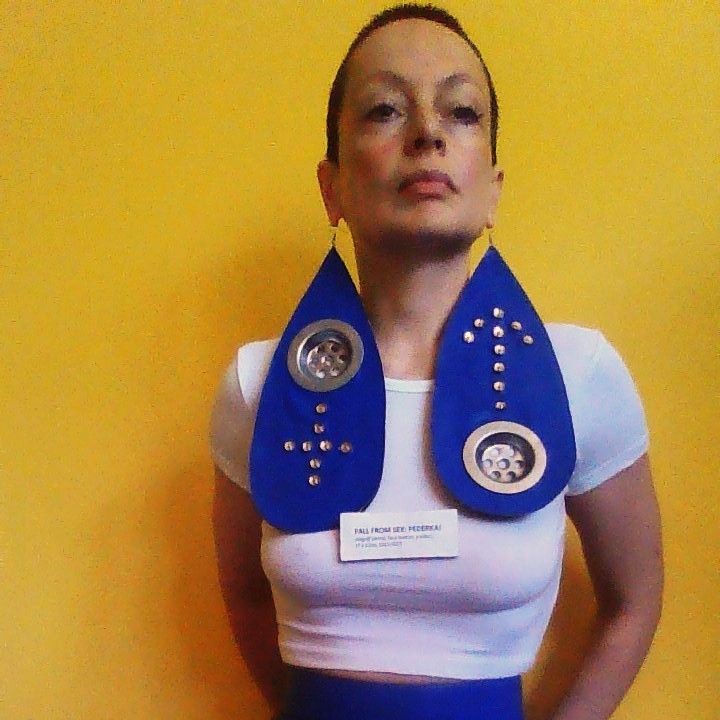
Fall From Sex: She-Fag!
Dušica Popović
OTOGRIFISM
Otogrifism is an artistic direction whose theory and practice I have been developing for many years. This involves performing five different functions at the same time, as I am the author, theorist, curator, exhibition space, and epigone of my art. The name of the direction is a neologism consisting of the words "oto" (Greek for ear) and "griff" (German for grip), which can literally be translated as ear grip. The direction is called this because it deals with otogriffs, objects that are worn on the ears (although there are sub-genres like hat-earrings or brooch-earrings). Otogriffs contain aspects of sculpture (due to their three-dimensionality); installation (because of the heterodoxy of materials); jewelry and accessories (otogriffs are "blind" or "clairvoyant" travelers in the land of accessories); and performance (otogriffs imply performativity, i.e., time as a kind of packaging in which they are exhibited, but not as their constitutive element, as is the case in performance art, since they are pre-made objects). Each otogriff (except the epigones) is accompanied by a legend containing the title of the work or its thematic backbone, the name of the object, the material, the year of creation, and dimensions. The legend is important because it helps carve out my own infinitesimal space between art and life, as I exhibit my works exclusively on myself. Thus, otogriffs function as a kind of "customs" where art and life evaluate each other, and each lets in the selected duty-paid goods, i.e., those constructs and affects that it considers operational in its domain. In this way, otogrifism positions itself equidistant from both institutionally housed and "homeless" art as life, which is also an institution today. The themes of otogriffs are always formulated as ironic visual comments; they deal with recognizing and ARTiculating the self-sabotage of contemporary society through satirical building, more precisely "Bildung" of contemporary trends. However, although each otogriff has its basic starting point, it remains open to different interpretations and, ideally, should spark a debate on the given topic. A Manifesto of Otogrifism is also in the works, in which I will address the poetics of the direction from the perspective of its visuality, semantics, presentation, reception, and art-historical references.
Here, an otogriff that thematically aligns with the concept of this portal will be presented.
Know who you are and adorn yourself accordingly.
Epictetus
The otogriff "FALL FROM SEX: SHE-FAG!" consists of pins and drain grates in the shape of the symbols of Mars and Venus, the male and female gender symbols, on a blue background. Everything, of course, begins long ago when we "leaked"[1] from Paradise, along with the "dirty" water of our disobedience, i.e., our desire for knowledge. Taught by the burdensome life or "punishment" as a consequence of that act, we subsequently built an entire "sewage system" of repression, to drain away suspicious impulses, preventing further moral contamination (i.e. self-awareness). But the inexhaustible disobedience as a permanent anthropological trait forced us a second time to overflow through the bottlenecks of the previously prevailing gender prejudices into the no man's land of post-gender identities. Yet, after the paradisiacal unconsciousness and patriarchal false consciousness, are we finally on the path to consciousness? Despite the increase in the number of genders/sexes and sexual preferences in the emerging gender-ornamental and gender-recreational order, we live similarly to before—as if all these changes do not have particular existential weight. In the quest for emancipation, we strive for the impossible through (mere?) mechanical multiplication of the possible, thus actually falsifying the impossible.[2]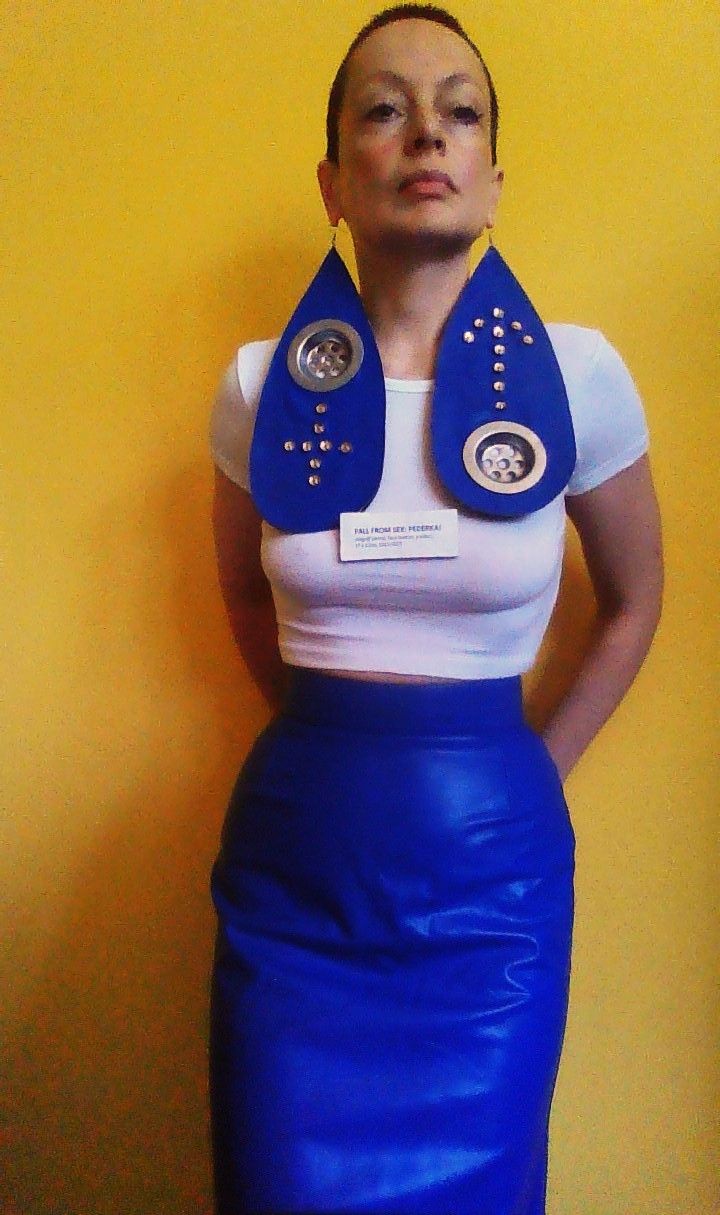
On the other hand, Alain Badiou claims: "[...] the great 'yes' that the reality of the world declares under the pressure of the event is always a promise that something previously impossible is possible. And in that sense, we can say that happiness is always the enjoyment of the impossible."[3] As a '68er, Badiou's starting point is certainly the slogan of the student and worker protests of that time: Be realistic, demand the impossible. So it seems that Badiou is suggesting that we should insist on something that currently seems impossible as a prefiguration of something that will be possible in the future. Unlike the previously mentioned approaches, this otogriff explores those forms of the impossible that are neither (only) nostalgia for the impossible freedom (?) nor a proposal for the future. It is the impossible as a code of rebellion against both gender (and any other) rigidity and the arbitrariness of allegedly unconditioned free choice. The word "she-fag" is a symbol of irreconcilability and an affirmation of the impossibility in itself, which will not be overcome by the possible over time because it is not in a dialectical relationship with it, but despite that, it calls for less humility towards the possible. Because in our age of the dominance of the hypertrophied possible, the impossible needs to be smuggled in. SHE-FAG suggests such an initiative: how to (remain) a cis woman under queer conditions,[4] by consistently implementing feminist language politics regardless of any petty objections. And whether this is an advanced political correctness or (self-)parody; to what extent it is possible to conquer/seduce the impossible; whether the impossible is an overrated or underestimated emancipatory "capital"... remain open questions.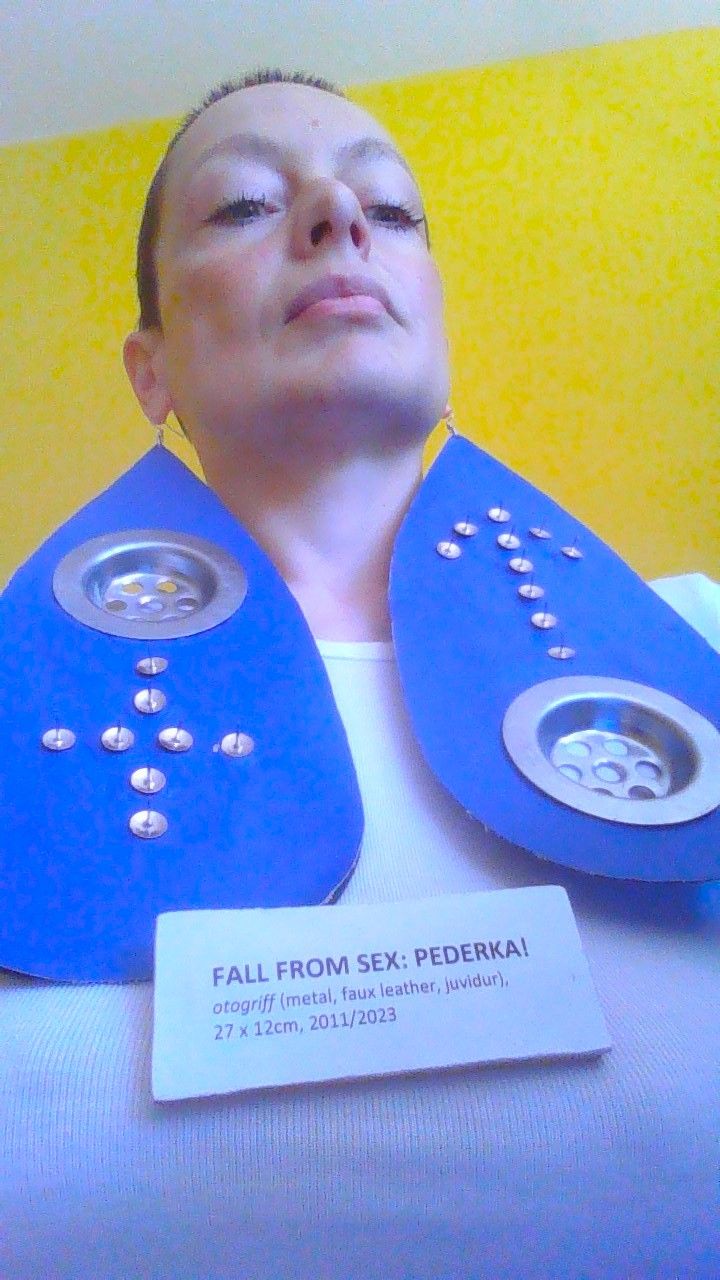
*Thanks to its absolute manipulability, contemporary digital photography has led to the forgetting of the referent and thus to a crisis of testimoniality. Therefore, the visual imperfection of these photographs is a paraphrase of the photography from the time when it could be trusted, conditionally speaking, in the function of information and documentation, modeled on the former even more imperfect reproductions of works of art. Consequently, it is implied that these photographs should not be understood as artworks in themselves (in the sense of documentation of art as art).
Notes:
I use the feminine gender as the generic gender, except where otherwise indicated.
This approach differs from, for example, the "apotheosis" of the Impossible, which surrealism resorted to. Surrealism naively believed that the impossible was a principle of absolute freedom of expression and that it resided in the unconscious. Surrealists (and some she-surrealists) believed that the philistine mentality of the early twentieth century could be defeated by mere inversion: instead of the supposedly narrow rationality of the conscious, it was necessary to place the unbridled, semantically irresponsible irrationality of the unconscious, where irrationality was considered synonymous with creativity (over time, however, it became clear that it was wrong to equate irrational and creative, and that the irrational can also be narrow and totalitarian).
Badiou, A. (2015) Metaphysics of Real Happiness, Belgrade: FMK, p. 46.
The term "she-fag" could potentially (mis)be used to denote a man who has changed or adapted their gender to become a woman, while remaining attracted to men. Similarly, the same term could potentially (mis)be used to denote a woman who has changed or adapted their gender to become a man, while remaining attracted to men. However, in both cases, it would be about possible and even today standardized perspectives of fluid gender and sexual character. But in this paper, I do not start from such fluidity, but from a female "imperial" perspective or an expanded field of femininity, observing the entire gender and sexual spectrum from a female, de-essentialized but (proto)universal rather than particular position (as it has always been until now). Accordingly, in the contemporary so-called post-gender and post-sex world, this otograph does not rest on mere hybridization of gender and sexual determinations, but on observing one's own "unproblematic" cis identity from a "problematic", impossible (queer) angle.
Another example could be a sequence from Woody Allen's film Hannah and Her Sisters, where Allen's character at one point tells his future partner that she is polymorphously insensitive. Of course, this phrase in the film parodies Freud's description of a young child as a polymorphous pervert, but it can also be seen as a form of the impossible that I am talking about in this work.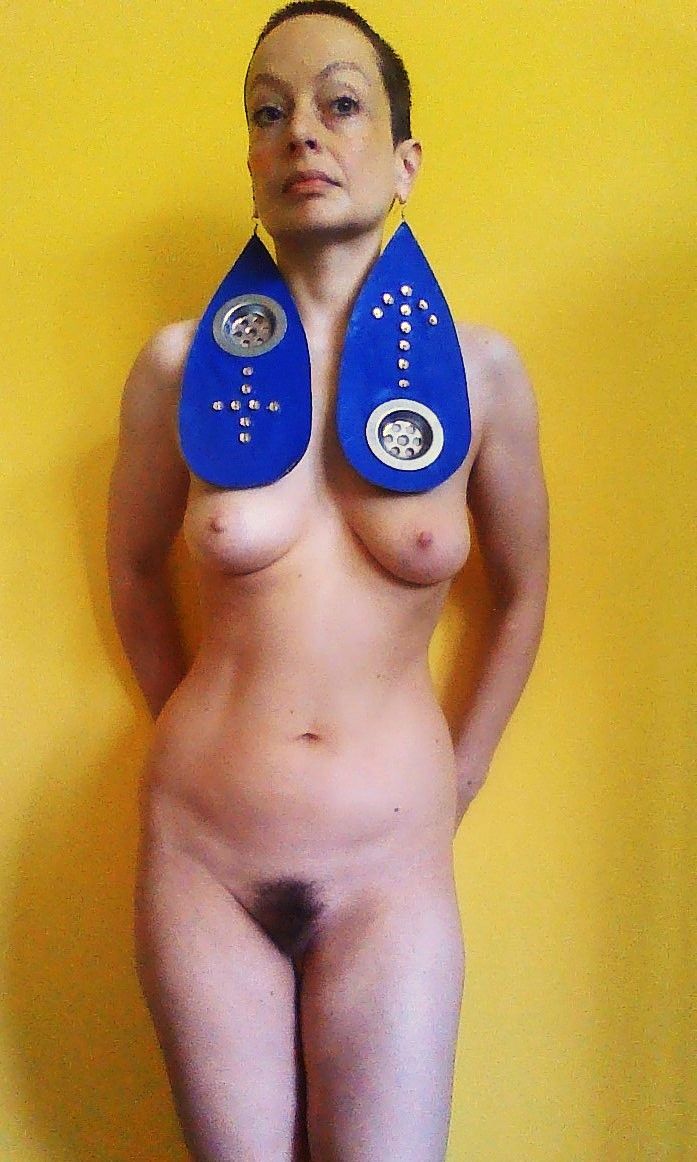
Portrait of a Faith-Plumber
If science and technology have enabled the creation of a human being without sex through artificial insemination (‘immaculate conception’), one may expect that they will one day also enable the disappearance of the human being without death.
The Seductive Emptiness of Form
Wilde’s incisive reflections on false social morality perhaps have an even more piercing effect today, in a contemporary society where the boundaries between lies and truths have become still more fragile and porous, and where the obsession with bodily beauty and youth is far more tragic
Bolet and Marie – cryptoqueer Norwegian photography pioneers
The photography exhibition Bolette Berg and Marie Høeg, organised by the Center for Queer Studies, was held at the European House from 15 to 19 December 2025.