Cruel Scenes from Everyday Life
Dragana Nikoletić
The promised hot autumn has fully materialized in Belgrade’s galleries, bringing a multitude of exhibitions throughout October. Most of them present works by already established artists, often placed in a new context or shown alongside young talents whose careers are just beginning. Some exhibitions are so extensive that they had to be displayed in two separate spaces of the same gallery, while others—more thematically focused on certain segments of an artist’s oeuvre—manage to convey the essence of their creators’ work across several generations.
Such a description fits the exhibition Mythology of Reality at Gallery DOTS, featuring works by Marina Marković, Astrid Oudheusden, Monika Sigeti, and Ana Simić. Curators Mirjana Dušić and Ljuba Jovićević aimed to highlight how the artists’ personal narratives rise to the level of the universal—and succeeded in transforming their different poetics into a single, fluid handwriting.
That handwriting is distinctly feminine and at first glance abounds in gentleness. However, a closer look at the drawings, digital prints, and video works reveals the pain and trauma emerging from the artists’ own experiences. The most shocking realization comes when analytically approaching the works of Marina Marković: her soft, pink strokes speak of the external pressures weighing on a fragile inner world, ready to absorb that aggression and turn it into “internalized gazes” on the female (her) body.
Institutional Marks
The body thus succumbs to the dictate of thinness, giving rise to disorders such as anorexia, and this tension is released in drawings of stretchable, almost fluid corporeality. The boundary parameter is the skin, especially in two of her video works. In them, Marković tattoos the “marks” (logos) of institutions where she has exhibited, which function “as a living archive of negotiations on the boundaries of power, consent, exposure” between institutions, theorists, and the artist.
Monika Sigeti’s works are also autobiographical, but she tells stories of “love dramas,” sending the message that it is better to be alone than with the wrong (partner). Using photographs as templates for her drawings (as supposed truths), Sigeti constructs “fairy-tale narratives that are far more grotesque in reality.” One of them, however, is real: it depicts the bliss of her body touching sun-warmed stone, metaphorically suggesting that salvation lies in escaping into nature.
The Dutch artist Astrid Oudheusden belongs to the “old guard” of painters, absorbed in daily drawing notes since 2004. And here, charming compositions are intersected by cruel scenes from her everyday life, masked by delicate lines. Her aim is to “make the world a better place for the coexistence of all living species,” and she therefore employs both warnings and glimpses of possible salvation.

Ana Simić is the youngest artist in the group, interested in the clash between the oppressive system and queer subculture. She adopts its motifs from the internet and prints them digitally onto large formats of silky fabrics. She draws additional (feminine) allure from the granulation of enlarged pixels. Simić finds it fascinating that with each new download from the web, a work gains new layers of meaning, which here testify to anxiety—caused by the repression of LGBT+ minorities outside rigid norms of sex and gender. The exhibition runs until November 29.
“Modeling” the Image
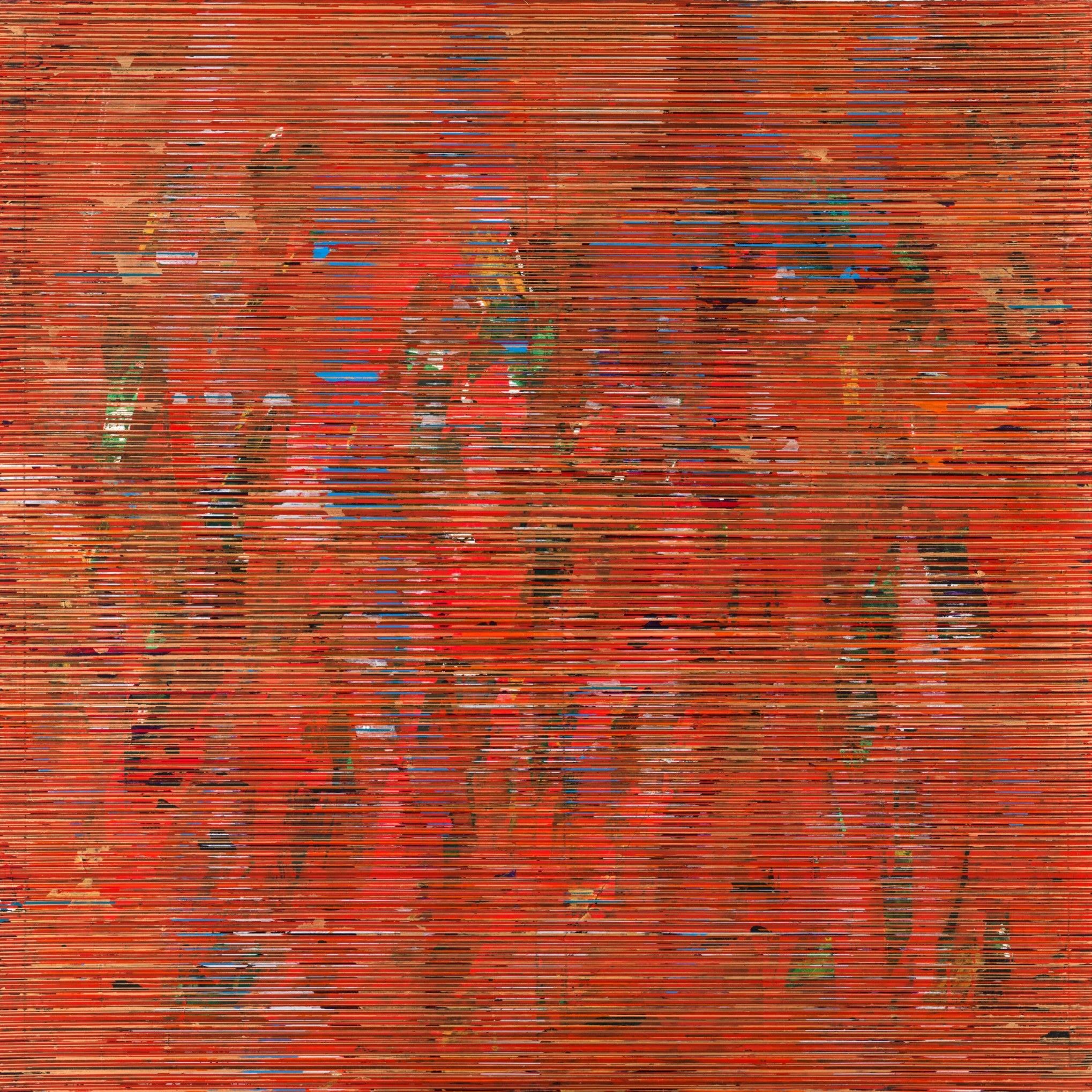
Marko Lađušić is a painter, sculptor, performance artist, and professor. Recent fruits of his artistic research are shown in two venues of Arte Gallery (Kralja Milana 48 and Andrićev venac 12), under the joint title Layering. The title refers to Lađušić’s recognizable style of repetitively applying and removing layers of paint, through which he deliberately creates authentic pictorial structures and builds complex worlds.
This method produced the scenes of Sunset (where everything glows in reddish tones), Megastructures (resembling views of New Belgrade–type housing complexes, full of life in each apartment), The Red One (which resembles the warp of a carpet, its loops tiny rectangles and squares)… The paintings are mostly large formats, and there are triptychs as well, all crisscrossed with straight lines.

“To achieve the desired effect, I use stencils—rulers, adhesive tape, scrap materials like mesh wire… The foundation is always abstract, and I do not deviate from it when applying new layers of acrylic. Later I remove them with a strong jet of water or peel them away in other ways, and then I finish the paintings,” Lađušić says, describing his process of “modeling” the layers.
The “unforeseen” he strives for is an illusion of a world sublimated onto a painted canvas. These exhibitions last until November 10 and offer an opportunity to purchase a bilingual monograph of the artist, published by Arte Gallery.
Killing the City
At the Sales Gallery on Kosančićev venac, the exhibition Urbicide – The Erasure of the Spirit of the City by Milivoje Miško Pavlović—renowned painter and professor at the Faculty of Fine Arts in Belgrade—is on display until November 3. In it, Pavlović examines the ethical and social responsibility behind the degradation of the urban milieu, as well as the positions of power in the devastation of natural and urban environments, within the broader context of community survival. He records the different stages of urbicide through schematic depictions based on patterns of social games such as Monopoly.
This “game” takes a terrifying turn in the (huge) canvas It’s time to pay now, where much of the world map, with its “most developed” regions, is engulfed in flames, while the surrounding areas are suffocating in thick smoke to the point of complete invisibility. The painting Belgrade Water Freude depicts the construction of the nationally significant project Belgrade Waterfront, which brought joy (Freude) only to the chosen few. Black City references a strange game played by the Nazis in April 1937 when they bombed Guernica—later “sung about” by Pablo Picasso in his masterpiece.
“There are many ways to ‘kill’ a city besides bombs that ‘spread democracy,’ as shown in the skeletons of buildings in Aleppo, which I portray in several works. A city is also erased by building ugly ‘lego settlements’ in the heart of the old center where centuries accumulated. Identity is lost when important buildings are sold off, demolished, and memory erased—such as the intention to sell the General Staff building. A city disappears through illegal land-grabbing, as happened with the best plots along the Sava River, which I also allude to in one of the paintings,” Pavlović articulates his critical view of our reality.

A far more cheerful outlook came from the exhibition Fantastic Fables by sculptor Marko Kresoja at the Gallery of the Ilija M. Kolarac Foundation—but again only at first glance. Beneath the humorous forms of a fish breathing air from a tank or a zeppelin attached to a grenade lie “societal anomalies, human stupidity and weakness,” says curator Tijana Duka of the exhibition, which ran until October 25. And the drawings of Montenegrin sculptor Adin Rastoder, shown at Gallery Haos (on paper and on his sculptures) until November 21, testify to our obsession with fears.
The exhibition The Kitty Circles Around You by Selena Vicković, displayed until November 30 at Gallery November, despite its title taken from a children’s game, confronts discomfort with pleasure, judging by the presented drawings and paintings. Thus, this month in Belgrade’s galleries could be called a “black October,” a phrase known in history for political crises, economic collapse, strikes, and mass protests.
Published on the portal of weekly magazine Radar, November 1, 2025.
Portrait of a Faith-Plumber
If science and technology have enabled the creation of a human being without sex through artificial insemination (‘immaculate conception’), one may expect that they will one day also enable the disappearance of the human being without death.
The Seductive Emptiness of Form
Wilde’s incisive reflections on false social morality perhaps have an even more piercing effect today, in a contemporary society where the boundaries between lies and truths have become still more fragile and porous, and where the obsession with bodily beauty and youth is far more tragic
Bolet and Marie – cryptoqueer Norwegian photography pioneers
The photography exhibition Bolette Berg and Marie Høeg, organised by the Center for Queer Studies, was held at the European House from 15 to 19 December 2025.